Singapore-based Dou Yee Technologies (DYT) is moving from a complementary service to an industrial workflow built around metal binder jetting (MBJ).
Over the years, the company has built up expertise in Powder Injection Molding (PIM), metal and ceramic injection molding (MIM/CIM); supplying complex components and sub-assemblies to the medical, semiconductor, automotive, consumer, and industrial sectors.
Since its founding in 1996, it expanded into Malaysia (2011) and China (2015). While little information is shared about when the company debuted in AM, we know the company has been relying on laser powder bed fusion, fused filament fabrication, stereolithography, and binder jetting, leveraged in collaboration with partners.
How it started
The program builds on a Memorandum of Understanding signed in October 2025 with the National Additive Manufacturing Innovation Cluster (NAMIC) and HP. It now also involves A*STAR’s Additive Innovation Centre (AIC).
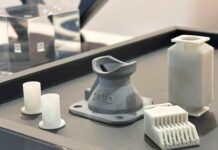
The partners want to validate a development-to-production workflow on HP’s Metal Jet S100. An early demonstrator is a 316L industrial sensor housing printed at AIC.
According to DYT, 316L and 17-4PH stainless steels are listed as qualified, for medical, semiconductor, and high-strength precision parts while copper is under evaluation for heat sinks, cold plates, and heat exchangers. On the other hand, nickel superalloys (turbomachinery, aerospace) and tungsten carbide-cobalt (wear parts, tooling) are earmarked for future development.
The company sees a big opportunity ahead with copper. Its research reveals that in AI data centers, rising heat loads are driving demand for liquid cold plates with complex internal channels. For DYT, development data show that binder-jetted copper at about 8.2 g/cm³ as-sintered and near-full density (8.9 g/cm³) after HIP would be ideal for their manufacturing process.
Their research also reveals that thermal conductivity rises from roughly 315 to 365 W/m·K, and electrical conductivity approaches 97% IACS.
Why a MIM company makes sense here
With extensive expertise built around MIM/CIM production and sintering and its ability to move “prototypes into production using the most economical manufacturing route”, DYT might be well position to develop a binder jetting the market can trust.
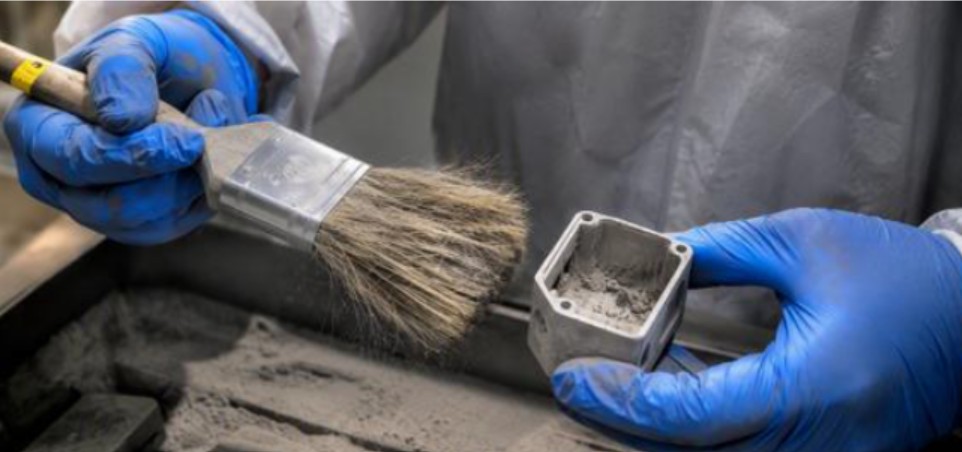
As you may know, in metal binder jetting, printing is only half the process. Yield depends on debinding and sintering, where parts shrink and can distort, and MIM producers have spent decades addressing this issue.
Regarding the market, let’s remind that when HP opened the Metal Jet S100 to the wider commercial market in 2022, we described MBJ as an “elitist” technology for mass production. At the time it was driven by Desktop Metal (via ExOne), GE Additive, and Markforged (via its acquisition of Digital Metal). Almost five years, the field has thinned: ExOne is so far the only company that confirms it is in business today.
HP, meanwhile, is widening its materials base and Colibrium Additive remained quiet since this covnersaiton at Formnext 2024.
With DYT’s movev, we are tempted to believe the opportunities MBJ adoption can further bring to the market.
*We curate insights that matter to help you grow in your AM journey. Receive them once a week, straight to your inbox. Subscribe to our weekly newsletter.