A little over a year after it created a 3D printed sports bra for Faith Kipyegon, Nike is betting once more on 3D printing to produce Olympic 800m champion Keely Hodgkinson’s suit.
Primarily developed within the LeBron James Innovation Center at the Philip H. Knight Campus, the sports brand says that the 3D‑printed vortex generators are its fastest ever produced.
Hodgkinson debuted the suit at Athlos London, where she won the 800m in 1:56.80.
“In this speed kit, I feel fast, free-flowing, comfortable and empowered,” says Hodgkinson, a Nike athlete since 2019.
A suit designed for a body in motion
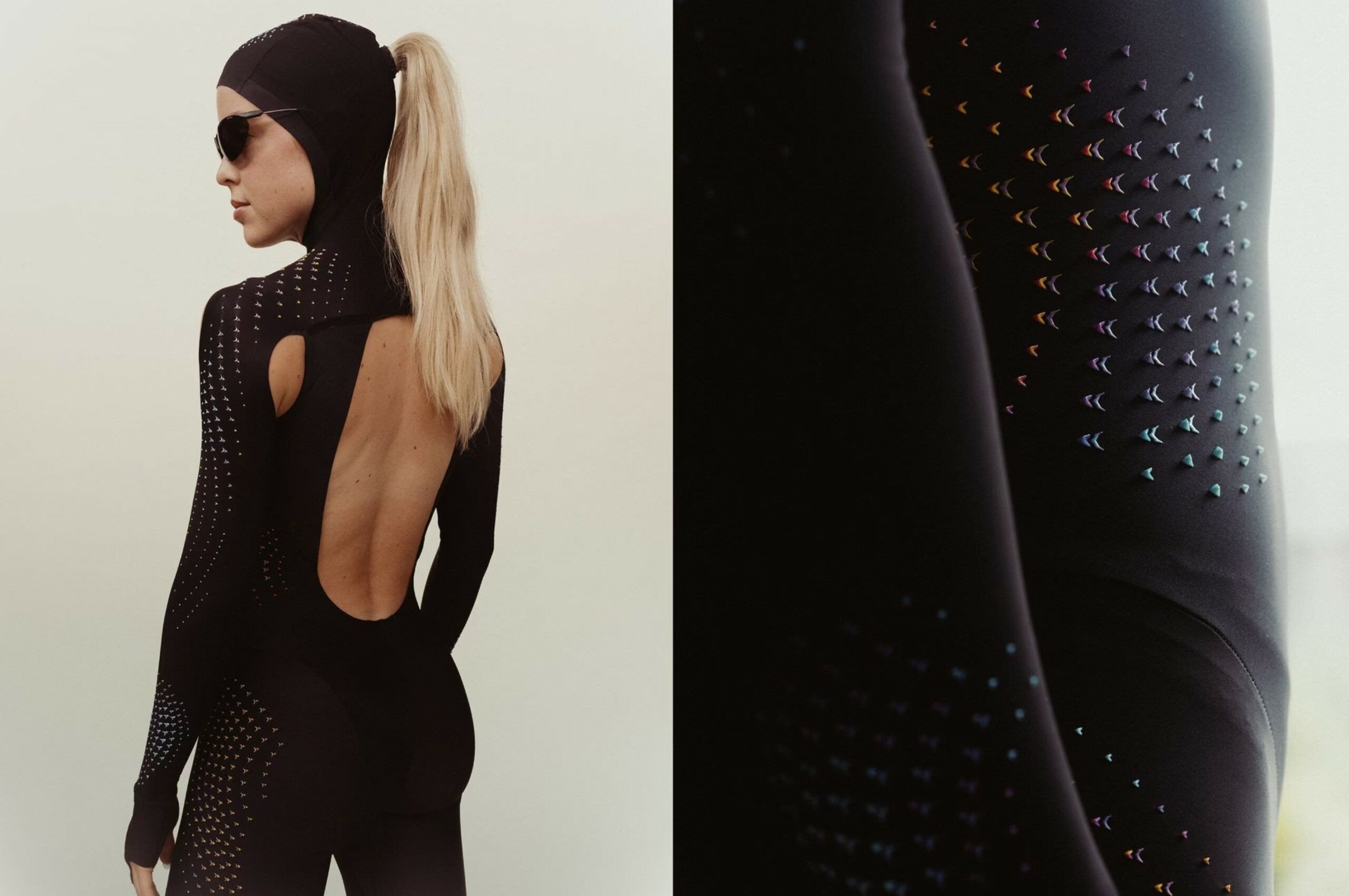
The open-back, full-length, hooded suit combines a strategic mix of fabrics, minimal seams and no closures to reduce air resistance as the athlete loops around the track. According to Nike, the manufacturing process relies on a 4D design methodology, an approach that maps the garment on a body moving through time and space.
“As much as we’re designing for peak performance, we’re also designing for pinnacle expression,” says Dan Farron, VP, Innovation Apparel Product Design. “Keely’s an athlete who’s unafraid to take risks; she’s bold and vivacious. This speed suit is a reflection of who she is. It’s sport and style in equal measure.”
The 3D printed vortex generators are arrayed along the shoulders, thighs, torso and hood. They vary in size and orientation and are computationally tuned for each part of the athlete’s body.
They create “mini tornadoes” that force fast-moving air to mix with and attach to the slower air trapped against the body. This reduces the low-pressure wake that usually forms behind the runner and therefore drag.
“Keely has an immense amount of personal confidence when she wears black,” says Hannah Amis, Director, Innovation Apparel Product Design. “It’s sleek, it’s brave, and it allowed us to celebrate her vibrant personality through color-shifting, 3D-printed vortex generators instead. There’s a beautiful, healthy tension between mathematical function and visual aesthetic. We spent six months endlessly tweaking, shifting and obsessing over every detail.”
As a reminder, for Kipyegon’s Nike FlyWeb bra, Nike produced a 3D printed TPU piece whose computationally designed surface was denser where more support was needed. In both cases, the technology is used where the geometry has to change from one body zone to another.
From sneakers to functional apparel features
The way Nike uses 3D printing is evolving. In footwear, 3D printing has mostly been the product itself or its most visible component whereas in apparel, it increasingly delivers functional features that textiles alone cannot provide.
That said, this suit remains a one-of-one garment, and Nike does not say whether the vortex generators will reach its commercial collections.
As with previous announcements, the brand did not share much about the printing process, material and technology partners, which makes it difficult to assess how ready these applications are for scale.
*We curate insights that matter to help you grow in your AM journey. Receive them once a week, straight to your inbox. Subscribe to our weekly newsletter.