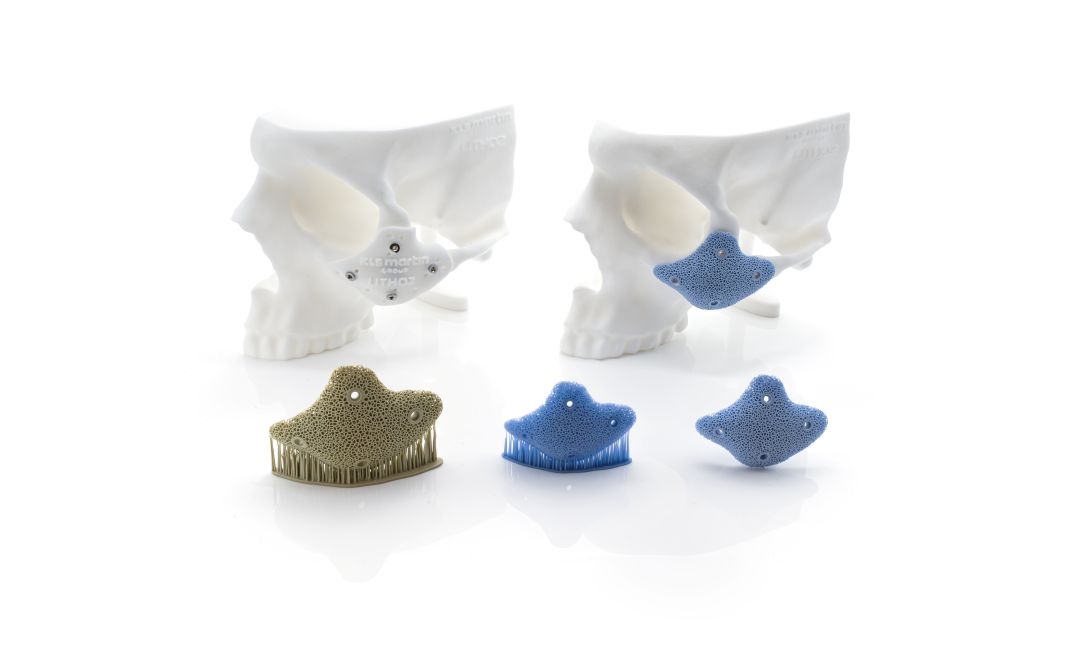
At the end of Q3 2026, the manufacturer of surgical instruments, implants, and medical devices KLS Martin Group achieved the delivery of 500 individual bioceramic implants.
The milestone is enabled through IPS Gate®, the company’s web-based platform for planning, ordering, and delivering its Individual Patient Solutions (IPS®). The case-planning app is designed for custom-made implants that are made from various materials using a variety of technologies.
Frank Reinauer, Senior Director Division Implant, KLS Martin: “Individual-Patient-Specific (IPS®) ß-TCP status on IPS Gate® means a broad availability; surgeons can plan, specify, and order a patient-specific bioceramic implant through the same digital workflow they already use for our other IPS® solutions. That shortens the path from CT data to a case-specific, tailored-porosity scaffold in a surgeon’s hands, which translates directly into faster treatment planning and more predictable delivery timelines for patients that rely on bone-regenerating implants.”
Among the key products of the platform, there are patient-specific 3D-printed implants made with Lithoz’s calcium phosphate material LithaBone TCP.
Johannes Homa, Lithoz CEO: “Launching LithaBone TCP implants as an official product on IPS Gate® marks a true milestone for bioceramic 3D printing in surgery. What began 12 years ago as a research collaboration with KLS Martin has grown into a proven clinical pathway with scalable solutions. Seeing the success KLS Martin is having with our technology, as well as the general global adaptation of LCM in MedTech, shows that resorbable, additively manufactured bone-regenerating solutions are gaining broader clinical acceptance worldwide and demonstrate the growing role of additively manufactured bioceramic solutions in regenerative medicine.”
The manufacturing process of LithaBone TCP implants
To manufacture these implants, the KLS team relies on Lithography-based Ceramic Manufacturing (LCM) 3D printers, operating under an ISO 13485 certified quality management system.
LCM enables biomedical and engineering teams to produce patient‑specific geometries and controlled porosities, which directly influence how the scaffold degrades and is replaced by new, healthy bone.
Beyond traditional fixation with titanium screws, the implants can also be secured using KLS Martin’s SonicWeld Rx® system with resorbable polymer pins, creating a fully resorbable implant assembly that removes the need for a second surgery.
With resorbable, patient‑specific solutions now entering routine practice, we can’t wait to discover how far ceramic additive manufacturing will reshape the standard of care in cranio‑maxillofacial reconstruction.
Read more about how Lithoz’ LCM is used in the healthcare and medical industries
*We curate insights that matter to help you grow in your AM journey. Receive them once a week, straight to your inbox. Subscribe to our weekly newsletter.