
Some people talk about AI as if it will replace quality management. Tim Wischeropp, CEO, amsight thinks AI will make quality management more important. As algorithms become more involved in production decisions, the need for structured evidence, traceability, governance, and accountability increases. The better the AI, the more important it becomes to understand what it was trained on, what it sees, what it does not see, and why its recommendations should be trusted.
The question is: how does one create an AM quality data infrastructure that strengthens AI credibility?
While AM companies and users often have good reasons to use AI (reduce scrap, shorten qualification loops, automate analysis, predict quality, optimize parameters, or make production more autonomous), they often struggle to understand what AI is supposed to learn from.
The truth is, AI amplifies the quality of the data environment it is given. If that environment is fragmented, inconsistent, poorly labelled, or disconnected from process context, it will just create more confusion on the road to industrialization.
Demystifying the myth around AM data
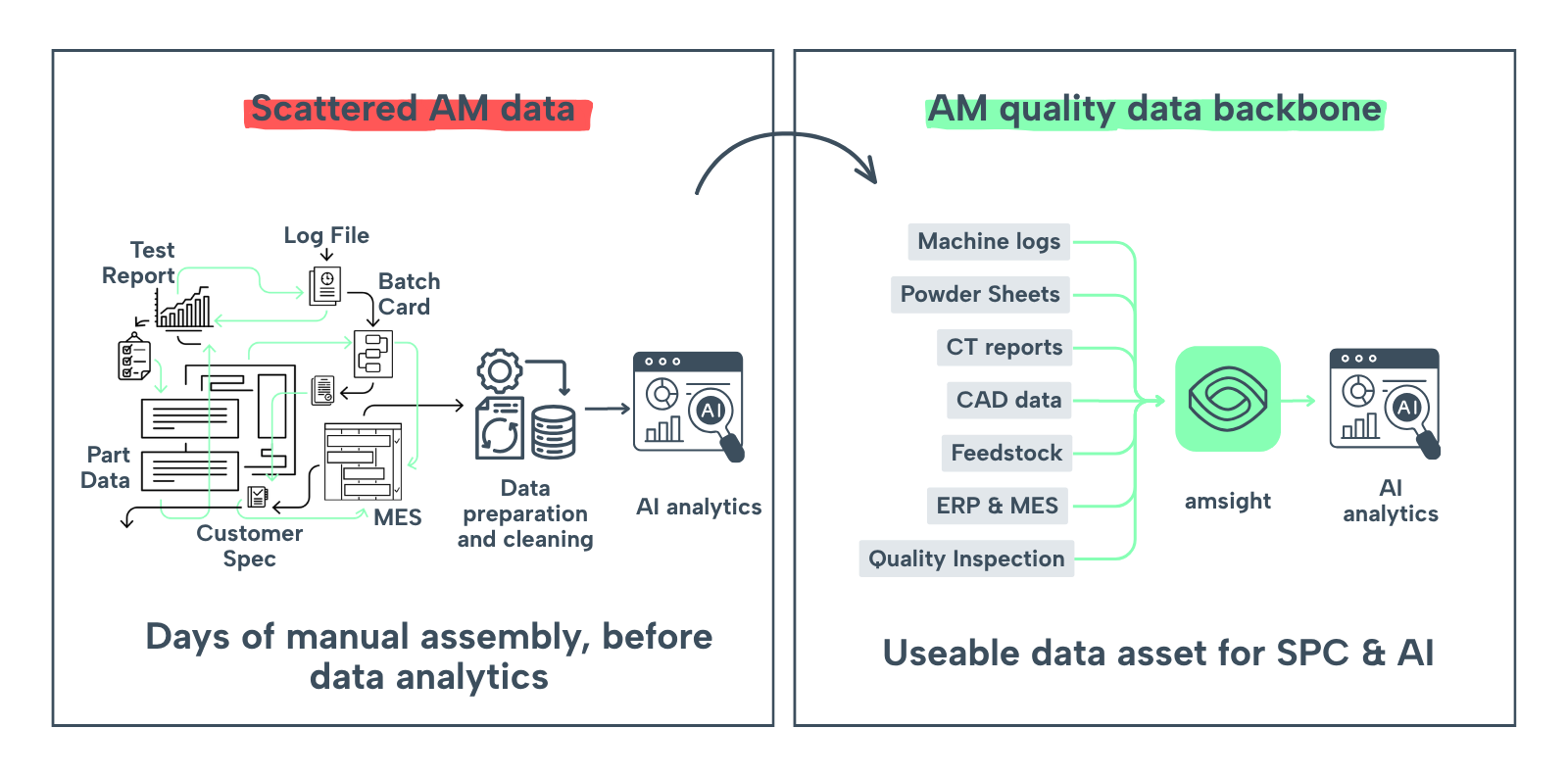
One of the myths in additive manufacturing is that its digital nature automatically leads to a strong data foundation (understand data generated by the AM process). The reality is, the real pain lies in building a usable evidence chain.
Can powder history, machine state, build parameters, post-processing, inspection outcomes, and part-level conformity be linked in a way that is consistent, queryable and trusted over time?
Answering this question accurately deeply relies on “data with context”: knowing, for instance, which powder lot was used, how many reuse cycles were involved, which machine produced the build, whether maintenance had occurred, which parameter revision was active, which post-processing route followed, and which inspection result belongs to which part or coupon.
Failing to address this the right way might result in dashboards with scattered data that claim to detect risk, predict defects, or recommend actions.
What a quality data backbone means
For AM, a quality data backbone is a structured system that connects the full production evidence chain around the part and process. It captures and normalizes data from machines, powders, parameters, post-processing steps, inspection systems, and quality records. It links that information across builds and across time. It makes the data usable for traceability, reporting, SPC, root-cause analysis and, eventually, AI.
The word “backbone” matters here. AI cannot be a floating layer above production. It needs a spine: a reliable model of the process that tells it what the data means.
This is where many AM organizations need to rethink their IT architecture. AM needs a dedicated production-level quality software that owns quality truth (part-level evidence, powder genealogy, process history, inspection results, stability metrics, and repeatable reports.) Only then can AI move from experimentation to operational credibility.
AI needs labels, and AM often hides them
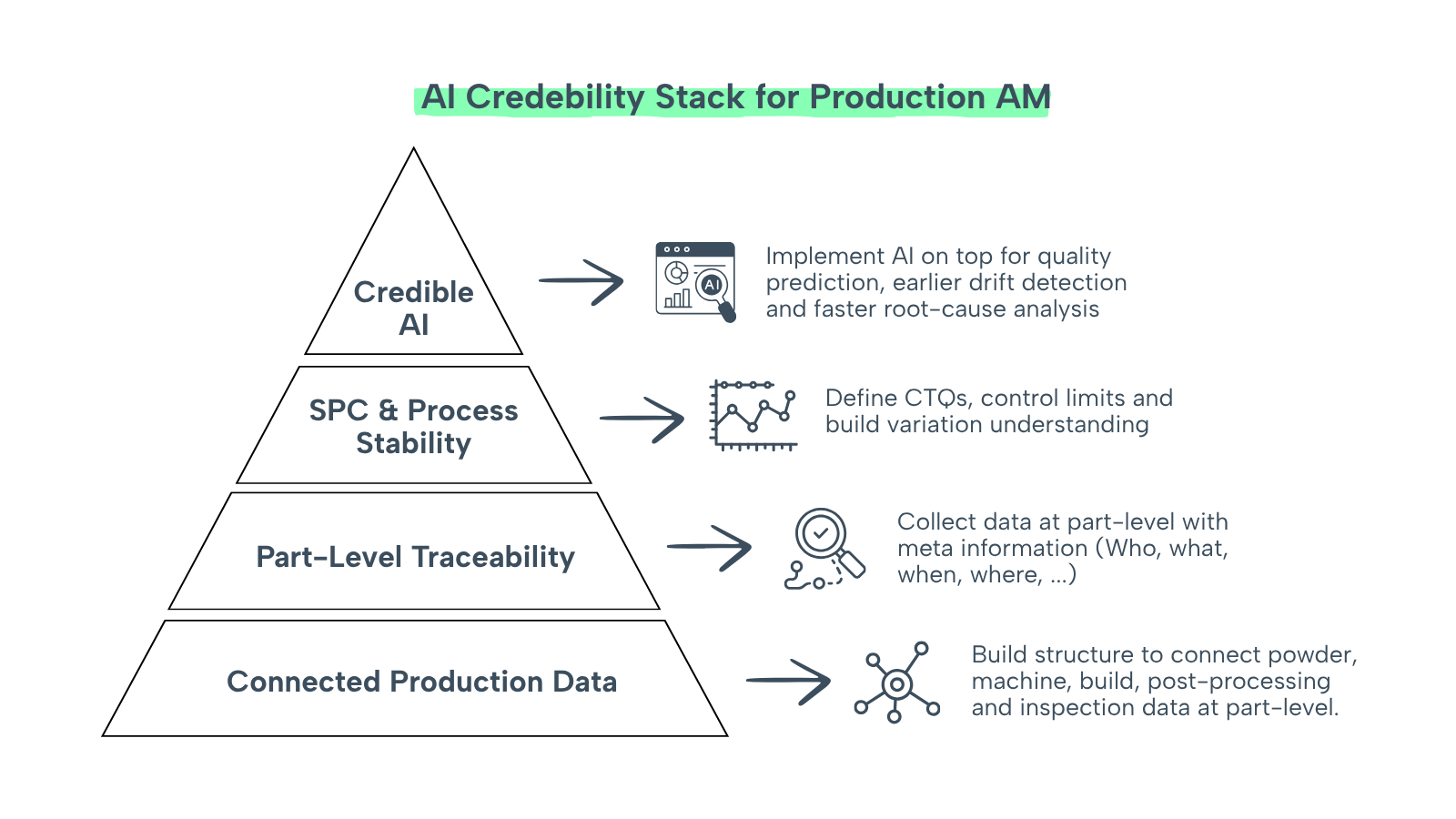
In machine learning, labelled data is precious. Understanding for example, why a part is accepted or rejected enables to turn outcomes into learning signals.
If organizations only store final reports, AI learns very little. It sees results, pass/fail mode and defect categories, rather than the chain of events that produced them.
A quality data backbone turns production into a learning environment. Every build becomes a structured data point in an evolving understanding of the process.
Beyond all of this, the commercial reason to care remains credibility. Demanding sectors that leverage AM require controlled intelligence. And it’s the duty of AM providers and contract manufacturers to ensure that their recommendations are grounded in traceable evidence.
This means that if a supplier can show that its AI efforts are built on connected powder, process, and inspection data, then AI is seen as an extension of quality maturity.
What AM leaders should do now
The path begins with building the evidence chain:
• Start with traceability
• Link powder, build, post-processing, and inspection at part level
• Standardize how quality data is captured.
• Reduce manual reporting
• Define critical-to-quality attributes
• Implement SPC where variation matters most.
• Make root-cause analysis faster by connecting machine events, maintenance, powder state, and inspection outcomes
• Create repeatable reports that do not require forensic spreadsheet work.
Then, and only then, ask where AI can add value:
– Can AI help detect early drift?
– Can it identify correlations between powder reuse and quality outcomes?
– Can it suggest more targeted inspection?
– Can it shorten root-cause analysis by surfacing likely process changes?
– Can it support parameter development by learning from historical production evidence?
Having this checklist in mind could be a good start for a credible data foundation.
*This article has initially been written by Tim Wischeropp. It has been edited for brevity, clarity and to meet our editorial guidelines. The veiws shared here do not reflect 3D ADEPT Media’s opinion.