Several automotive OEMs producing vehicles powered by combustion drivetrains tend to explore additive manufacturing in fields that often go beyond their core activity, sometimes making the argument that automotive parts in these vehicles represent a difficult space for AM to grow, or a field that does not allow for much flexibility and innovation. This narrative looks drastically different when examining the electric vehicles market, or more broadly, transportation powered by electric drivetrains. Because they use fewer parts than combustion drivetrains, they could highlight a structural advantage for additive manufacturing. Given the niche market, companies are increasingly exploring where and how AM could make perfect sense, and all the enablers this strategy could entail. The nexAMo project, led by ZF with Solukon as a key technology partner, aims to address this flexibility and innovation challenges. Interestingly, one of the critical enablers that could help make this project a reality is depowdering.
February 13, 2024. ZF Friedrichshafen AG, one of the world’s largest automotive suppliers, active across drivetrains, chassis systems, safety technology, and electrification, invited all ten project partners from industry and science to the kick-off meeting of the nexAMo project. Supported by the German Federal Ministry for Economic Affairs and Energy (BMWE) as part of the “Digitalization of vehicle manufacturers and the supplier industry” funding measure, the project aims to develop a highly flexible, decoupled matrix production system enabling unprecedented manufacturing adaptability. According to BMWK, the automotive sector is already seeing a trend toward greater product variety and smaller batch sizes, with shorter development cycles, a pressure that “traditional” production, with its limited flexibility, struggles to absorb cost-effectively.
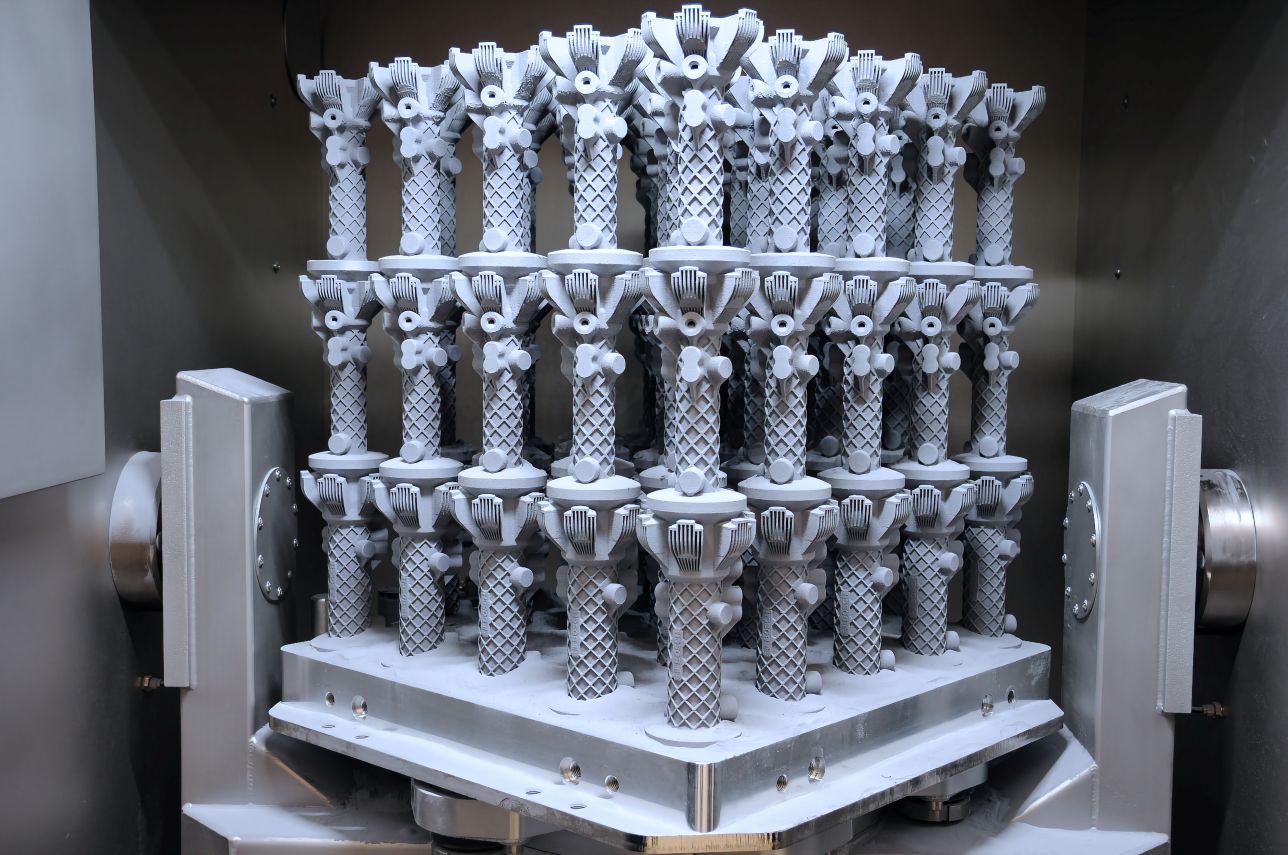
Additive manufacturing, and LPBF in particular, gives automotive OEMs a flexible way to produce small and medium-sized batches. But that flexibility exposes a challenge the EV ecosystem rarely acknowledges: powder removal.
Addressing it requires looking at how ZF approaches AM first.
ZF and automotive AM

With operations spanning more than 40 countries and over 160,000 employees, ZF’s engagement with additive manufacturing followed a trajectory familiar to many large industrials: it began with prototyping, expanded into tooling, and gradually revealed deeper potential.
As Ignacio Lobo-Casanova, Head of Production Tech Center SMART Material Technologies, Production Tech Center SMART Material Technologies (OPTT) states, the shift in perception has been fundamental: “In the early days, AM was often seen internally as a promising but experimental technology. Today, that perception has fundamentally changed. The conversation has shifted from ‘Is this technology mature enough?’ to ‘Where does AM make the most sense in our production landscape?’”
What brought AM into the EV discussion at ZF was precisely what makes EVs interesting from a design standpoint: the need to integrate more function into less space. Components related to thermal management, power electronics, and compact housing structures are areas where additive manufacturing enables solutions that conventional routes cannot easily replicate.
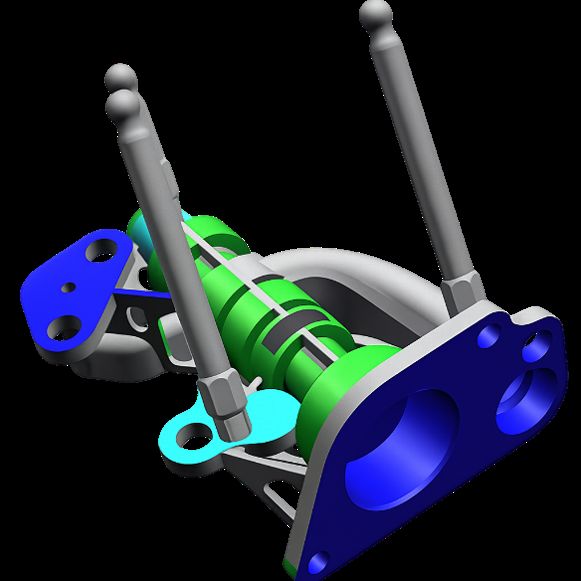
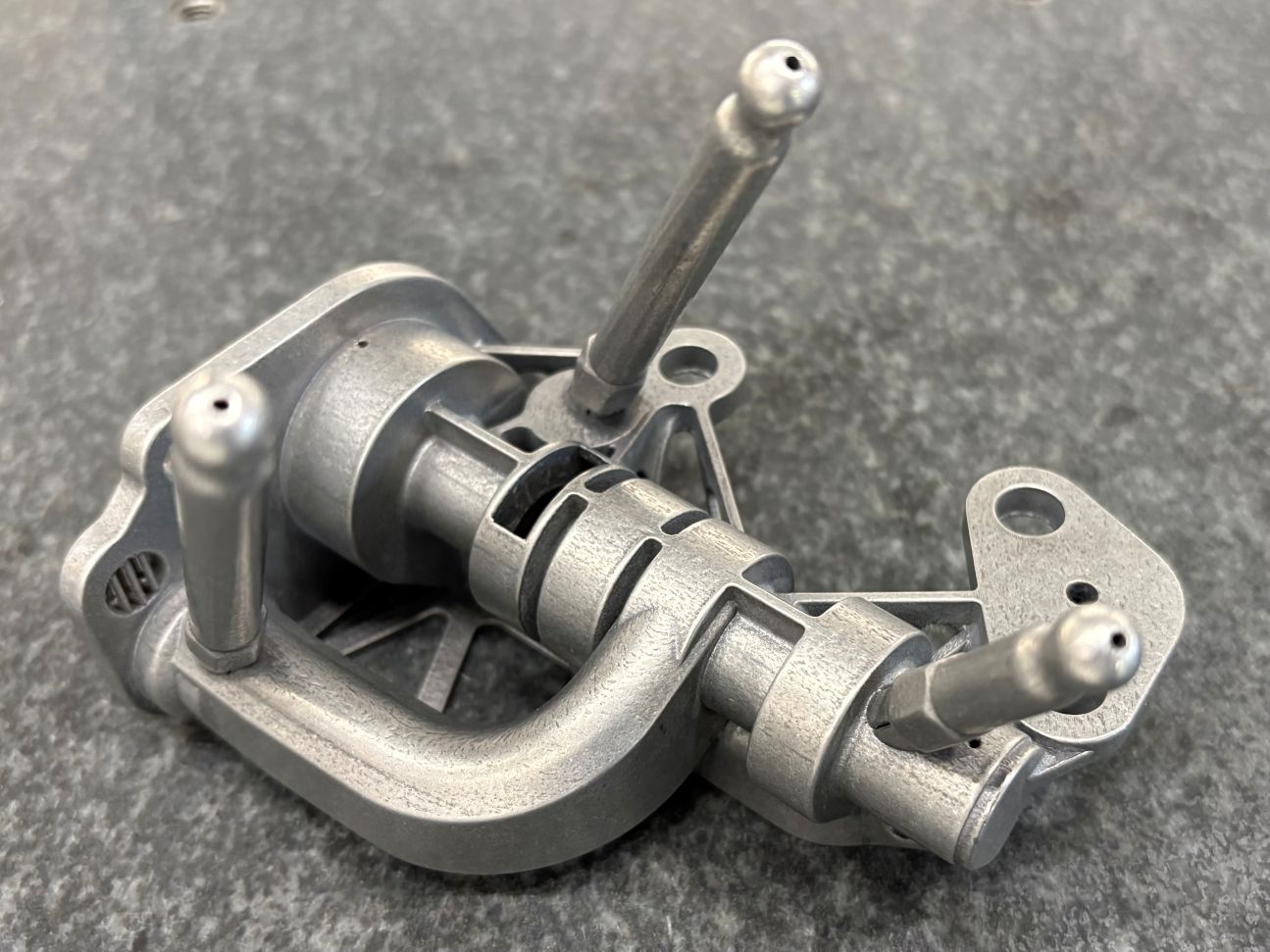
Valve units with complex internal flow paths, where multiple functions are consolidated into a single component, are one example Lobo-Casanova cites. These parts contain small, intersecting channels essential for fluid control. They are also extremely difficult to depowder.
Same problem, different pressure
Depowdering has never been discussed in the context of EVs across 3D ADEPT Media’s channels. That said, it’s good to remind or point out that EV manufacturing does not just change what parts look like. What changes are the conditions under which they must be made.
Andreas Hartmann, CEO and co-founder of Solukon, emphasized this argument when asked whether automotive manufacturers face the same depowdering challenges as other industries: The fundamental challenge, getting powder out of complex geometries safely and repeatably, is shared across sectors. However, “in the automotive industry, production typically involves high volumes and conventional production lines that are highly automated and run on a synchronized schedule. […] This maximum flexibility for integration into the production line poses a challenge for powder removal.”
Although electric vehicles require far fewer parts than combustion engines, the parts that must be manufactured are often more complex, more functionally integrated, and subject to the same automotive-grade quality requirements: 100% cleanliness, full traceability, and process repeatability at scale. A design that requires manual cleaning, Hartmann notes, is not scalable.
Inside the nexAMo project: Where automation becomes the architecture
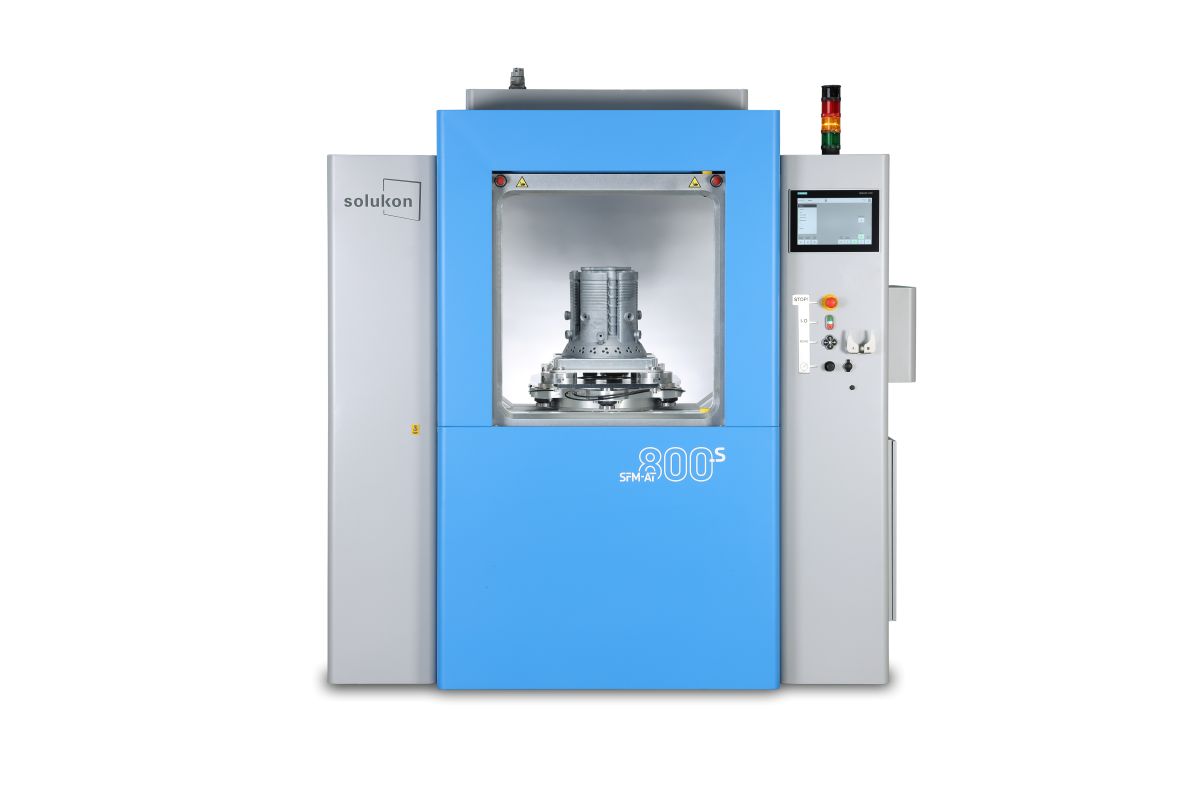
One thing is certain, the nexAMo project surely demonstrates how a truly integrated AM production line looks like in an automotive context. Within that production line, depowdering is a node. The SFM-AT800-S integrated into the nexAMo line is equipped with an AGV docking station and an automated vertical sliding door.
“The printed part, transferred by an AGV, is loaded automatically into the Solukon system. The part is clamped automatically via a zero-clamping system. After the automated depowdering process and a waiting time (for powder particles to settle) the part is unloaded with the AGV again and transferred to the next production step,” Andreas Hartmann explains.
That integration required more than hardware. Solukon developed customized software and engineering solutions specific to this configuration: interface programming for the door concept and its sealing, communication bridges with the AGV and the overall control center, and a new sliding-door concept designed to fit within the machine’s modular architecture.
What we learn here is that standard systems can be extended precisely because they are built modularly, with custom requirements in mind.
From ZF’s perspective, the operational gains are tangible. Lobo-Casanova describes the improvements in process predictability as central to what makes automated depowdering viable for series applications:
“Automated depowdering fits much more reliably into an end-to-end production process, resulting in shorter and more stable lead times. For us, this predictability is essential when we think about scaling AM toward series applications.”
The valve units mentioned earlier are a concrete illustration of what that confidence enables in practice:
“Automated depowdering has made it possible to clean these valve units in a controlled and repeatable way, giving us confidence that the internal channels are fully cleared. This reliability is key for qualifying such components and using them beyond pure prototyping.”
What automation enables and what it still demands
One of the less obvious consequences of reliable automated depowdering is its effect on how engineers design parts. Lobo-Casanova outlines this effect: automated depowdering has not removed all constraints, but it has reduced a key uncertainty. Engineers no longer have to be as conservative when designing internal geometries. Greater confidence in the downstream process translates into greater design freedom upstream.
But that freedom comes with conditions. Hartmann frames the engineering guidance in terms that connect perfectly to the EV context:
– Avoid deep blind holes, sharp internal corners, and long narrow passages where powder can compact or bridge.
– Design cavities, channels, and overhangs so powder can fall out under gravity.
– Pay attention to surface texture: residual powder adhering to rough surfaces due to static charge often still requires manual intervention and manual intervention is precisely what automotive-scale production cannot afford.
– In an industry that requires 100% cleanliness, design decisions made at the beginning of the process determine whether the end of the line is viable.
From our coverage of this specific vertical, we can confirm that development cycles in automotive are more cost-sensitive and validation-heavy than in other sectors. Aligning the depowdering process to a fixed design as early as possible reduces the risk of additional production cycles caused by insufficient powder removal.
What the rest of the industry should take from this

Beyond the specifics of ZF’s experience, Lobo-Casanova identifies a lesson with wider implications:
“AM must be approached holistically. Focusing only on the printing process is not sufficient. Post-processing steps such as depowdering, handling, quality assurance, and data integration are equally critical for industrialisation. If additive manufacturing is to move beyond niche applications and into automotive-grade production, automated and standardized workflows are essential.”
Solukon’s Hartmann echoes that system-level thinking when he addresses the remaining bottlenecks in scaling metal AM for automotive. Cost-per-part is the most cited challenge, and it is real but depowdering is directly relevant to that equation: time savings at the depowdering stage lower cost per part, and effective powder reclamation reduces material waste.
The Digital-Factory-Tool that Solukon has developed to make the depowdering process more transparent is one step toward the kind of process visibility that quality assurance demands at scale.
Overall, connecting all AM and post-processing equipment within a coherent automation concept is a challenge, that if well addressed, could take the EVs landscape to another level and nexAMo may be one of the first projects to make it a reality in Europe.
*This FOCUS is created in collaboration with Solukon. It has first been published in the May/June edition of 3D ADEPT Mag ).