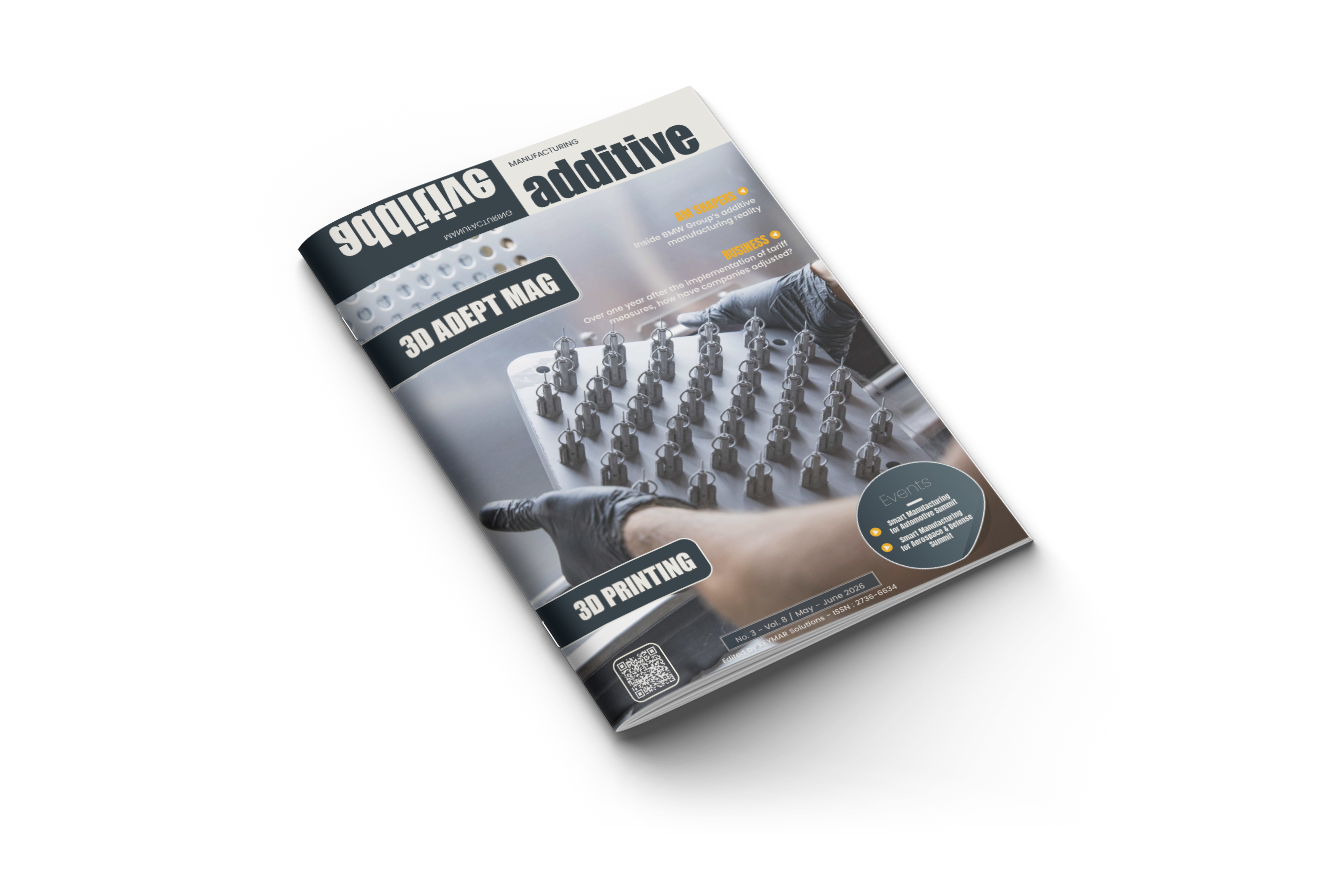
Decline, or Discipline?
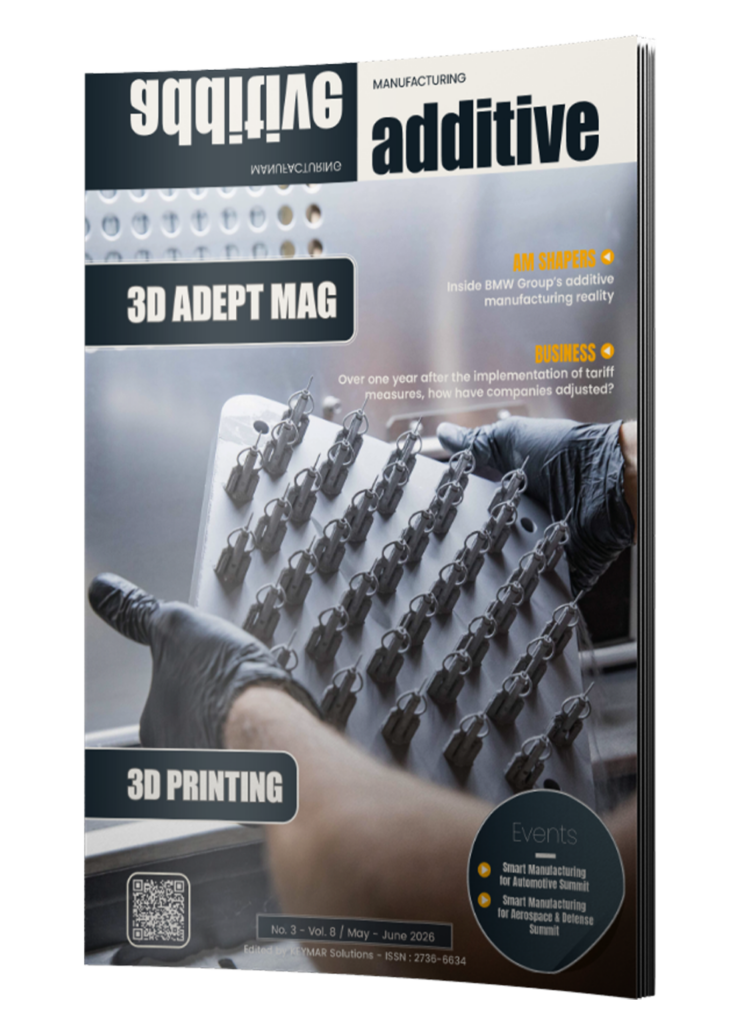 Summer has a way of making everything look paused. Over the years, I have come to realize that it’s often a disguise, a cover for big things in the making. This new issue of 3D ADEPT Mag could be that confirmation.
Early in the year, at a partner event, I was told plainly that the use of additive manufacturing in the automotive industry was decreasing. So, at the next networking event, I brought it up, to take the general sentiment of experts on the topic. That feeling of a slowdown was real, shared, and stated with the confidence of something everyone already knew.
I’ll admit it: I left that room half-convinced.
Then May happened. We reported on advancements in hydrogen vehicles, and on the strategies automotive giants like BMW Group are using to get the most out of AM.
Take BMW Group. On the surface, an automotive OEM pushing AM beyond automotive frontiers could read like a company hedging its bets. Look closer and it’s the opposite: there is a deliberate strategy behind every step.
And the question doesn’t stop at automotive. This issue applies the same test to two companies that have no incentive to play along with any hype: a wind company and an oil-and-gas one. Vestas is blunt about it: “We don’t want AM to be one of those buzzwords.” Vår Energi sets an equally unsentimental bar: “print what’s suitable.”
Today, I believe what people called a “slowdown” was probably AM users becoming more selective. All the other areas where they restrain might look like they are pulling back whereas in the end, they are trying to be more disciplined.
That discipline runs through the rest of this edition: in how companies absorbed a full year of tariff measures, in what it really takes to qualify large-format parts for industrial environments, and in the unglamorous business of post-processing that decides whether a printed part is ever fit to use.
Read on, and decide for yourself.
Exclusive features
Business | Over one year after the implementation of tariff measures, how have companies adjusted?
April 2, 2025, a day he called “Liberation Day”, Trump declared a national emergency regarding the national trade deficit and announced “reciprocal tariffs” on all countries not subject to other sanctions.
Obviously, a lot of countries and companies were affected around the world. The impact of tariffs is multifaceted and perceived differently depending on a company’s position in the AM ecosystem.
How have other companies adjusted? Does it advantage US-based businesses? How about those based outside of the USA, yet providing their services to the country of Uncle Sam? This dossier aims to provide clarity on that with insights from Velo3D, Lockheed Martin and Protolabs.
FOCUS
How LCM enabled a monolithic ceramic gyroid that delivers five times the power-to-weight ratio of conventional solid oxide fuel cells
This is not the type of application you will discover every day. And when you dig deeper, you realize that ceramic manufacturing processes are almost always the most ideal route for this, which makes me think that ceramics, and in this specific case, ceramic AM and LCM in particular, have once again achieved another level of maturity.
But before reaching that conclusion, we sat down with Johannes Homa, CEO and founder of Lithoz to understand what makes these SOFCs so compelling.
Fewer parts, more complexity: Why depowdering is emerging as a key enabler in electric vehicles’ manufacturing
Because they use fewer parts than combustion drivetrains, vehicles powered by electric drivetrains could highlight a structural advantage for additive manufacturing. Given the niche market, companies are increasingly exploring where and how AM could make perfect sense, and all the enablers this strategy could entail. The nexAMo project, led by ZF Friedrichshafen AG with Solukon as a key technology partner, aims to address this flexibility and innovation challenges. Interestingly, one of the critical enablers that could help make this project a reality is depowdering.
How do you qualify large-format AM parts in industrial environments? The case of LSAM
Knowing that Large Scale Additive Manufacturing (LSAM)’s primary aerospace applications are tooling (autoclave molds, layup tools, jigs and fixtures), one could be tempted to assume the qualification burden is lighter than for flight parts. Tooling never flies, after all. It just has to survive what happens on the ground.
Thermwood’s Scott Vaal immediately warns us on this.
Software | Understanding scalable simulation and optimization for production metal AM
Simulation for additive manufacturing is not a new conversation. At 3D ADEPT Media, we have covered the subject from multiple angles over the years: simulation for composite AM, for polymer 3D printing, for large-format parts, through solutions developed by dedicated independent software vendors and through collaborations between software vendors and machine manufacturers. PanX ‘s approach is built around a novel Multi-Grid Modeling methodology which rethinks how FEA meshes are generated and how the thermomechanical problem is solved.
Industry voices on post-processing of polymer 3D printed parts
Weerg (Alessandro Tenderini), Tenco DDM (Daniel Hoogstraate), AMT PostPro ( Giorgio Ioannides)
AM Shapers
Inside BMW Group’s additive manufacturing reality
January 2025: Jens Ertel stepped back from his role as Head of BMW Additive Manufacturing, passing the torch to Timo Goebel. A leadership change of that weight deserves time for the successor to settle into his new role, assess and decide what to carry forward and what to do differently.
So, we waited a year for this conversation to happen, and it was worth it.
AM Shapers powered by Formnext
- “Print what’s suitable”: Inside Vår Energi’s additive manufacturing strategy
- Jeremy Haight on Vestas’s AM strategy: “We don’t want AM to be one of those buzzwords.”
Subscribe to Download the 2026 May/June edition of 3D ADEPT Mag
"*" indicates required fields