




“Too good to be true”
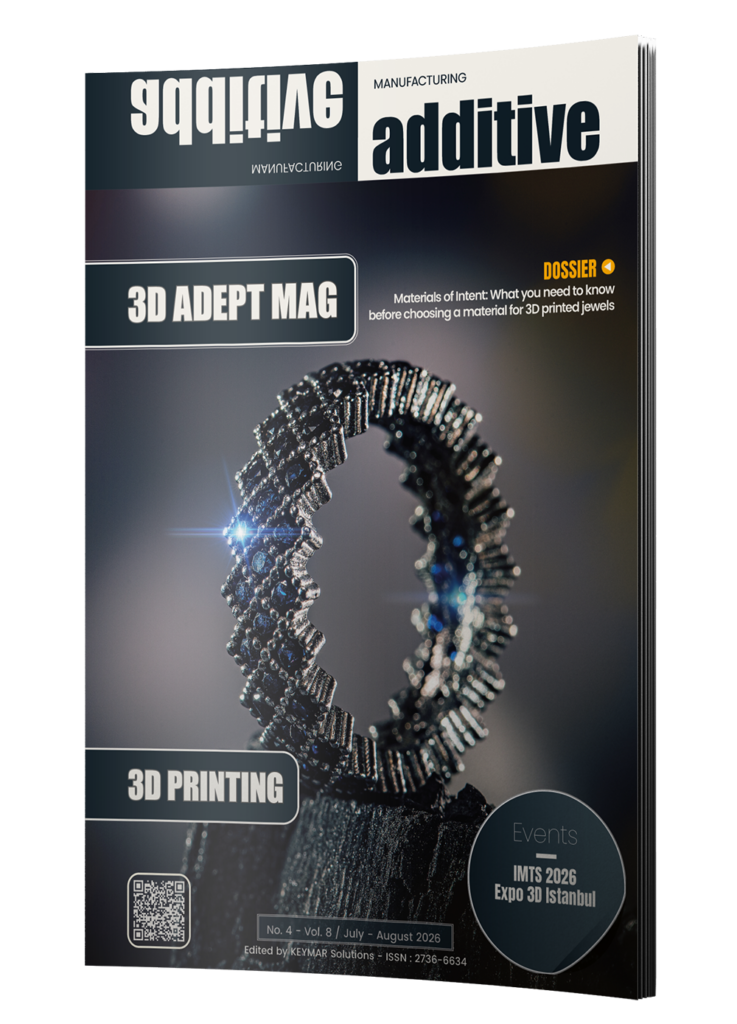 With no FAA, no FDA, no thirty-year service life to prove, I am often tempted to think that additive manufacturing looks way too easy in the creative industries.
From entertainment, jewelry, architecture to arts or even fashion, applications seem to be manufactured in the blink of an eye. A prop? a ring? a façade? It just has to look convincing under a light.
Yet, most sections of this new edition of 3D ADEPT Mag highlight how it remains complex, demanding, and as much as remarkable as applications seen in aerospace or medical.
The problem, I believe, may be how we measure it. When looking at AM in the creative industries, we unconsciously expect the technology to generate the billions it promises elsewhere. What should raise our interest is the applications AM enables, what experts from these industries know that we do not, and how each of them builds a business model that survives without those volumes.
With this foundation in mind, you will realize that in this issue, technology experts and experts from the creative industries are teaching us when not to deploy additive manufacturing, what the business model of AM looks like in entertainment, fashion, architecture, jewelry or even sports or consumer goods sectors.
And after weeks of talking, and learning from them, I am now eager to believe that creative industries are the most honest testing ground of AM. Given the fewest constraints, what experts across these industries are teaching us is that they are more selective and more demanding on what deserves to be printed.
Exclusive features
Dossier | Materials of Intent
What you need to know before choosing a material for 3D printed jewels
In a conversation about wedding rings, my cousin asked me: “In a world where money is not a matter, what would be the ideal metal to 3D print the rings I designed?”
In the jewelry sector, where material cost often exceeds manufacturing cost, and where aesthetic perfection is non-negotiable, material choice has become an act of creative strategy. This dossier explores what that means.
With contributions from Legor, Neoshapes and Incus GmbH.
AM Shapers
Brigitte Kock on fashion 3D printing: What’s wrong, what’s surreal, and what’s reproducible
In the conversation below, fashion designer Brigitte Kock is without hesitation honest about what makes her work tangible. By redefining what “scalability” means in her context, she reveals why materials remain a decisive factor in 3D-printed fashion and what to expect in the near future.
Nagami’s decade of designing and making and why the next one is about distributed manufacturing
This article discusses current state of manufacturing in large-scale 3D printed architecture, the focus on recycled materials, and how Nagami aims to rething what a factory can be in the architecture sectors.
Interview of the Month
Pir Arkam on AM in Dubai’s creative economy: what deserves to be printed, what doesn’t, and why he rejects certain jobs
Over the years, we have seen companies thrive with “fail fast” mindset. Proto21’s Pir Arkam does not agree with that. The company’s philosophy is anchored in an assessment strategy that enables the team to know what deserves to be printed, what doesn’t, and why certain jobs are rejected.
Partner content | IMTS
Hybrid Manufacturing: Additive freedom, metalworking quality
Conditions driving renewed interest in Additive Manufacturing (AM) are real and structural. Supply chain disruptions, reshoring pressures, workforce shortages, and the erosion of domestic supplier capacity in key sectors have forced manufacturers to look for more flexible and efficient ways to meet production demands. In many of those situations, AM is filling gaps that traditional production can no longer reach.
Application deep dive
A 3D printed cooling wall against the heat: inside TU Graz’s clay ceramic cubes
The concept of a 3D printed cooling wall is particularly timely, as this year, several European countries experienced unprecedented heatwaves, with temperatures often reaching 42 °C. A project of TU Graz in Austria.
Materials
A materials-first approach to entertainment
A conversation with Jason Lopes underscores the potential and impact of an underrated element of the manufacturing value chain, the value AM processes can bring to movies, as well as the opportunities in business.
Opinion pieces
Before CAD and additive manufacturing: How a decisive AI Agent helps teams choose the right product direction
AI can’t replace CAD or engineering. It can help teams agree on what to build before the expensive work starts. An article written by Wayne Zhang, Founder of Ohwait.ai.Q
A single athlete is reason enough to design and customize 3D-printed sports equipment
In precision sport, equipment that is “almost right” is still wrong. A support can be only a few millimeters too high, a grip can put the wrist at the wrong angle, or an accessory can fit securely while still forcing an athlete to rebuild the same position before every repetition.
To an outside observer, those differences may look small. To the athlete using it hundreds of times, they can determine whether the equipment works with them or whether they should spend every practice adapting to the equipment.
A piece of Ashwath Ram, a17-year-old national-level precision-rifle athlete, student researcher at Stony Brook University, and founder of CADletics and The Parallax Coach.
Partner content
EXPO3D Istanbul 2026: Where additive manufacturing connects continents, innovation and industry
Subscribe to Download the 2026 July/August edition of 3D ADEPT Mag
"*" indicates required fields