

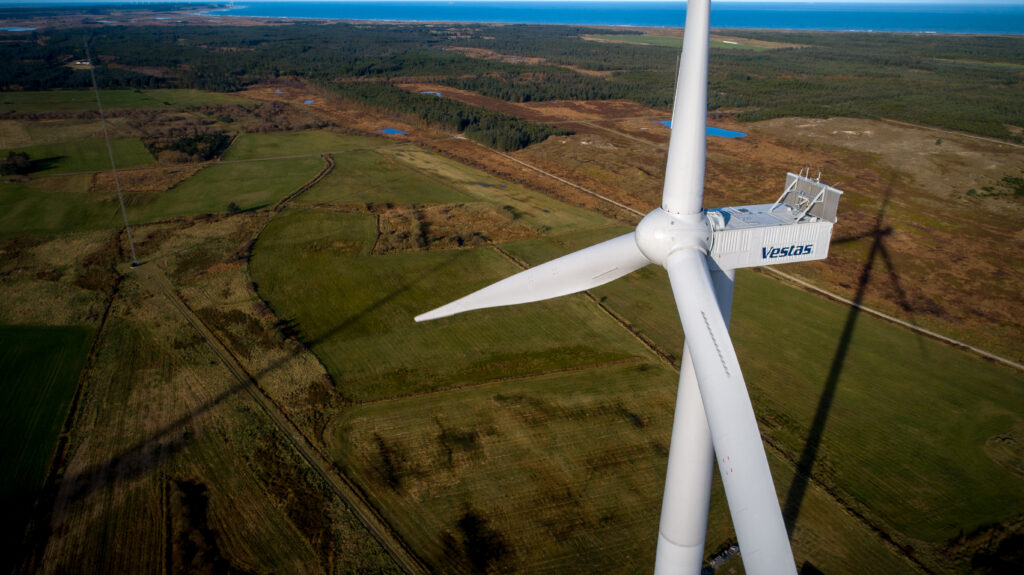
So far, most of the energy companies we covered are pushing the AM agenda within their respective organizations with the support of an external partner. Equinor and Vår Energi’s AM strategy, for instance, leans on a shared digital inventory: Fieldnode. The logic is collective: pool qualified part files across companies that don’t own their designs, and everyone’s lead times shrink at once.
Vestas draws our attention to a different route. A major global manufacturer of wind turbines and turbine blades, with close to 35,000 employees, headquartered in Denmark, with an additive laboratory in the United States, built its own digital inventory system, and kept it locked down.
Vestas is an energy company, and a renewable one. Does that change how it deploys AM? Less than you might expect.

According to Jeremy Haight, Product Owner and Chief Engineer for Additive Manufacturing & Applied Robotics within Vestas’ Digital Solutions group, the use cases are “very, very similar” to those of his oil and gas peers; operations in remote areas, and mobilized manufacturing as a focal point for the future.
Vestas stands out by tracking material circularity and carbon footprint more closely than its fossil-fuel counterparts, going as far as building models to calculate carbon diversion as a performance metric. Furthermore, unlike Equinor and Vår Energi that run assets and do not own the designs of many parts they need (hence the need of a cross-company digital inventory), Vestas designs, manufactures, commissions, and services its turbines. It owns the intellectual property, reinforcing this way the relevance of a closed system.
A closed system, by design
Keeping the system in-house was, in Haight’s words, “very much intentional.” The choice was predicated on Vestas’ initial use case (calibrated inspection tooling, production aids, and machinery spare-part replacements) where an inward-facing program delivered two advantages:
- Speed: a closed setup let the team stay highly agile and make the program operational quickly.
- And security: guaranteed protection of intellectual property rights
Timing reinforced that decision. Vestas kicked off its Direct Digital Manufacturing (DDM) program in 2017 and brought it to full launch around 2020–2021, in partnership with machine manufacturer Markforged.
Fieldnode coming onto the scene around 2020, it’s fair to note that Vestas’ system was not a reaction to the shared-inventory approach. To date, Vestas continuously evaluates alternative technologies and platforms so as not to box itself into a single dependency.
Haight told 3D ADEPT Media he expects a move toward a hybridized model, through an expansion the team refers to as Digital Kanban. Here Vestas would work with external suppliers on a royalty basis: a supplier’s component is formatted as a digital asset to be produced on Vestas’ own printers, and for every download and satisfactory part that comes off the machines, the supplier receives a one-time royalty. It is a way to open the system without surrendering control of where production happens.
The numbers behind Vestas’ DDM program
As a distributed manufacturing model by essence, Vestas’ DDM involves identical fleets of machines inside Vestas’ manufacturing facilities, with each site pulling qualified parts from a central digital repository to produce on premises.
The last time we checked Markforged’s files, the repository held about 2,000 parts, with average part-cost savings the vendor put at roughly 88% and, in one pilot, around 7,800 days of cumulative lead time eliminated.
Those figures look modest today. Vestas’ digital inventory holds close to 6,000 parts, and the program has produced close to 28,000 parts to date, Haight says. New designs are added at a rate of roughly 1,000 parts per year. Those numbers indicate how deeply the organization has adopted the program.
From the US lab to the factory floor everywhere
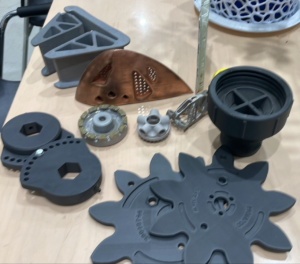
Haight shared with us that their team holds the mandate for all additive across the organization. The US laboratory stress-tests new platforms and materials at the applications level before anything is rolled out. The rollout itself, however, is global: when a revised strategy or technology roadmap is set, it lands across the entire organization, with production happening in-house at the manufacturing sites themselves.
Vestas began with tooling, jigs, and gauges; it is now pivoting into what Haight calls “product architecture”, components for the end-use product itself. Progress has been “slow moving, but moving,” with multiple qualified parts that can be produced on site or distributed from central hubs.
Their main challenge is one that we observe in the oil and gas and in other demanding industries leveraging AM: qualification. I have to admit, I like the way Vestas addresses it. According to the Chief Engineer, the company commissions and services turbines it does not own, then works with the wind-farm owners who do, under a right-to-repair arrangement. The owner accepts the liability of a 3D-printed part; Vestas gets the machine back up faster than the original subcomponent OEMs could; and the part is, in effect, qualified by being placed into field service and running without failure.
Vestas has been building turbines for more than 30 years, and many of those older platforms are still turning, owned by operators who want to keep them running.
As automation remains the vision for most companies running a production facility, I thought it was fair to ask Haight where they are in this scenario, given the fact that everything is produced in-house.
And he says the means and methods already exist to do it; what remains is connection, and that work is underway and progressing well. The AM team is building the application links into the other enterprise platforms, but it is a resource-heavy, strategically sequenced task: each connection ties the additive pipeline into a separate commercial system — SAP, Windchill, Dassault — and those integrations are prioritized carefully rather than rushed. The workflow itself is designed to run autonomously; bringing the rest of the enterprise into it is a matter of methodically wiring those systems together.
That points to where the current bottlenecks now sit. Organizational adoption, Haight states, is largely behind them. The next hurdles are capital and people. The more elaborate metal technologies Vestas is assessing (LPBF, DED, cold-spray additive) are capital-intensive, and they demand a properly trained workforce at multiple locations at once.
But it’s not an easy task: the team chased low-hanging fruit and high business value first, so the organization grows comfortable accepting higher levels of additive over time. Metal AM, in particular, has been “a very hard thing to position in the company,” precisely because of that capital intensity. “We don’t want additive to be one of those buzzwords. We want it to be something that brings extremely high value year over year over time,” Haight notes.
Our expert believes that too much of the AM industry still focuses on the machine and the part, and not enough on what an enterprise actually needs to run additive as a managed program. For him, the real work sits in software and systems management, built on five fundamentals:
- Cybersecurity and cyber‑resilience
- Role‑based access control (RBAC)
- Cross‑enterprise integration; connecting SAP, Windchill, PLM, MRP, and other platforms directly into the additive pipeline
- Data integrity: outbound job/print files
- Data pedigree: telemetry and quality data capture
In his view, the strength of additive lives in the supply chain. What holds the industry back is still the lack of interoperability between the 3D printers and the systems around them.
What success looks like
So, what does success look like three to five years out: a percentage of parts produced additively, a fully distributed network, or AM as a default in new turbine design? “All of the above,” Haight says. He wants Vestas’ product-design teams to treat additive as a new tool in the toolbox. And he wants that 1,000-parts-a-year cadence to hold or climb, because a rising number is the clearest signal that adoption is deepening rather than plateauing.
Vestas has been playing a different game from the operators we usually cover and winning it on its own terms.
Haight will dive deeper at the technology talk organized by Formnext, where he is keen to compare notes with energy-sector peers: to see what they are doing, who they are partnering with, and where there might be something to learn.
*All images: Courtesy of Vestas Wind Systems A/S. Partner content: Formnext.
Source: GWEC — wind turbine supply data, 2025.
THE 3D ADEPT WEEKLY NEWSLETTER
The industry moves fast. Stay ahead.
Every week, the latest additive manufacturing news, in-depth features and real-world applications, straight to your inbox. Plus, be the first to know when a new issue of 3D ADEPT Mag is out.
Free · One email a week · Unsubscribe anytime
Clicking loads our email provider’s sign-up form, including its analytics and Google’s anti-bot protection. You’re only subscribed if you complete the sign-up. Read our privacy policy.