The International Energy Agency (IEA) once estimated that advances in manufacturing technology worldwide could cut industrial energy use by 18–26%. This shift would translate into equally significant reductions in CO₂ emissions. For me, this reinforces a conviction: additive manufacturing (AM) should be part of that equation. In the energy and maritime industries in particular, where spare parts production has become the go-to strategy to leverage AM, a key question remains: how do we calculate (and prove) that 3D printed parts can reduce the carbon footprint? That’s the million-dollar question this dossier aims to tackle.
The focus on energy and maritime is simple: when we compare across sectors, the energy industry (oil, gas, coal, electricity generation) and the maritime industry are indeed among the largest sources of emissions globally, though in different ways. According to the IEA, around 73% of global emissions come from energy use (electricity, heat, and transport fuel). International shipping accounts for roughly 2–3% of global CO₂ emissions (IMO data). While this is much less than the entire energy sector, it’s still significant.
Our coverage shows that energy companies are increasingly joining forces through collaborative projects to test technologies and applications that could play a role in tackling climate change. The maritime industry, meanwhile, is emerging as one of the fastest-growing adopters of AM. To boost production efficiency, cut costs, and improve the performance of vessels, shipbuilders are turning to 3D-printed parts that meet strict hydrodynamic and durability requirements.
In doing so, they waste less material, gain greater design freedom, and sidestep supply chain bottlenecks. With this explained, this dossier aims to highlight:
- Specific AM technologies that are more favorable for low-carbon parts production
- Strategies implemented to measure the carbon footprint of 3D printed parts
- Regulatory frameworks or standards that can address environmental assessments
AM technologies vs use cases
As WAAM, binder jetting, and powder-bed fusion are often the technologies most used for applications across the energy and maritime sectors, it might be easy to think that they are more favorable for low-carbon parts production in these sectors.

“There is no single AM technology that stands out as being more favorable, as its suitability depends heavily on the specific application, material, part design, and the entire life cycle of the component. However, each technique has its own advantages and disadvantages. For instance, WAAM may have a lower carbon footprint compared to BJT and PBF, but factors such as wire feedstock production, shielding gas production (typically argon), and the need for post-print milling contribute to its overall environmental impact. BJT is often considered to sit between WAAM and PBF in terms of carbon footprint. It does not involve melting the feedstock; however, post-processing (de-binding and sintering) can be energy intensive. PBF is considered the most energy-intensive; however, this can be offset by the production of lightweight parts, which increase efficiency,” Adam Saxty, Lead Additive Manufacturing Technologist at Lloyd’s Register, told 3D ADEPT Media.
That said, before the advent of AM, most parts were designed for machining, casting, or forging; and depending on the application, these conventional methods are still widely used by energy and maritime companies around the world. Regardless of the technology in play, it is worth looking at the common identifiers of sound production processes, whether in AM or traditional manufacturing.
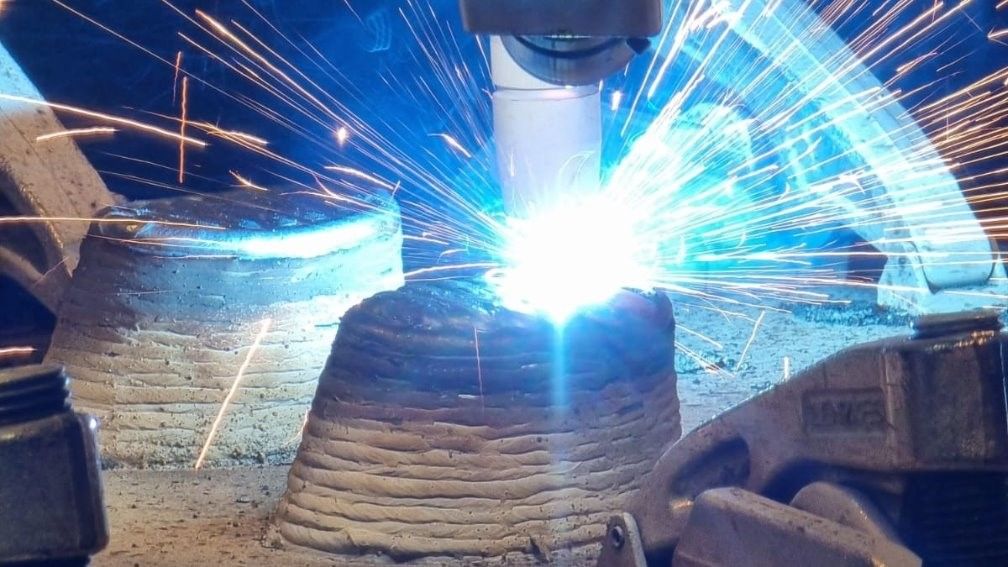
As Juho Raukola, Innovation Manager (Additive Manufacturing) at Wärtsilä, explains: “Industrialized, low scrap-rate, high-quality and minimum guesswork are some identifiers for good industrialized production methods. Thus, L-PBF and WAAM would be [their] selection in AM of metals; sand core printing for casting processes is a viable option, especially for replacing one-off or small series of cast parts quickly.”
On another note, as spare parts’ production is often considered the go-to strategy to leverage AM across the energy and maritime sectors, it might be easy to believe it remains an attractive use case to measure the carbon footprint of 3D printed parts produced for these sectors. It turns out that’s not the case for all companies – at least not at Wärtsilä.
“For us, spare parts are currently not the most attractive use case for AM. Therefore, we are not measuring the carbon footprint of the 3D printed spare parts compared to their conventional counterparts. If additive manufacturing is utilized as an alternative method for manufacturing, we would typically have lead time saving as the driver in mind,” Raukola states.
Strategies implemented to measure the carbon footprint of 3D printed parts
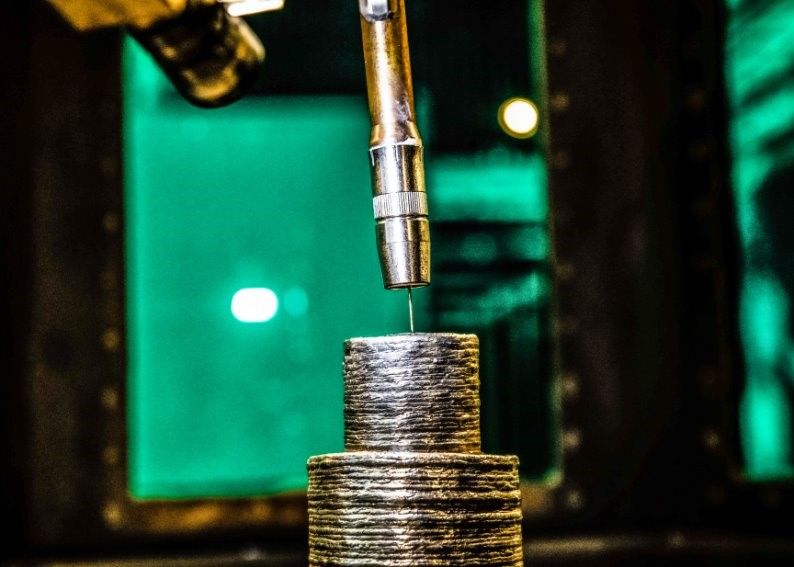
Wire arc additive manufacturing process – Credit : Lloyd’s Register
In general, the most widely used strategy to measure the impact of AM is Life Cycle Assessment (LCA) guided by ISO 14040/44 standards. A strategy that Saxty approves when a comparison is made with conventional manufacturing processes:
“An effective strategy for calculating the environmental impacts of AM versus conventional manufacturing is to consider the life cycle of the component, from the raw materials used, through how it’s made and used, and then all the way to how it’s disposed of or recycled. Instead of comparing the energy consumption of each method to manufacture a part, we should consider how it performs and how much it helps conserve resources during its lifetime. This approach gives a fair and complete picture of which method is more suitable.”
In AM, that typically means assessing:
● Feedback production (powder atomization, filament extrusion, resin synthesis)
● Printing process energy consumption (laser, heat, movement, cooling, auxiliaries)
● Post-processing
● Transportation & distribution
● End-of-life options (reuse of powder, recyclability, disposal).
In the AM industry, manufacturers use different calculation models to estimate the environmental impacts of production by AM versus conventional production techniques.
According to Raukola, there are free-of-charge and paid model options. However, their observations reveal significant discrepancies in AM life cycle assessment (LCA) results, even when the input data and scope are the same. The differences come from how assumptions are built into each model.
In Raukola’s view, comparing two widely used LCA models for AM showed differences of up to 100%, which is troubling for anyone trying to make a reliable sustainability case against conventional manufacturing.
“My advice would be to utilize the real data based on measurements conducted by the supplier themselves as much as possible,” he affirms.
Read more: Can Additive Manufacturing (AM) deliver “faulty” implications for its “green” credentials? (Part 3)

Onno Ponfoort, Practice Leader 3D printing at Berenschot, highlights a different approach brought by the consortium of 25 companies working on phase 3 of the ProGRAM JIP (Joint Industry Project).
For those who do not know, the consortium was created in 2018, to produce a guideline formulating the necessary requirements to introduce components made by AM into the oil, gas and maritime industry. Each phase of the project aimed to meet specific objectives. A key part of phase 3 led by Berenschot and DNV, aimed to understand the viability of AM in relation to a part’s carbon footprint.
“In the example cases in the JIP, Directed Energy Deposition reduced CO2 emissions by considerable amounts: a 40-80 % reduction compared to conventional production methods was observed. This was mainly achieved by the reduction of material use (less waste using near-net shape production) and the associated lower energy consumption during production,” Ponfoort points out.
Interestingly, the team used the AMPower framework for measuring and comparing the carbon footprint of AM versus conventional production. The framework would incorporate all essential elements, not only the material production and the part production footprint. Also, aspects of transportation, electricity used and use phase aspects are included.
When asked if AM really reduces emissions when considering the entire lifecycle, he said yes and no. Results of their use cases revealed that “AM does not always reduce the environmental impact of manufacturing compared to conventional.”
“The energy mix used for manufacturing has a significant impact on production emissions. AM often allows for local and on-demand production of parts in areas with local sources of renewable energy. Most conventional technologies require large and energy-intensive production facilities. As such, AM more easily supports production in countries with a cleaner energy mix and production closer to the point of use which limits transportation and can reduce logistics emissions,’’ he adds.
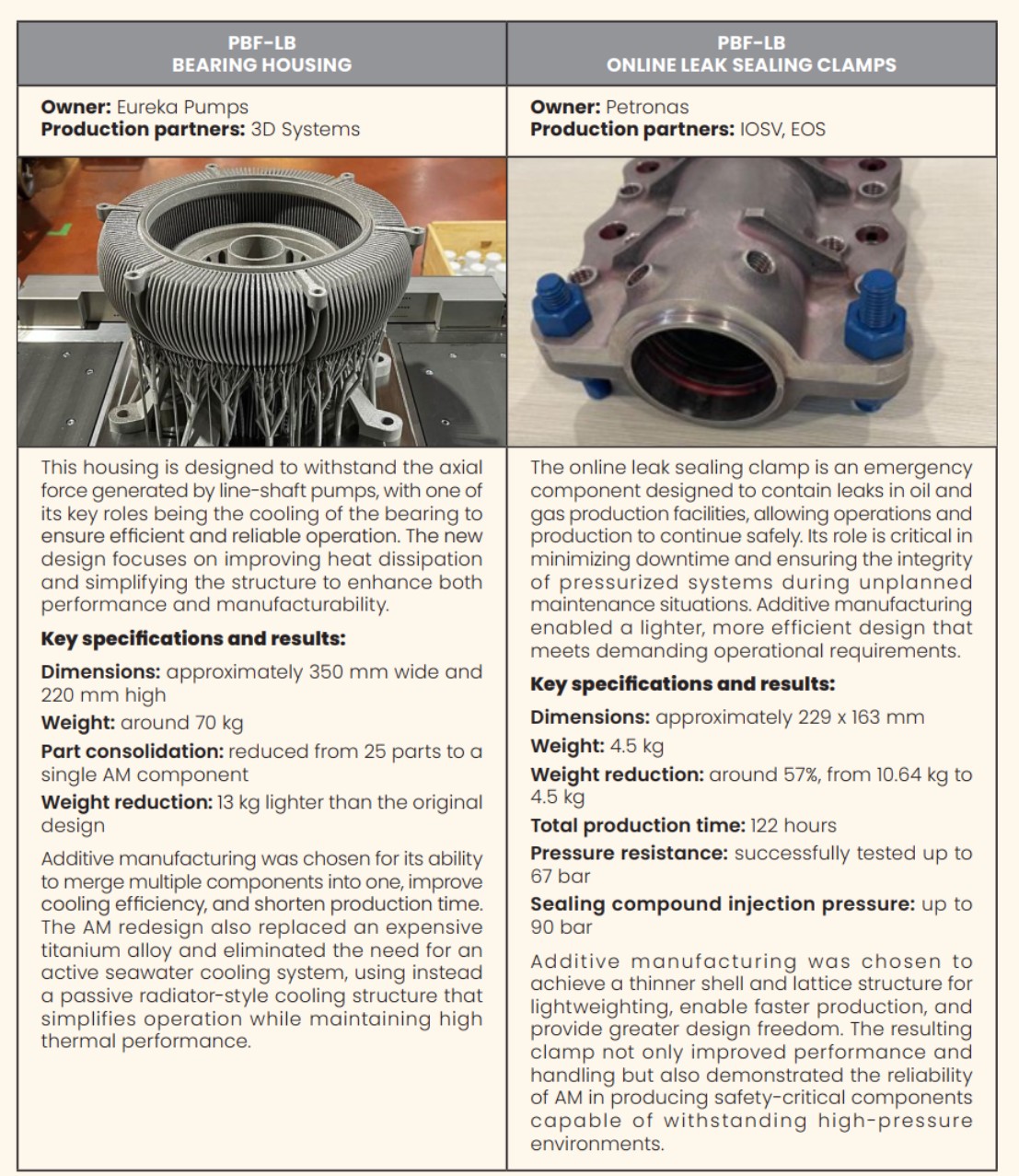
That said, the ProGRAM JIP emphasises the importance of material waste and recycling as repair and manufacturing as key considerations to lower the carbon footprint of 3D printed parts: “The impact of reducing material waste is partially compensated by material recycling. When material for conventionally produced parts can be recycled, this should be factored in with regards to the footprint of the material production. Therefore, a potential reduction in material usage during AM production does not necessarily translate for 100% into proportional carbon emission reduction.
[Additionally], parts can be repaired or remanufactured by AM with acceptable quality. In addition to the economic benefits, AM for repair or remanufacturing offers substantial sustainability benefits We observed CO2 savings of up to 80% compared to the production of new parts with conventional technologies. Hybrid production set-ups (ones that combine simple stock geometries made by conventional manufacturing with the complex features made by AM) also showed sustainability benefits.”
Are there any differences in environmental performance between 3D printed exact replicas of parts and AM-optimized parts?
The short answer is: YES.
Our experts provide different cases where these differences are flagrant below.
According to Lloyd’s Register’s expert:
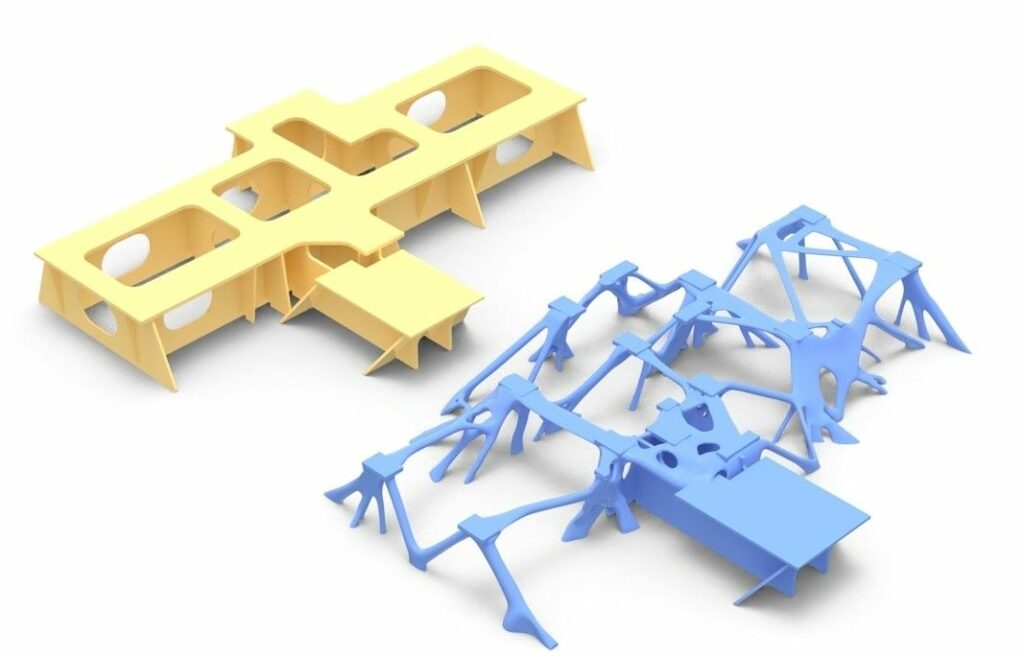
“3D-printed replica parts will have the same geometry and similar weight compared to conventionally manufactured components. However, an optimized part can be redesigned specifically for its application by taking advantage of the design flexibility offered by AM. With topology optimization (a mathematical method that optimizes material layout within a given design space), an improved material layout can be used, resulting in a lighter design. Consequently, less material is used during production, resulting in lower energy consumption and a smaller environmental impact throughout a component’s service life.”
“Based on the sustainability study done with FAME (Finnish Additive manufacturing ecosystem) we could clearly see that printing a 2kg steel part as-is on 316L, we would have increased the emissions by a factor of 2 or 3, same design printed on AlSi10Mg would have increased the CO2 emissions by 25%, while drastic re-design for an AM-native model achieved 90% reduction compared to CNC machined component.
Smart design with minimal material consumption is the key to LCA efficiency as powder production and the electricity consumption in the printing process consists of more than 90% of the total CO2 of the AM production. Re-designed spare parts offer significant upgrade opportunities for legacy components. By leveraging design freedom, we can enhance component functionality while maintaining compatibility with existing interfaces. Field implementations demonstrate substantial performance improvements, proving this approach delivers measurable value to existing installations,” Wärtsilä’s expert completes.
“When using Powder Bed Fusion AM technologies (PBF-LB and PBF-EB) for ‘like-for-like’ manufacturing of conventionally cast parts, increased emissions during the production phase were observed. However, the extra effort of doing a part re-design to optimize the part for AM production or improve the functionality of the part in the use phase should be considered. This often has positive effect, which leads to a net benefit to the sustainability of AM-production or performance during the lifetime compared to conventional manufacturing,” Ponfoort adds.
Regulatory frameworks or standards that can address environmental assessments
To date, there are no AM-specific rules for environmental assessments of 3D printed parts. The industry is still very much relying on general environmental assessment frameworks, which Saxty confirms:
“The usual approach of regulatory frameworks and AM standards has focused on reliability, safety, and minimizing the risk of failure, especially for energy and maritime applications. This is highlighted by the publication of IACS Recommendation 186*, which facilitates the safe and effective adoption of AM in the marine sector. However, standards such as this do not assess the environmental impact of AM. A growing body of research at the academic level is developing frameworks for assessing the environmental impact of AM, although this work has not yet been integrated into most certification schemes.”
Concluding thoughts
From our discussions with experts, it is clear that assessing AM’s potential to cut emissions in the energy and maritime industries requires careful consideration.
Factors such as geographical location (which affects the carbon intensity of electricity), the use of digital warehousing to reduce production and transportation, and the choice of recycled versus virgin materials also influence the overall footprint.
When applied strategically, through thoughtful process selection, design optimization, localized production, and efficient qualification, AM can significantly reduce the carbon footprint of maritime parts. Yet, the benefits remain highly case-dependent.
This underscores the need for careful modeling, planning, and data-driven decisions to fully realize its potential.
Editor’s notes
Three companies brought their expertise to this dossier.
Lloyd’s Register (LR) provides classification, compliance, and advisory services to the marine and offshore sectors. We support a safe and sustainable ocean economy by providing trusted technical and digital solutions that enable maritime decarbonization and digitalisation.
The company’s AM services provide classification and certification of AM-produced parts to ensure the same integrity standards as traditionally produced parts. In relation to this topic, LR has focused its efforts on understanding the benefits of lightweighting component design and how this can be integrated into shipbuilding.
Wärtsilä is a global leader in innovative technologies and lifecycle solutions for the marine and energy markets, shaping the decarbonisation of both industries. AM accelerates this transition by enabling unique component performance capabilities essential for future fuels including ammonia, methanol, and hydrogen. While minimizing production emissions remains important, AM technology unlocks the development speed and technical solutions needed to replace fossil fuels at scale.
After eight years on the frontline of technology, application, and business case development for industrial AM at Wärtsilä, Raukola explained how at WHAM (Wärtsilä Hub for Additive Manufacturing), they found the answer. Their approach combined developing numerous 3D-printed short-term solutions while nurturing long-term strategic bets, constant experimentation, and highly open co-creation. Today, they are close to a breakthrough with mission-critical AM components for Wärtsilä products.
Over the past 15 years, Berenschot has guided companies in the targeted use of 3D Printing. The company developed the Berenschot Business Impact Model (3D BIM).: a solution that helps businesses gain insights into the competitive advantages that 3D Printing can bring to their company. The tool even supports strategic choice with an investment plan and an indication of payback time.