

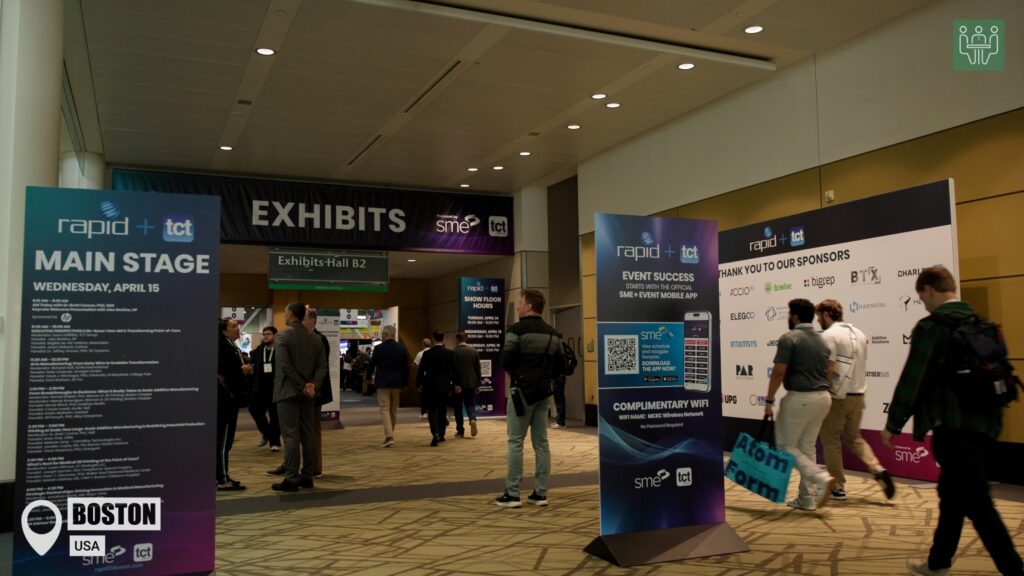
All I knew about Boston before coming here was that the city had earned a reputation built on law and legal institutions; knowledge largely amplified, I’ll admit, by Boston Legal (also known as Boston Justice), a series I was watching back when I was dreaming of becoming a lawyer. And then life happened. And then RAPID+TCT 2026 came with an altogether different perspective, revealing a region with a deep concentration of manufacturing capability, life sciences activity, and AM-relevant research. The city traded courtrooms for clean rooms in my mental map, and I’m not complaining.
As the United States is a vast country, the change of locations from one edition to the next genuinely helps: each city brings a different professional demographic to the show floor. Boston was no exception. The professionals here are specific, rooted in industries that are actively leveraging additive manufacturing.
I walked into the Thomas M. Menino Convention & Exhibition Center as a first-time attendee at this event, jet-lagged and genuinely excited to meet this part of the North American AM community. Other colleagues had covered previous editions; so my fresh eyes could be both a liability and a gift.
A format that works, mostly
With April 13th and morning sessions of subsequent days dedicated to conference and keynote programming, and the remainder of the schedule opening up the exhibit floor, the format makes it relatively easy to make the most of your participation. The generous time given to exhibits confirms that this remains a core part of the RAPID+TCT experience, unlike AMUG, for instance, where the conference takes clear precedence.
The organizers structured the show floor around three focused expo showcases: AeroDef Manufacturing, StartUp, and Healthcare. These labels help orient first-time visitors and signal where to direct your energy. That said, they don’t always reflect the full positioning of every exhibitor on the floor. Most companies in the AM space don’t serve a single vertical, and trying to contain them within one showcase label often feels like forcing them into a category that simply doesn’t fit.
AeroDef Manufacturing: When defense sets the tone
Given the growing investments in defense applications of additive manufacturing, AeroDef’s prominence at the show was hardly a surprise. The main stage of April 14th featured an Executive Perspectives panel discussion bringing together Foster Ferguson, VP Industrial Business at Stratasys; Arun Jeldi, CEO at Velo3D; Karsten Heuser, VP Additive Manufacturing at Siemens; and BG Beth A. Behn, Commanding General at U.S. Army TACOM AMC.
This lineup signaled that the conversation focused on what AM is already doing for defense, and at what scale.
Healthcare 3D printing: Familiar faces in unfamiliar latitudes
There is something disorienting, in the best possible way, about following companies for years through reports, interviews, and events, only to encounter them across an ocean, in a different continent, going about their work with the same confidence. That was my experience with two names I’ve been tracking closely through 3D ADEPT Media: Lithoz and Solukon.
Ceramics you can trust in life‑critical applications
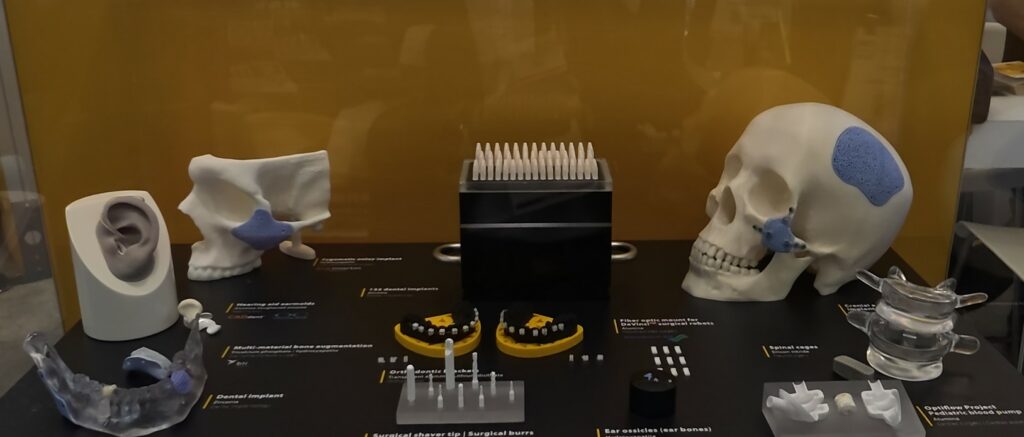
If you follow healthcare 3D printing, Lithoz needs no introduction. The Austrian ceramic 3D printing company has been building its case in the medical and dental space for well over a decade, and their presence at RAPID+TCT reinforced how far that journey has come.
At the show, Lithoz highlighted the qualities of their materials alongside the capabilities of their flagship Lithography-based Ceramic Manufacturing (LCM) technology, a process in which ceramic particles are dispersed in a photosensitive resin, solidified layer by layer through light exposure, then sintered to deliver full ceramic properties. Among the applications on display: patient-specific hearing aid earmolds, dental crowns, and cranial implants.
Lithoz has spent years building clinical and regulatory credibility to back them up. Their quality management system achieved ISO 13485 certification, a quality management standard for the medical device sector, and their bioceramic implants have demonstrated a 92% clinical success rate over a five-year follow-up study, using their LithaBone TCP 300 tricalcium phosphate material.
In dental applications, they have collaborated with Ivoclar to develop a lithium disilicate material for restorations, the kind of crown you’d actually want in your mouth, and have recently expanded their portfolio with a medical-grade LithaCon ATZ for dental implants and surgical tools.
Solukon: The art of removing powder you can’t reach
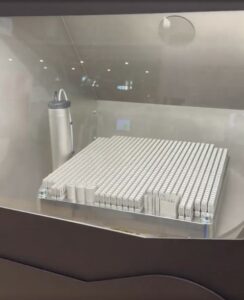
Solukon continues to make sure the parts are usable once they come out of the printer, which, in medical manufacturing, is a distinction that matters enormously.
At RAPID+TCT, the German automated depowdering specialist showcased its SFM-AT350-E, one of the key systems in their portfolio. The E-version enables gentle, low-noise depowdering through piezoelectric (ultrasonic) excitation, a particularly relevant capability when working with the delicate geometries that define medical 3D printed parts.
On display was a build plate featuring more than 1,100 3D printed spinal cages, a visual that makes the scale of what automated post-processing now enables very tangible.
Startups: AI Everywhere (With reason)
The Startup showcase at RAPID+TCT is worth the time. Some of these companies will be acquired within the next few years; others will quietly fade. But a handful will become the infrastructure of how this industry works. The challenge, as always, is telling one from the other before the market does it for you.
What stood out on this visit: a distinct gravitational pull toward AI-powered solutions across the startup cohort. Not surprising in the current era, but the specific angles varied.
Accio 3D: I had a good conversation with Bindiya Vakil, CEO and co-founder, who explained that Accio 3D helps identify parts suitable for 3D printing through AI agents. The problem they’re solving, identifying suitable aftermarket parts for AM, is more pointed than it sounds, particularly for manufacturers managing large inventories of legacy parts. Their story reminds me a bit of CASTOR, which ceased operations in July 2025, after eight years of activity. I hope Accio 3D will last longer than that.
Skody AI: Alexander Klimov, CEO, walked me through their AI planning engine for scheduling and production planning, with a current focus on the U.S. market. Regular readers of 3D ADEPT Media may recall our coverage of nPower Technologies, which we explored in more depth around the cost of inefficient scheduling in AM. Both companies are operating in the same underappreciated corner of the AM workflow: the gap between what ERP systems can handle and what an actual additive production floor demands.
The distinction, at least from what Klimov described, lies in the AI-native approach. Where nPower built its scheduler on top of established ERP and MES logic, essentially bridging the existing infrastructure. Skody AI appears to be building its planning engine with AI at the core rather than as a layer on top.
Whether that architectural difference translates into a meaningful operational advantage remains to be seen. And the fact that this problem is attracting multiple dedicated players suggests the industry is beginning to take scheduling seriously as a production bottleneck.
Not technically in the startup zone, but worth noting: Lothric Labs offers a 3-in-1 service model combining prototyping, printing, and distribution. Their real differentiation may lie in the software platform they’re developing: Chronos AI.
According to CEO Jonathan DiMattei, the current version is essentially a CAD interface for non-programmers, designed for FDM and metal 3D printing. The intended endpoint version will be voice-driven, a spoken interface that removes the last remaining technical barrier to part creation. Whether that’s the right bet on how AM adoption unfolds is an open question. But the direction is clear.
Other companies that caught my attention…
A number of companies caught my attention for what they’re doing in the less-spotlighted corners of the production chain.
Joke Technology GmbH brought an interesting proposition with their Enestra post-process system, a cabin-based solution that addresses depowdering and finishing in a single step. The core idea: measuring the dust inside the cabin, targeting the removal of metal supports, and combining powder removal and surface finishing into one operation. For metal AM workflows where these steps are often separated and manual, that kind of consolidation deserves a closer look.
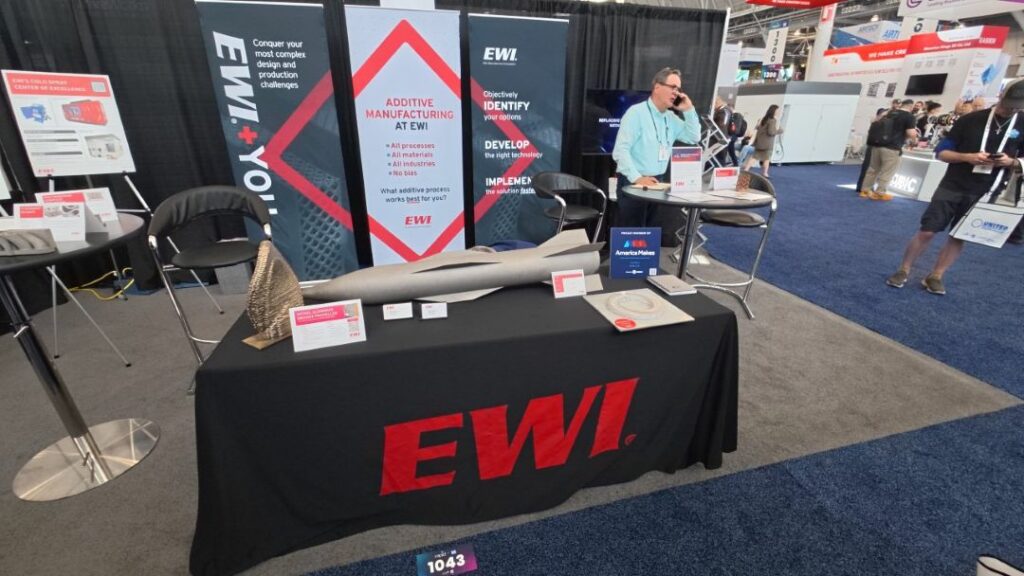
EWI reminded me that not every important organization at a show like this is trying to sell you hardware. A process- and vendor-agnostic non-profit, EWI reinvests membership revenue into new equipment and focuses on supporting both commercial and government professionals who are implementing AM directly on the shopfloor. It’s a model that prioritizes knowledge transfer over transactions and in an industry that still has significant educational gaps at the operational level, that’s not a trivial offering.
Neumann & Esser had grinding equipment for plastics on display, targeting SLS manufacturers and other part manufacturers.
SENECA Ceramics presented capabilities around indirect 3D printing for ceramics, a corner of the technical ceramics landscape that is not usually in the spotlight, but one with growing traction in specialized industrial and medical applications.
Well, well…
My overall impression for now is one of an industry that has moved decisively, if unevenly from demonstration to deployment. Boston, it turns out, is a better setting for that conversation than I expected. The legal associations can wait though given how quickly the defense and medical sectors are moving here, the lawyers won’t be far behind.
Watch on YouTube: Inside RAPID + TCT 2026 | By 3D ADEPT Media
Source: Lithoz, ISO 13485 quality management certification, May 2025.
Source: Accio3D, identifying additive manufacturing options for legacy parts.
THE 3D ADEPT WEEKLY NEWSLETTER
The industry moves fast. Stay ahead.
Every week, the latest additive manufacturing news, in-depth features and real-world applications, straight to your inbox. Plus, be the first to know when a new issue of 3D ADEPT Mag is out.
Free · One email a week · Unsubscribe anytime
Clicking loads our email provider’s sign-up form, including its analytics and Google’s anti-bot protection. You’re only subscribed if you complete the sign-up. Read our privacy policy.