

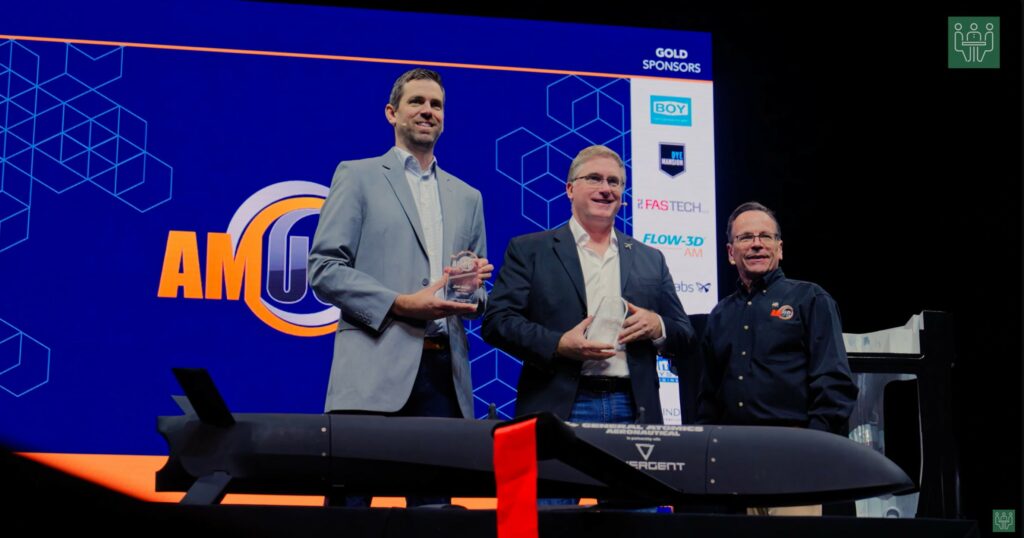
After five consecutive years in Chicago, the Additive Manufacturing Users Group packed up and headed west. AMUG 2026 took place in Reno, Nevada, a city within reasonable driving distance of the Bay Area and Silicon Valley. This positioned the event closer to a dense concentration of technology companies, investors, and advanced manufacturing operations.
The city is also in the middle of a genuine growth phase: a revitalized downtown with quality dining and cultural events, proximity to the Sierra Nevada mountains, and a growing industrial footprint, most visibly anchored by Tesla’s Gigafactory, make it a destination for industry gatherings.
That said, attendees who found themselves drawn more to the mountains than the casino floor may have wished the surrounding program leaned further into Reno’s outdoor and cultural offer. It is a fair note for future editions.
What remained constant was the quality of the event itself. The sessions were highly educational and technically substantive. The networking opportunities were, by most accounts, among the most valuable the event has offered. The community it brings together has always defined AMUG more than its location, and 2026 was no exception.
Divergent and GA-ASI: transferring experience across industries
Among the conversations worth listening to was the one forming around Divergent Technologies and General Atomics Aeronautical Systems (GA-ASI). Their partnership offers one of the most instructive case studies in what it actually looks like to move additive manufacturing from concept to structural production hardware in aerospace and defense.
Divergent originally developed its approach for automotive structures. Cost pressure, volume, and performance requirements define this environment and are demanding in their own right.
What has become increasingly clear is how much of that foundation translates to aerospace and defense, where complexity, lightweighting, and supply chain agility are no less critical. Scott Sawyer, who leads partnerships at Divergent, spoke directly to which elements of the company’s manufacturing philosophy proved transferable, and which required rethinking.
On the customer side, Steve Fournier from GA-ASI reflected on what it meant to encounter Divergent’s technology for the first time. Specifically, he discussed how it challenged long-held assumptions about how aircraft and drone structures should be designed and built.
These are the kinds of exchanges AMUG is built for: direct, technically grounded, and between people who are actually doing the work.
Watch the video:
Watch on YouTube: Cross-Industry Innovation in AM | Divergent x General Atomics at AMUG 2026
Continuing the conversation on Additive Talks
With the idea of knowledge transfer between industries, Steve Fournier, Technical Director of the Additive Design & Manufacturing Center of Excellence at GA-ASI, will be back on April 22, 15:30–16:30 CEST | 09:30–10:30 EDT, Additive Talks, season 6. Alongside Hauke Schulz, AM Roadmap Leader at Airbus, they will discuss how civil aviation, aerospace & defense – two leaders from two industries that rarely talk to each other – approach AM: the convergence, where the gap shows up and the pathway to qualification frameworks.
Video produced by Ian Von Herbulis.
THE 3D ADEPT WEEKLY NEWSLETTER
The industry moves fast. Stay ahead.
Every week, the latest additive manufacturing news, in-depth features and real-world applications, straight to your inbox. Plus, be the first to know when a new issue of 3D ADEPT Mag is out.
Free · One email a week · Unsubscribe anytime
Clicking loads our email provider’s sign-up form, including its analytics and Google’s anti-bot protection. You’re only subscribed if you complete the sign-up. Read our privacy policy.