

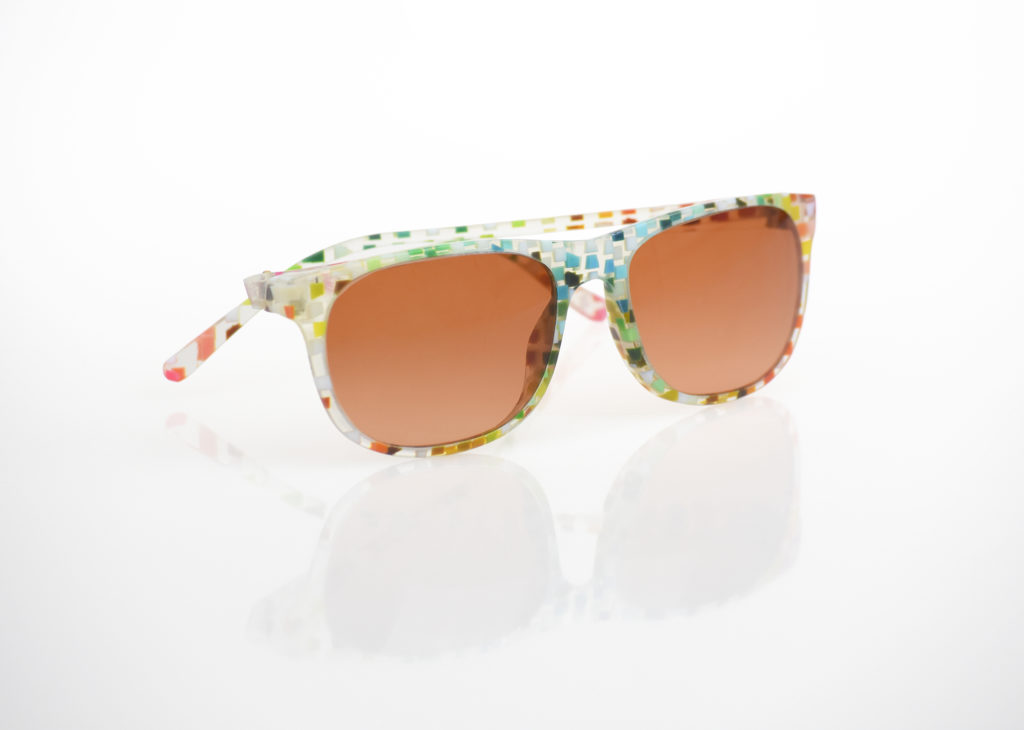
Following designers’ needs for a more efficient process, Stratasys offers a unique combination of stiffness and flexibility, essential for eyewear makers’ prototyping requirements.

Stratasys’ 3D printing solutions are recognized in a wide range of sectors. However, this innovation somehow reminds Materialise’s partnership with Safilo.
The new manufacturing process
The challenge in this manufacturing was to get a premium product while saving time during the production. It takes about 18 months from initial design concept to display on the store shelf using traditional techniques. With the use of 3D printing, this time may be reduced to eight weeks or less.
Stratasys combines the performance of its J750 Multi-color, Multi-material 3D Printer with VeroFlex, a specific 3D printing material for eyewear rapid prototyping needs.

VeroFlex presents a more sustainable and flexible material for detailed internal tests before tooling and production. Manufacturers then have the possibility to deliver products over a year faster and lead with the latest market trends, while improving salability of products.
Furthermore, when used for design verification, the Stratasys VeroFlex material offers ultimate realism enabled by combining six new materials (Cyan, Magenta, Yellow, White, Black, and Clear), and the ability to create and mix solid, opaque, transparent and color shades. All of this, in addition to simulating true-to-life textures such as wood grains, leather, stitching, bone, carbon-fiber, and photo-realistic images.

“The eyewear market continues to expand, driven by new technologies, demand for customization and growing addressable markets,” says Mike Vasquez, founder and CEO at the digital manufacturing consultancy, 3Degrees. “As the industry seeks to maximize its opportunity, Stratasys’ prototyping solutions for frames and eyewear accessories — which can cut time-to-market by upwards of 80 percent — will be an attractive solution that is able to deliver immediate value for users looking to make parts with a high degree of mechanical function and appearance.“
For further information about 3D Printing, follow us on our social networks and subscribe to our newsletter!
//pagead2.googlesyndication.com/pagead/js/adsbygoogle.js
(adsbygoogle = window.adsbygoogle || []).push({});
THE 3D ADEPT WEEKLY NEWSLETTER
The industry moves fast. Stay ahead.
Every week, the latest additive manufacturing news, in-depth features and real-world applications, straight to your inbox. Plus, be the first to know when a new issue of 3D ADEPT Mag is out.
Free · One email a week · Unsubscribe anytime
Clicking loads our email provider’s sign-up form, including its analytics and Google’s anti-bot protection. You’re only subscribed if you complete the sign-up. Read our privacy policy.