


3D printer manufacturer Bambu Lab has announced the A2L, the latest addition to its A-Series desktop lineup. Positioned as a “large-format” machine for creative users, the A2L features a build volume of 330 × 320 × 325 mm. That is a 105% increase over standard 256 mm-class machines in the brand’s own ecosystem. It is available globally starting June 1, 2026, starting at $469 (non-combo).
On paper, it’s a solid release. The machine packs in a closed-loop PMSM servo motor, adaptive vibration compensation with multi-point calibration, integrated granular dampers, and a comprehensive detection system. These features are typically reserved for higher-end models.
It also supports up to 19 colors via four AMS units. Alongside the usual creative audience (cosplayers, families, home décor enthusiasts), it targets print farms. It even doubles as a cutting plotter via a Blade Cutting Upgrade Kit.
Bambu Lab has been steadily expanding its ecosystem, from the H2D all-in-one manufacturing station to the H2C supporting up to 24 filaments in a single print, open-source footwear designs, and even a flagship retail store in Shenzhen.
A word of caution for industrial readers.
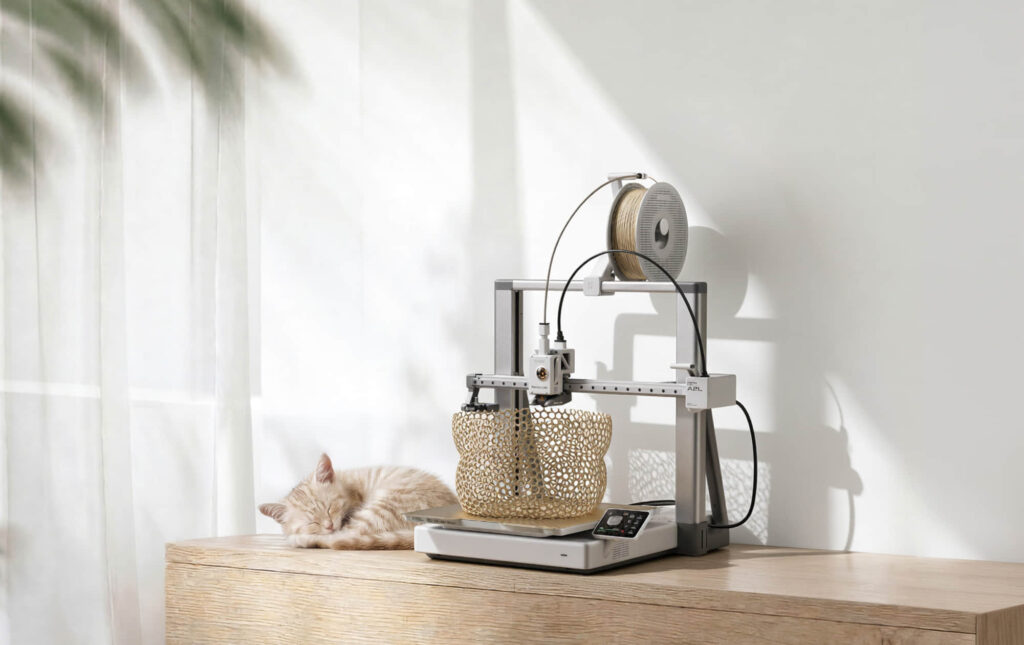
The term “large-format” deserves scrutiny here. In the industrial AM world, large-format additive manufacturing refers to systems capable of producing yacht hull molds, autoclave tooling, life-size furniture, or entire building components, machines where build volumes of 600 × 300 × 600 mm are already disqualified as insufficiently large. That definition doesn’t apply to the A2L.
The A2L’s 330 × 320 × 325 mm build volume is larger than Bambu Lab’s own A-Series standard, but well within, and in some cases below, what open-frame competitors like the Elegoo Neptune 4 Max (420 × 420 × 480 mm) or the Anycubic Kobra 3 Max (420 × 420 × 500 mm) already offer. The “extra large” claim is relative to Bambu Lab’s own ecosystem, not to the open-frame market at large. The distinction matters, because Bambu Lab’s machines can be used beyond the maker community, in small-batch production, print farms, and light industrial workflows.
Source: Anycubic, Kobra 3 Max user manual.
Source: Bambu Lab, H2C system announcement.
THE 3D ADEPT WEEKLY NEWSLETTER
The industry moves fast. Stay ahead.
Every week, the latest additive manufacturing news, in-depth features and real-world applications, straight to your inbox. Plus, be the first to know when a new issue of 3D ADEPT Mag is out.
Free · One email a week · Unsubscribe anytime
Clicking loads our email provider’s sign-up form, including its analytics and Google’s anti-bot protection. You’re only subscribed if you complete the sign-up. Read our privacy policy.