

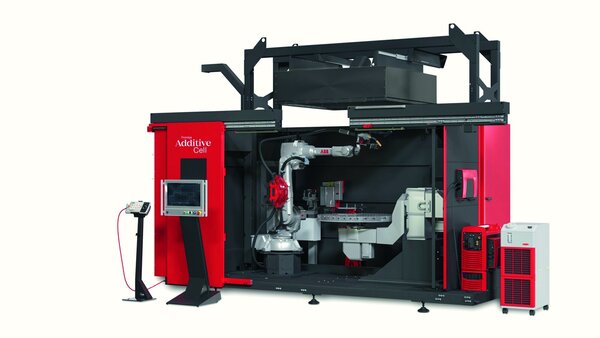
Engineering company Fronius will introduce at Formnext 2026 a new WAAM-based Additive Cell.
Combining CMT welding technology, intelligent process control, and user-friendly software, the new system could produce metal components for industries such as aerospace, automotive, pressure vessels, rolling stock, as well as oil and gas.
“WAAM enables decentralized, location-independent manufacturing without the need for complex production lines. Even irregular geometries can be built to the highest quality standards without wasting valuable material,” summarizes Manuel Stinglmayr, Business Development at Fronius International GmbH.
How does it work?
The system enables uniform layer build-up, crucial for achieving the desired quality with the Directed Energy Deposition-Arc (DED-Arc) method.
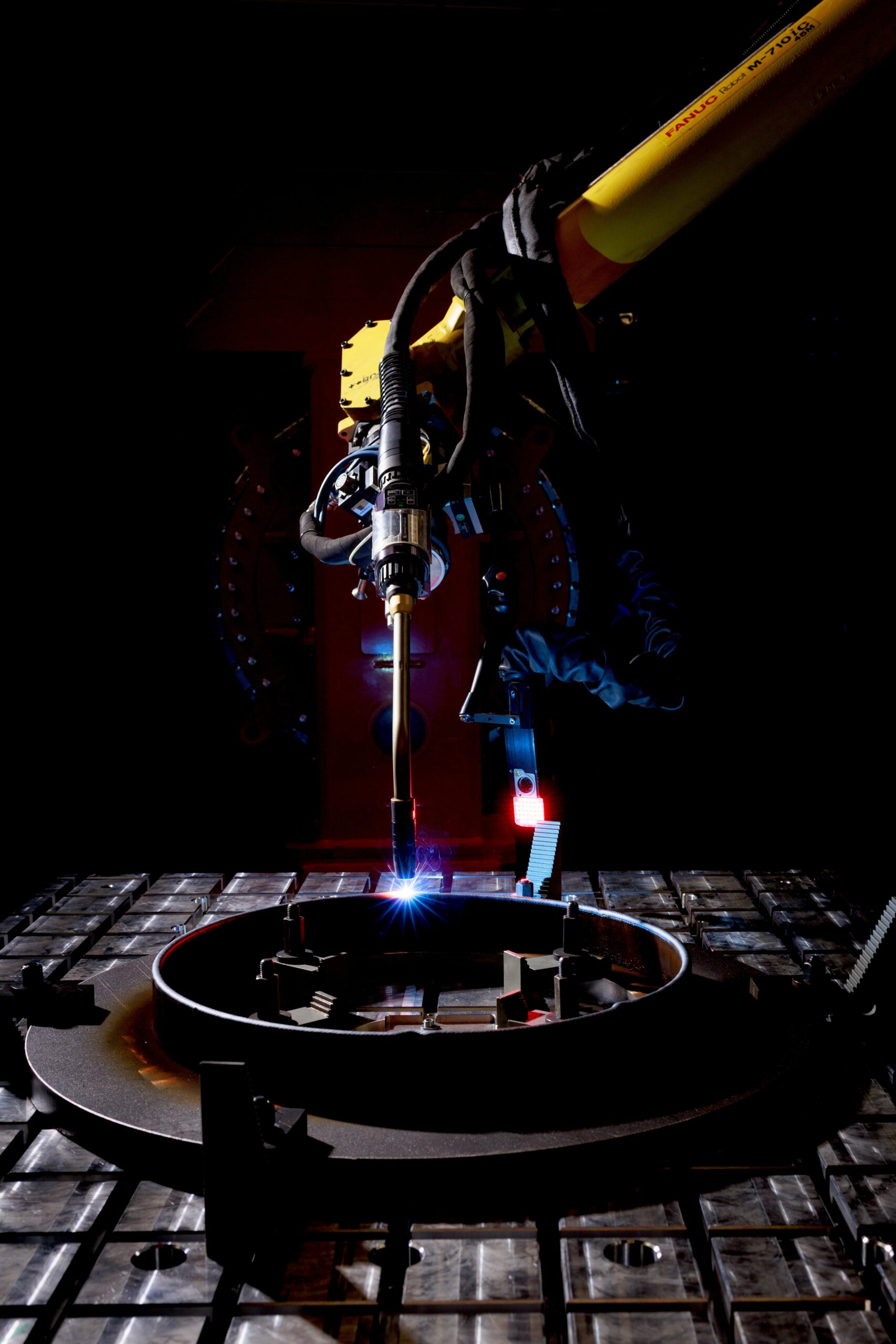
The company explains that its CMT Additive PRO is based on the Cold Metal Transfer (CMT) process and is particularly well-suited to additive manufacturing as a relatively cool dip transfer arc process that combines a higher deposition rate than other additive manufacturing methods with low heat input.
The “CMT Additive PRO” welding characteristics are specifically tailored to the requirements of additive manufacturing, providing features such as a deposition rate stabilizer, Pulsed HotStart, CTWD measurement, and power correction to ensure the necessary process stability.
“The CMT Additive PRO guarantees uniform and, above all, predictable layer build-up across the entire component. This drastically reduces scrap rates as well as the workload required for any rework,” emphasizes Manuel Stinglmayr.
As for the software, it is designed specifically for additive manufacturing with the Fronius Additive Cell. In addition to an integrated kinematic model, an adapted user interface, and validated welding operations for additive processes, it also supports geometry-based detection of different component regions.
This allows for flexible process parameters, such as different settings for outer walls, panels, infills, or component joints. Thanks to the “FroArc” welding command integrated into the post-processor, these so-called “build styles” are translated directly into code for the welding robot, and the system switches to the correct welding parameters at the exact desired location without delay.
Fronius’s integrated system, consisting of a welding machine and software, ensures a simple, stable, and reliable welding process.
THE 3D ADEPT WEEKLY NEWSLETTER
The industry moves fast. Stay ahead.
Every week, the latest additive manufacturing news, in-depth features and real-world applications, straight to your inbox. Plus, be the first to know when a new issue of 3D ADEPT Mag is out.
Free · One email a week · Unsubscribe anytime
Clicking loads our email provider’s sign-up form, including its analytics and Google’s anti-bot protection. You’re only subscribed if you complete the sign-up. Read our privacy policy.