

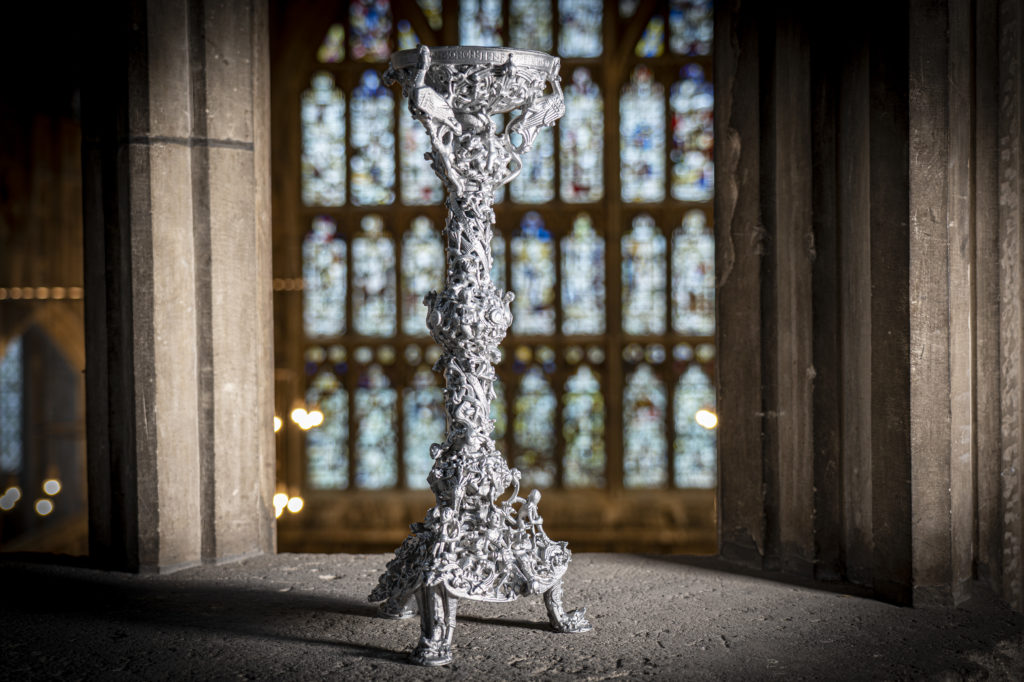
Casting in bronze was at its peak in England during the Middle Ages (early-twelfth-century). One of the remarkable examples of this art is the candlestick, which displays the designer’s creativity as well as the manipulative skill on the part of the smelter.
In order to replicate this piece of art, Gloucester Cathedral and the Victoria and Albert (V&A) Museum turned to Renishaw.
The engineering technologies company created a 3D model of the original candlestick which features densely-entwined foliage and fantastic creatures. Thereafter, using its metal additive manufacturing technology, the RenAM 500Q system and aluminium powder, the engineering team has been able to produce the exact replica of the candlestick.

Choosing aluminium for the replica
It should be noted that the candlestick’s uniqueness lies in the materials used for its fabrication. The original component was cast using a brass alloy with unusually high silver content hence the importance of materials in this reproduction.
They were initially planning to use titanium models, but they finally opted for aluminium powder because of this material’s ductility. According to the engineering team, they could easily clean and finalise the candlestick, to achieve a higher level of detail.
“Because of the Gloucester Candlestick’s complexity, there is no other way to reproduce it than additive manufacturing,” explained Paul Govan, Customer Training Manager at Renishaw and chief facilitator of this heritage preservation project. “The candlestick is composed of three distinct sections, each with intricate openwork decoration and a patina that has accumulated over 900 years. Renishaw used scans to reverse engineer each aspect of the design to recreate this historic masterpiece in all its original glory.”
The original candlestick is on show at the V&A Museum, while Renishaw’s AM rendition will be displayed and used at Gloucester Cathedral. An inscription on the stem states it was given to the church of St Peter, now Gloucester Cathedral, by Abbot Peter, who held the post from 1107-13.
From art to the automotive industry, Renishaw demonstrates the capabilities of its technology to meet a wide range of requirements.
Make sure to follow us on our social networks and subscribe to our weekly newsletter: Facebook, Twitter, LinkedIn & Instagram! If you want to be featured in the next issue of our digital magazine or if you hear a story that needs to be heard, make sure to send it to contact@3dadept.com
THE 3D ADEPT WEEKLY NEWSLETTER
The industry moves fast. Stay ahead.
Every week, the latest additive manufacturing news, in-depth features and real-world applications, straight to your inbox. Plus, be the first to know when a new issue of 3D ADEPT Mag is out.
Free · One email a week · Unsubscribe anytime
Clicking loads our email provider’s sign-up form, including its analytics and Google’s anti-bot protection. You’re only subscribed if you complete the sign-up. Read our privacy policy.