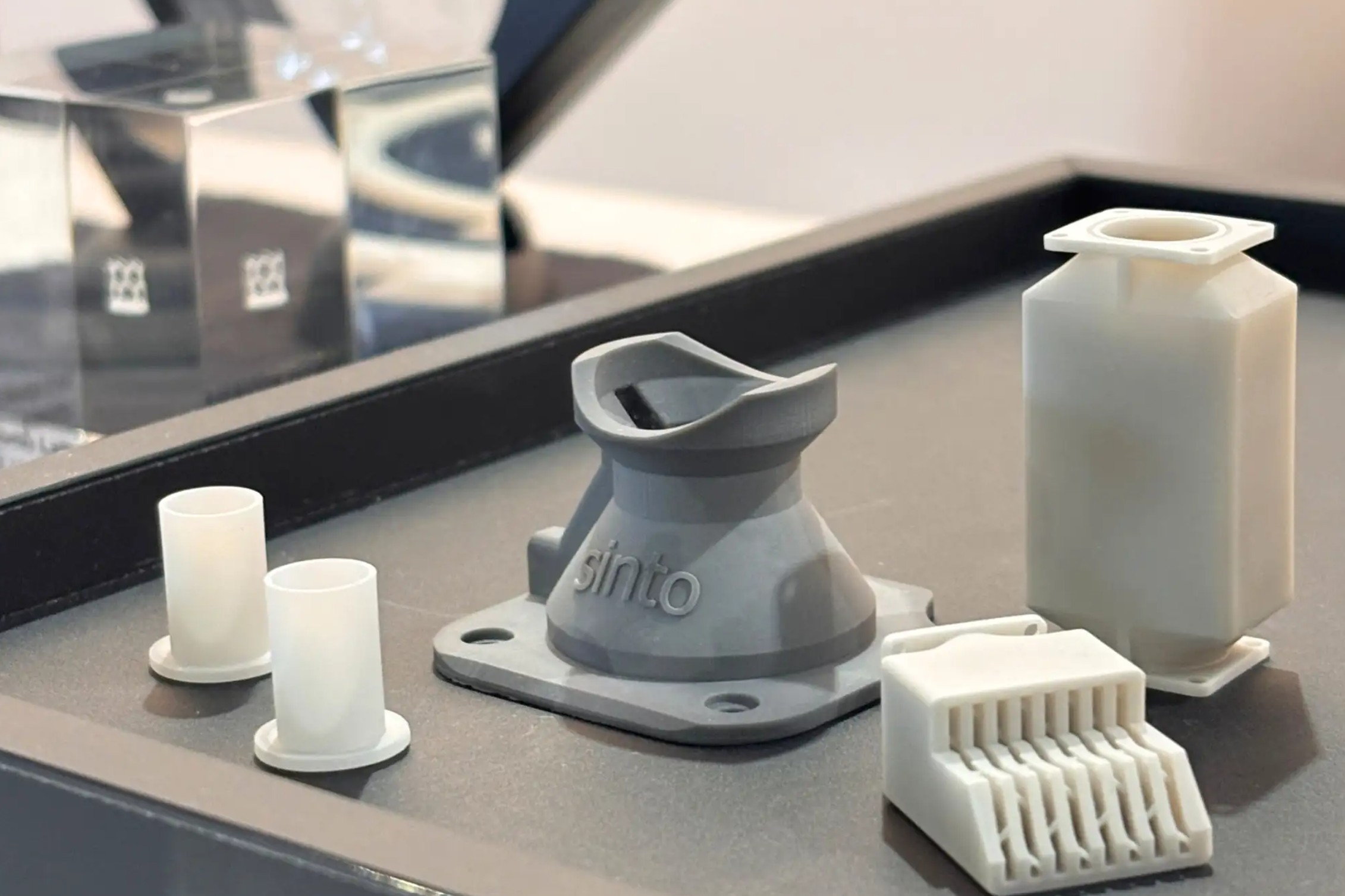
Sinto Advanced Ceramics Europe GmbH, an expert in technical ceramics for additive manufacturing, has added non-oxide materials aluminum nitride (AlN) and silicon nitride (Si₃N₄) to its material portfolio.
The new materials are part of a portfolio that includes high-purity oxide ceramics, including alumina, zirconia, ATZ, and ZTA.
“Every ceramic material exhibits a characteristic property profile,” explains Dr. Malte Hartmann, Head of Research & Development at Sinto Advanced Ceramics Europe. “With aluminum nitride and silicon nitride, we are expanding the range of materials that we can offer for additive manufacturing. This provides our customers with additional freedom in material selection and component design.”
Sinto Advanced Ceramics Europe GmbH uses Lithoz’s LCM technology for its ceramic 3D printing activities. And so far, we have seen these materials being processed mainly with 3DCeram’s SLA technology, particularly in semiconductor and aerospace applications. It will therefore be interesting to discover how they will perform with LCM.
That said, the properties remain unchanged
Aluminum nitride combines electrical insulation with high thermal conductivity, making it particularly suitable for thermal management, power electronics, and semiconductor manufacturing applications.
Silicon nitride offers high mechanical strength, good fracture toughness, and excellent resistance to thermal shock, making it suitable for applications with increased requirements for mechanical reliability and temperature cycling resistance.
“Material selection always starts with the requirements of the application,” Hartmann continues. “With aluminum nitride and silicon nitride, we can address additional combinations of thermal conductivity, electrical insulation, mechanical robustness, and temperature resistance. Ultimately, the most suitable material always depends on the specific application.”
Depending on the shaping method and, consequently, on the component geometry, Sinto Advanced Ceramics Europe utilizes either silicon nitride or related silicon aluminum oxynitride (SiAlON) materials. In SiAlON, some silicon and nitrogen atoms are replaced by aluminum and oxygen atoms, resulting in improved chemical resistance compared to conventional silicon nitride.
Sinto Advanced Ceramics Europe’s approach behind each new material release
Introducing new materials into industrial additive manufacturing processes requires far more than the availability of a suitable raw material. Success depends on mastering the entire process chain, from printing and thermal post-processing to quality assurance.
For this reason, Sinto Advanced Ceramics Europe follows a deliberate step-by-step approach when introducing new materials. Before a material is officially released, its printing behavior, thermal processing, component properties, and process stability are thoroughly evaluated.
“Materials are often described by their intrinsic properties. For industrial manufacturing, however, the crucial factor is whether those properties can be transferred reproducibly into real components. Accordingly, we systematically investigated processability and process stability before incorporating these materials into our portfolio,” Hartmann explains.
“We evaluate new materials not only in terms of material properties but also with regard to process-related metrics,” says Dejan Licinovic, Quality Manager at Sinto Advanced Ceramics Europe. “A material is only added to our portfolio once component quality, process stability, and reproducibility meet the requirements of industrial manufacturing.”
The expansion of the material portfolio is part of the company’s ongoing development strategy. In this context, Sinto Advanced Ceramics sees itself as both a contract manufacturer, and a technical partner during the early stages of product development.
“Many projects do not begin with a specific material request, but rather with a technical challenge,” says Frohwald Heller, Head of Sales at Sinto Advanced Ceramics Europe. “Our role is to work together with our customers to identify potential solution paths. In many cases, the actual solution emerges through this exchange, and sometimes that solution involves a material that had not previously been considered. With aluminum nitride and silicon nitride, we can now deliberately broaden this solution space.”
Read more about Sinto Advanced Ceramics Europe GmbH.
*We curate insights that matter to help you grow in your AM journey. Receive them once a week, straight to your inbox. Subscribe to our weekly newsletter.