I met Evan Bucther at RAPID+TCT 2026 in Boston. On their booth, prospectuses of what PanX can do were displayed. Without reading it, my attention was captivated by the images on the prospectus: rocket parts. Parts 3D ADEPT Media previously covered: The AMCM-built aerospike rocket engine and an AMCM M 8K demo rocket component. These parts are known in this industry for the complexity they represent, the geometry, the thermal stresses, the sheer engineering ambition they embody.
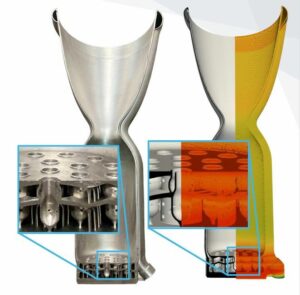
Reserved. – Thermal simulation of an aerospace part
Seeing those images on a simulation vendor’s booth implied to me that whatever PanX does, it is playing in a unique league. And so, I did my homework.
A young company with decades of depth.
On paper, PanOptimization is a relatively young company, founded in 2022. In practice, its founders bring decades of experience to the table:
– Dr. Pan Michaleris brings over 40 years in AM and welding simulation. A professor of Mechanical Engineering at Penn State, he wrote the CUBES solver, the very first commercial simulation tool for additive manufacturing, which later became Netfabb Simulation before being acquired by Autodesk in 2016 through the acquisition of Pan Computing LLC.
– Dr. Erik Denlinger, his co-founder, contributes 14 years of experience in the same field.
Which means that when PanOptimization describes PanX as a next-generation platform, it is the originator of this category, returning with a fundamentally different architecture.
For production applications in particular, where the gap between what legacy tools can handle and what the market actually needs has never been wider. It may be more accurate, as the founders themselves suggest, to think of PanX as the incumbent.
Reserved. –
Trial-and-error as standard practice
Simulation for additive manufacturing is not a new conversation. At 3D ADEPT Media, we have covered the subject from multiple angles over the years: simulation for composite AM, for polymer 3D printing, for large-format parts, through solutions developed by dedicated independent software vendors and through collaborations between software vendors and machine manufacturers. The conversation around Finite Element Analysis (FEA) has also broadened considerably since our last opinion piece.
However, since then, the industry hasn’t changed very much in how it normally behaves when making complex production parts. For the PanOptimization team, without adequate modeling, manufacturability was simply tested by building the part.
“If the print fails or does not meet tolerance, you try again. Part qualification is done in the same manner; by destructively testing a part to make sure it is suitable for its end-use application. This reality is reflected in the fact that if you get a quote from a supplier for a part, the cost will be several multiples of the single part cost. They are pricing the experimental iterations into the quote.“
This means that the cost of absent simulation is reflected into procurement pricing across the industry. Every quote that includes buffer for failed iterations is, in effect, a market-wide acknowledgment that physics-based models are still not universally applied.
The PanOptimization team draws an instructive parallel with nuclear energy, a sector where simulation-based compliance is regulatory. In nuclear, if a crack initiates in a reactor, you do not destructively test the reactor. Fracture mechanics, often in conjunction with Finite Element Modeling, is used to assess propagation risk, and these methods are embedded in the regulatory standards themselves. The PanX founders believe AM will move in the same direction.
How the industry has simplified its way around scalability
Previous conversations on simulation for AM reveal how most AM simulation tools were designed and have remained optimized for small-to-medium parts with manageable geometry. For years, the industry has worked around this limitation through simplification: defeaturing parts, reducing mesh density, accepting lower accuracy in exchange for computational feasibility.
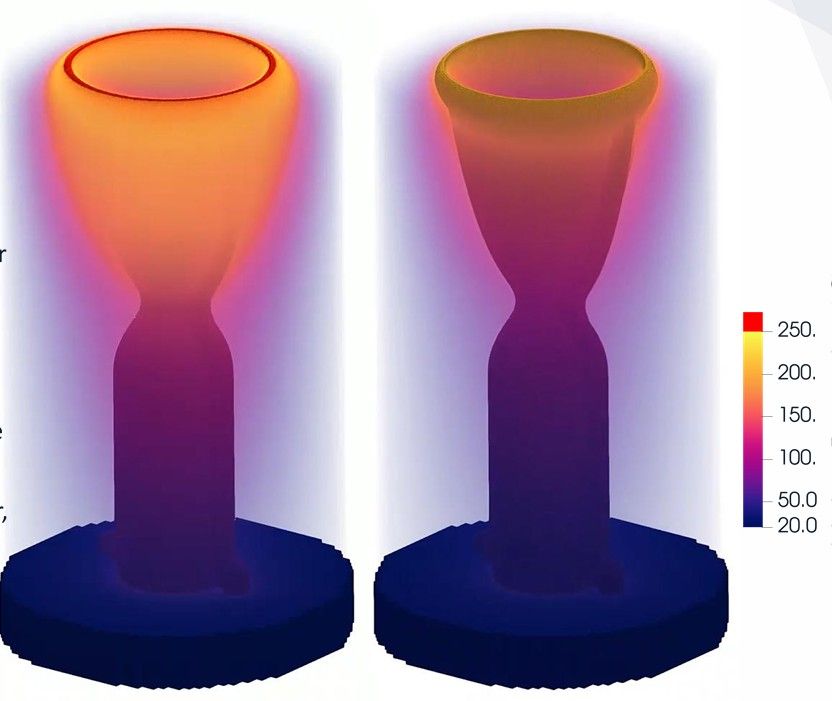
According to PanOptimization, traditional FEA solvers can typically handle around 5 to 10 million nodes before the user must start compromising on geometry fidelity and, by extension, on prediction accuracy. For a bracket or a small component, this ceiling is rarely reached. For a rocket engine or a large structural aerospace part, it is hit almost immediately.
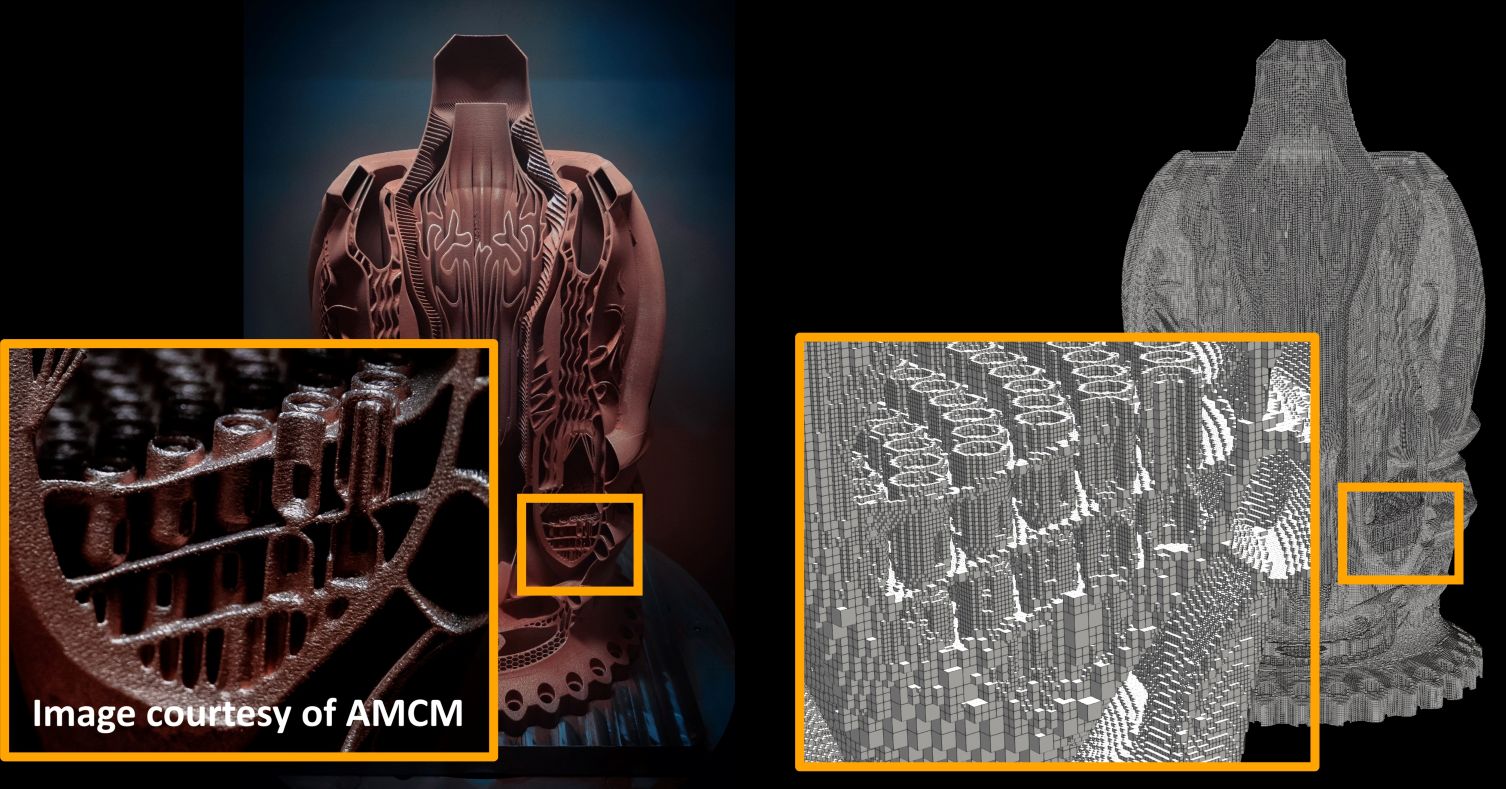
PanX ‘s approach is built around a novel Multi-Grid Modeling methodology which rethinks how FEA meshes are generated and how the thermomechanical problem is solved. “PanX has no such limit and can mesh and solve FEA meshes consisting of hundreds of millions or even billions of nodes,” the team told 3D ADEPT Media.
From predicting problems to resolving them
Much of the industry conversation around AM simulation has focused on distortion prediction, understanding where a part will warp, deform, or deviate from its intended geometry during the build process. This is where tools like Ansys Additive, Simufact Additive, or Amphyon have historically competed, each with different approaches to balancing accuracy, speed, and part complexity.
Our exchange with PanOptimization reveals two ways PanX stands out from the crowd:
- The first is the move from distortion trends to high-accuracy predictions. Most FEA-based AM simulation tools have been reliable for identifying where problems will occur (for example, the direction of warping, the regions at risk of stress concentration) provided the part is not too geometrically complex.
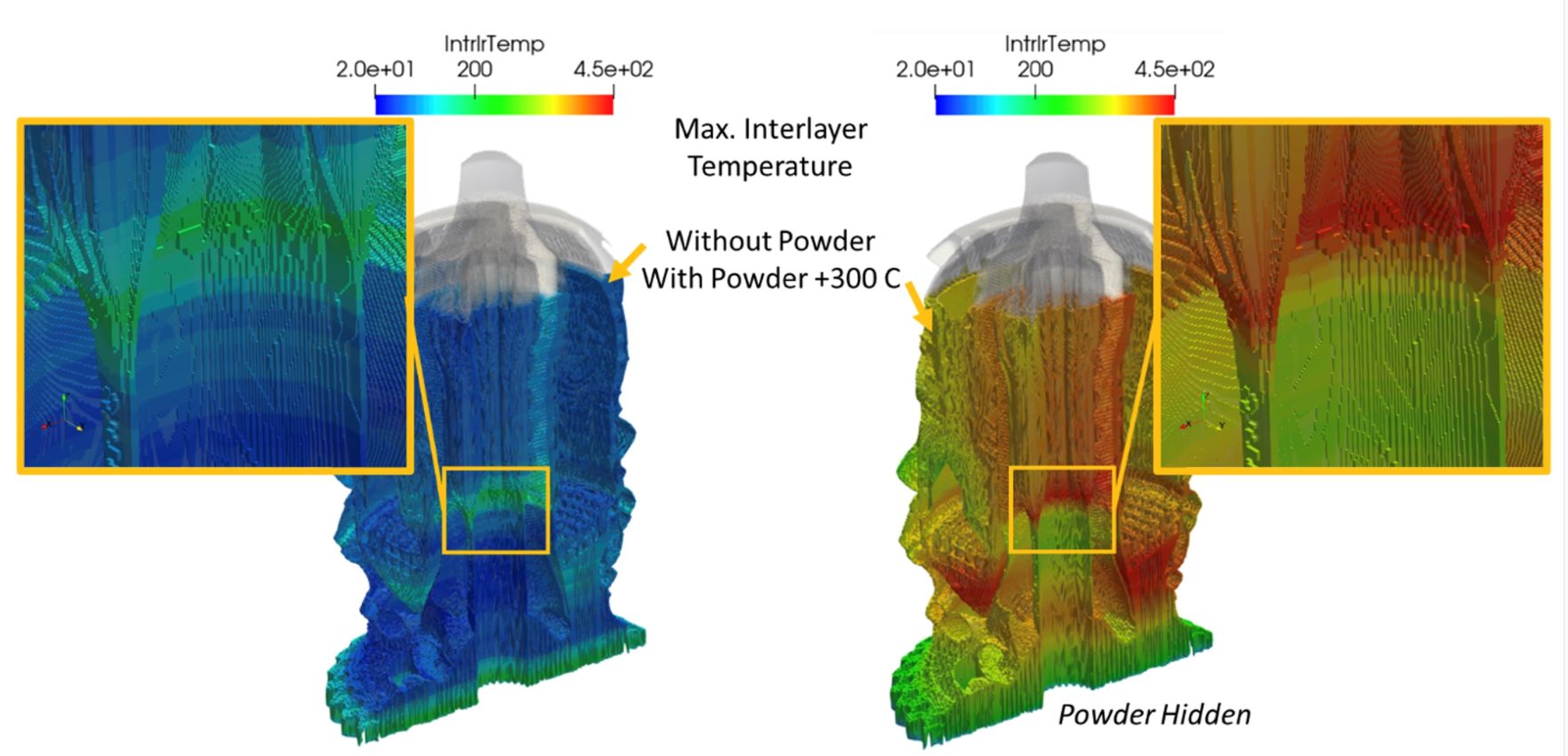
- What they have struggled to deliver consistently is precise magnitude prediction: how much a part will move, how hot it will get locally, what the residual stress distribution actually looks like. PanX claims high-accuracy prediction for distortion, temperature and stress fields, at any scale, within workflows that existing production teams can integrate without specialized simulation expertise.
“These can in turn be used to aid part design, manufacturability, and qualification for parts of any scale and in a way that fits seamlessly into existing production workflows and runs very quickly. We work directly with major machine OEMs to integrate these feed-forward optimizations directly with OEM print processors,” they note.
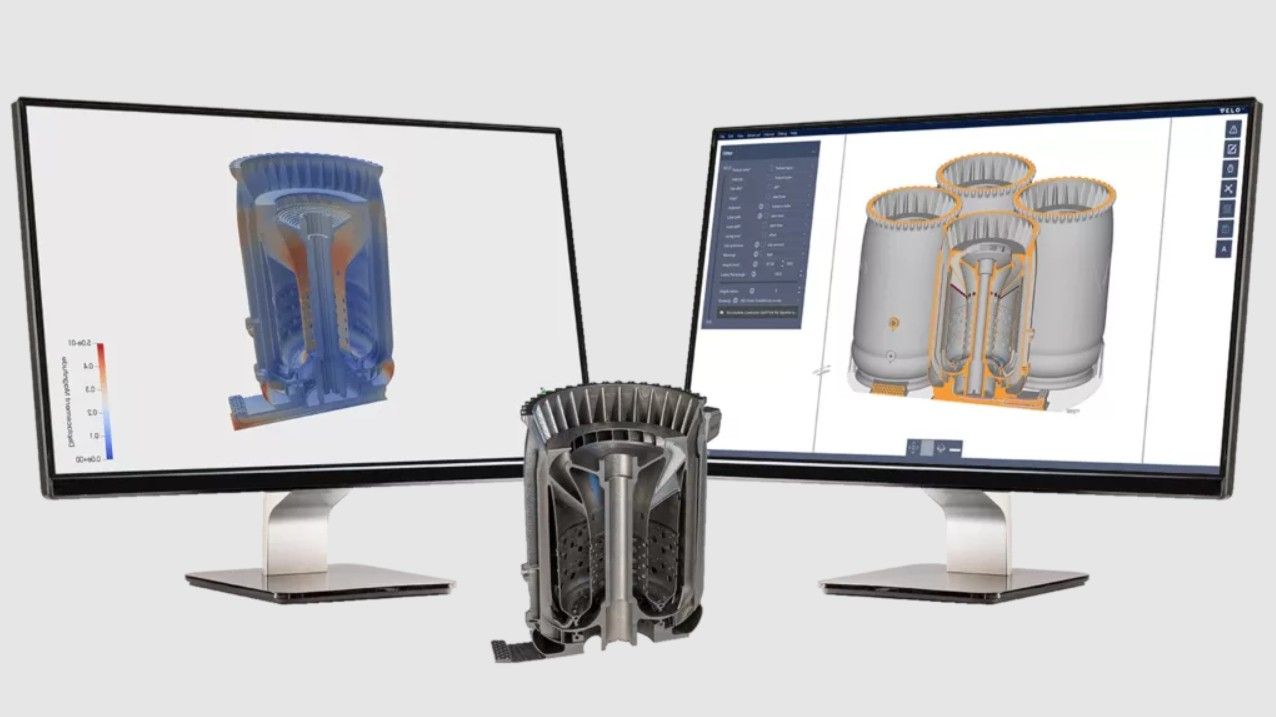
The second transformation is perhaps more significant: moving beyond prediction entirely, toward optimization. PanX can identify that a build will fail and it can adjust dwell times, geometry, and print parameters to prevent the failure from occurring. In the language of the founders, this takes “a lot of the guesswork out of the hands of the user” and represents a considerably broader view of what simulation should do in an AM workflow.
A look at two manufacturing processes the software solution can support
LPBF and Directed Energy Deposition (DED) highlight two processes with genuinely different thermal and mechanical dynamics. Powder bed fusion builds layer by layer in a controlled environment, with relatively constrained part geometries and well-characterized thermal gradients. DED, by contrast, deposits material onto a substrate that can itself be any arbitrary geometry, making the modeling challenge inherently more open-ended.
From a physics standpoint, the underlying governing equations are the same for both. The complexity of DED comes from the expanded degrees of freedom: the deposition geometry, the substrate geometry, and the interaction between them all need to be modeled accurately. According to the founders, PanX appears to be the only platform currently competing meaningfully in the part-scale DED simulation space.
The real competition is not another software vendor
Established names in AM simulation have built significant positions in the market. However, PanX’s competitive argument rests on a combination of superior accuracy, faster solve times, lower hardware requirements (many simulations can run on an engineering laptop), and workflow integration that does not require dedicated simulation analysts to operate.
Complex parts require a different modus operandi. From our understanding, the real competition remains a culture of trial-and-error printing that production teams have normalized, often without realizing it.
PanX’s argument is that one can see the cost of this mindset in supplier quotes, in failed print iterations, in parts that take months to qualify rather than weeks. In the founders’ own words: “The main advantage that we have bet on is our core technology, which really does represent a paradigm shift for the industry.”
*This interview has first been published in the 2026 May/June edition of 3D ADEPT Mag.