Four years ago, when I first met Lin Kayser, then CEO and founder of Hyperganic, he was betting on algorithms and AI to mass-produce parts in digital factories with additive manufacturing at their core. Today, together with Josefine Lissner, his new cofounder and life partner, he has taken that idea further and deeper.
Since 2023, with LEAP 71, they build custom computational models for engineering. Rather than focusing solely on geometry generation, their technology stack encodes engineering knowledge, physics heuristics, and reusable domain logic directly into algorithms capable of designing entire classes of functional machines.
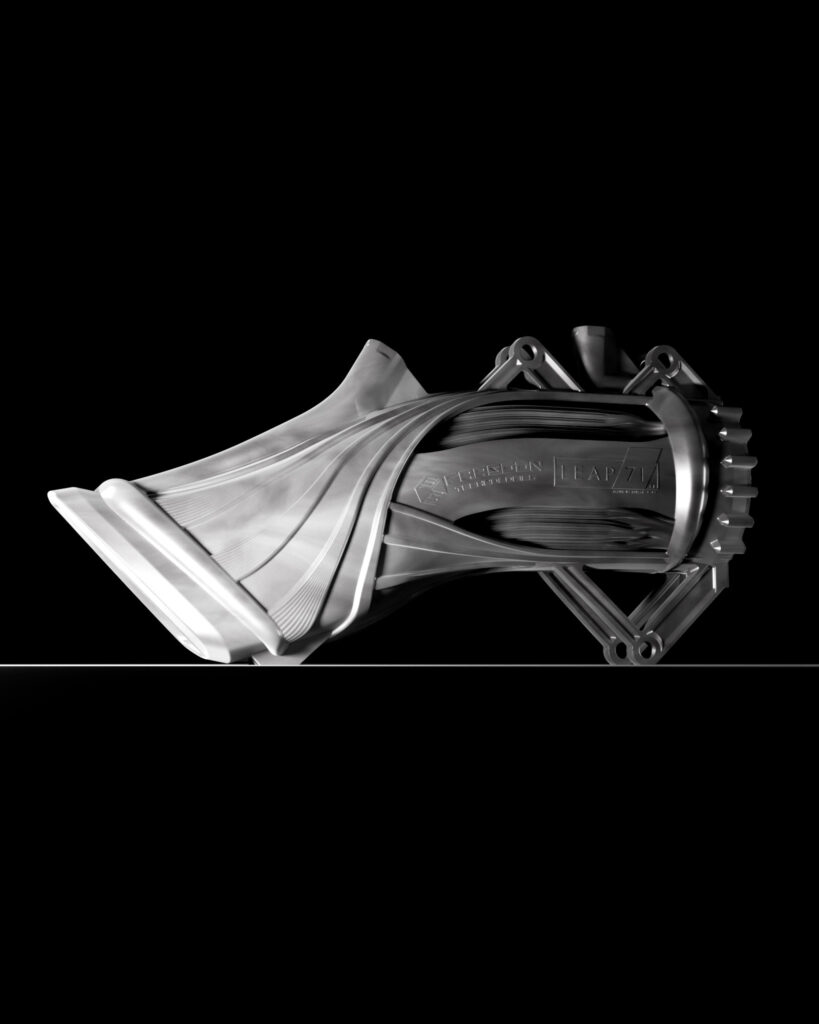
After launching their first geometry engine, PicoGK, LEAP 71 truly made a splash by unveiling Noyron, a large computational engineering model whose capabilities were showcased through some of the most ambitious projects I’ve seen to date, from an audacious rocket engine to a 1.5-metre hypersonic precooler concept.
Noyron embeds physics, engineering logic, manufacturing knowledge, and real-world constraints such as assembly and post-machining. In short, it does what an engineer does, only faster, more consistently, and without fatigue.
Fast forward to February 4th, 2026. I sat down once again with Kayser. Even through a virtual conference call, I could see he was living the dream of many industrial AM enthusiasts: a shelf lined with some of the most complex 3D-printed parts ever produced for aerospace and defense, displayed in his office like a miniature museum.
As I added myself to the (entirely unofficial) waiting list of people hoping to receive one of these marvels someday, I couldn’t help but think that this is what happens when code, curiosity, and engineering ambition collide.
In this Q&A, Kayser shares more about LEAP 71’s “wow” moments, why a code-first approach is particularly well suited to aerospace and defense, how bootstrapping has shaped their journey, and why building all of this in the UAE has been a strategic advantage rather than a constraint.

3D ADEPT Media (3DA): What problem in additive manufacturing and engineering convinced you that a code-first approach was not just useful, but necessary?
Lin Kayser (LEAP 71): The foundational problem is that engineering has not progressed at the same speed as information technology. I’ve been a software person for over 40 years, and when you compare how fast computing evolved versus how slowly physical engineering evolved, the contrast is striking.
We still use cars, airplanes, buildings, and infrastructure that are 40 years old, and we don’t see them as museum pieces. That tells you progress has been incremental. But engineering is the foundation of civilization. Without accelerating engineering itself, we limit how far humanity can go.
So, the core question became: How do we accelerate engineering? When you look for an example of engineering that did accelerate dramatically, you find computing, specifically computer hardware, which is designed using a code-first approach. Applying that same paradigm to the rest of engineering automatically leads to massive acceleration.
3DA: When did you realize computational engineering could scale beyond prototypes into full industrial production?
Lin Kayser (LEAP 71): That realization came when we decided to test our own rocket engines. Initially, LEAP 71 started as an engineering services company. People paid us to do prototypes and experimental designs, but there was always a gap between impressive prototypes and real industrial deployment.
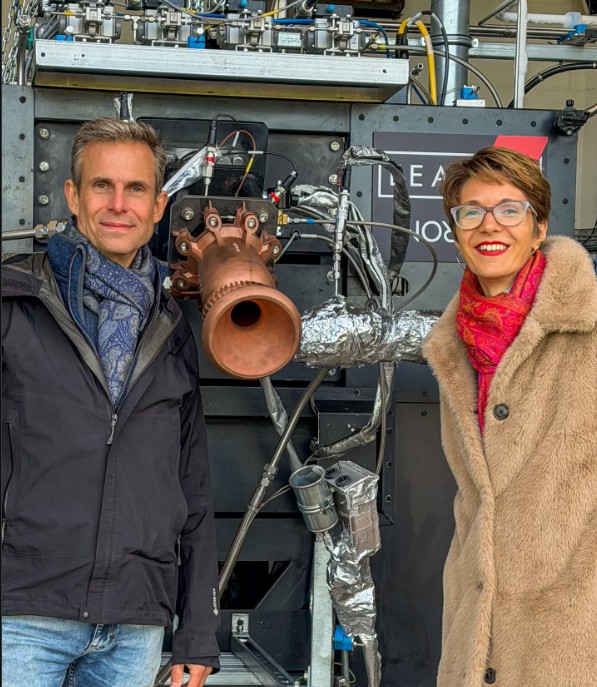
Eighteen months ago, after repeated delays with customers’ test schedules, my co‑founder Josefine decided we would find a commercial test stand ourselves and run our own engine tests. We did that in June 2025, and it performed perfectly.
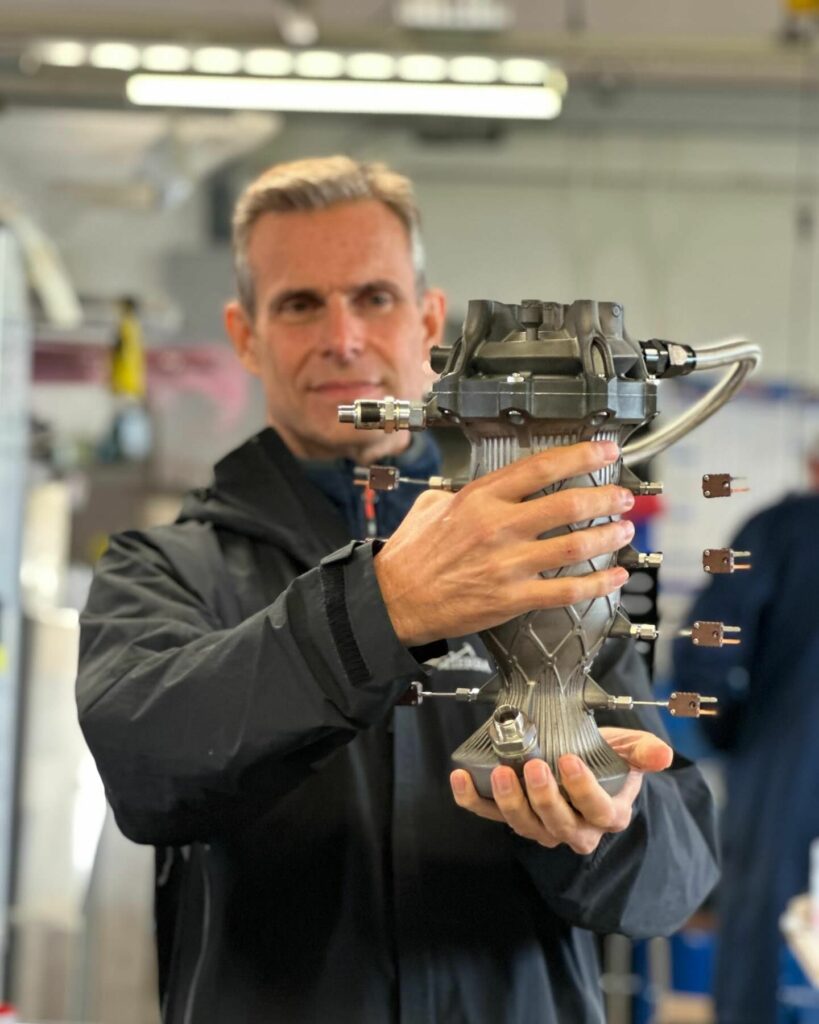
From there, we began testing a completely new rocket engine every four weeks. Each one worked. We eventually test-fired orbital-class rocket engines that were designed in under four weeks. That simply does not happen in traditional engineering. That was the moment it became undeniable: this scales.
3DA: Does Noyron work like ChatGPT or generative AI?
Lin Kayser (LEAP 71): No, this is a very important distinction.
ChatGPT is a statistical model trained on massive datasets. It doesn’t truly understand what it generates, and it’s non-deterministic. Ask the same question twice and you’ll get different answers. That’s unacceptable for engineering.
Noyron is deterministic. It’s built from algorithms, physics, logic, and rules. The same input always produces the same output. If the result is wrong, you debug the system, and the next time it works. You wouldn’t want to fly on an airplane designed by a non-deterministic system.
3DA: Does Noyron replace engineers?
Lin Kayser (LEAP 71): No. Engineers give direction and define intent.
Once Noyron completes its work, no manual redesign is needed. Engineers don’t “fix” the output the way they would with generative AI. Instead, they guide the system and improve the underlying logic if something isn’t right.
This determinism is critical for certification, traceability, and trust, especially in aerospace and defense.
3DA: Aerospace and defense value predictability and traceability. How do they accept designs that look non-human?
Lin Kayser (LEAP 71): Even if designs look alien, they are still governed by human-defined rules.
In fact, computational design is often more traceable and scientific than human design. Humans make implicit assumptions all the time: “Why is this wall 5 mm thick?” “It looked right.” In a computational model, every decision must be justified. Even assumptions are documented. That eliminates tribal knowledge and forces engineering to become truly scientific.
3DA: How do you ensure traceability and reproducibility?
Lin Kayser (LEAP 71): Every part we produce has a unique ID that encodes the model version and the input specifications. If you run the same model with the same parameters, you get the exact same output.
Unlike traditional CAD, where the designer’s intent exists only in their head, our system allows you to step through every line of code and understand exactly why a decision was made. That level of traceability is unprecedented.
3DA: You chose to bootstrap LEAP 71. Was that deliberate?
Lin Kayser (LEAP 71): Yes. Most companies I’ve built were bootstrapped.
I strongly believe companies should make money from their products rather than endlessly raising funding. Hyperganic was originally self-funded and profitable. When COVID hit, we were forced to bring in investors, which, in the end, resulted in too many cooks in the kitchen, and caused the venture to fail.
With LEAP 71, bootstrapping was the natural choice. We’re fundamentally a software company, you can build this with laptops and talent. Our core assumption was: If you build useful things fast, you should be able to make money. That turned out to be true.
3DA: How has being based in the UAE influenced your growth?
Lin Kayser (LEAP 71): The biggest benefit is the absence of bureaucracy.
In Europe, it often feels like the system works against you. Here, people leave you alone to build. There’s very little red tape, a strong sense of momentum, and a focus on creating rather than restricting.
We receive no government support and no investment, just a fertile environment for ideas. That freedom has been invaluable.
3DA: How do you see certification evolving when intent lives in code rather than drawings?
Lin Kayser (LEAP 71): Certification requires documentation, and our systems generate more documentation than traditional engineering ever did.
We track the source code, the specifications, the assumptions, the performance predictions, and the drawings. Everything is current and reproducible. You can rerun the model and get the same result every time. In many ways, this makes certification easier, because nothing is implicit and nothing erodes over time.
3DA: Any final thoughts you’d like to share?
Lin Kayser (LEAP 71): This is the best idea we’ve ever had, but ideas alone don’t matter. What matters is that we now see, every day, how fast this paradigm is.
My hope is that more people will adopt computational engineering. Just as we can’t imagine designing without computers today, soon we won’t understand how people manually drew CAD models for hours and redid everything when a change was needed.
We’re simply automating a slow, repetitive process, and by doing that, we unlock faster technological progress. And when technology advances faster, people gain more time to be human.
*All images: Courtesy of LEAP 71. Kayser’s words have been edited for brevity and clarity. This Q&A has first been published in the January/February edition of 3D ADEPT Mag.