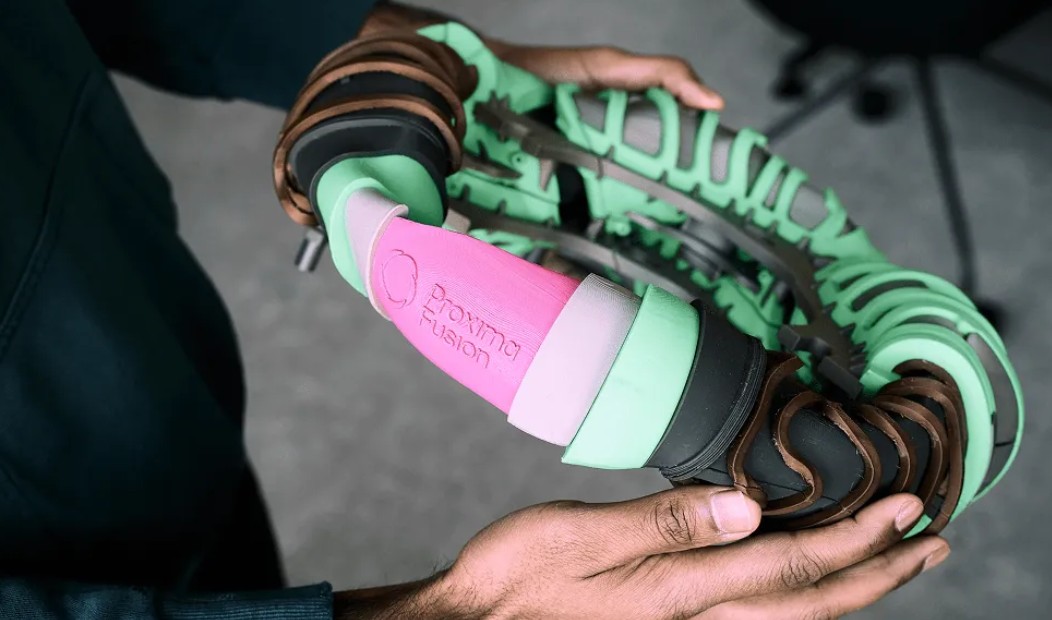
Proxima Fusion is developing a stellarator that aims to produce more energy than it consumes. The device would use a twisting, complex arrangement of external magnetic coils to trap superheated plasma. Imagine it like a tightly woven, twisted racetrack.
Before producing the final stellarator, Proxima Fusion will first develop a demonstrator, called Alpha, targeted for construction in 2027 and operation in 2031.
Described as the critical bridge between decades of fusion research and commercial deployment, the Alpha project is led by Proxima in partnership with the state of Bavaria, the Max Planck Institute for Plasma Physics and RWE.
The project will validate key technologies and accelerate the development of the world’s first fusion power plant later that decade.
To achieve all of this, the company just secured a €411 million ($468 million) financing round, bringing its valuation to €2.4 billion ($2.7 billion) and establishing itself as the best-funded fusion company in Europe.
Who is backing Proxima Fusion?
The round was led by XTX Ventures and East X Ventures, with RWE and Google as strategic investors
KfW Capital, SPRIND and Burda Principal Investments joined the round alongside returning investors including Plural, UVC Partners, Balderton, Cherry Ventures, DST Global Partners, Brevan Howard Macro Venture, Lightspeed, DTCF, redalpine, Leitmotif, Elaia, CDP Venture Capital, Bayern Kapital, and the EIC Fund.
German energy company RWE became an investor just months after signing an agreement with Proxima to partner on building the first stellarator fusion power plant on the site of a former nuclear fission power plant in Gundremmingen, Bavaria.
“Europe is racing with the United States and China to get to the first fusion power plant. Proxima’s financing demonstrates that Europe can not only invent breakthrough technologies, but also build globally competitive companies around them. Investors recognise both the urgency and the opportunity of what we’re doing and are backing us to develop a generational energy technology company,” said Dr. Francesco Sciortino, Co-Founder and CEO of Proxima Fusion.
In less than three years, Proxima has secured more than €650 million ($740 million), including €95 million in public grants. Just three months after signing its Memorandum of Understanding with the Free State of Bavaria, RWE and the Max Planck Institute for Plasma Physics, Proxima completed this €411 million financing round. The round exceeded its target of matching Bavaria’s commitment for €400 million public funding contribution to the company’s roadmap, illustrating how targeted public investment can catalyse private capital at scale, a press release reads.
How is AM going to be used?
Additive manufacturing is one of the core technologies behind Proxima’s stellarator, alongside high-temperature superconducting (HTS) magnets and machine-learning-driven design. Its quasi-isodynamic (QI) architecture needs external coils and supports shaped into complex, non-planar geometries that conventional machining struggles to produce accurately.
Proxima runs that geometry work through StarFinder, its own cloud-based design platform, then moves from simulation straight into 3D printing to prototype the shapes fast. That same approach feeds into Stellaris, Proxima’s commercial power plant concept, where 3D printing is applied to the coil and support geometries the design requires.
*We curate insights that matter to help you grow in your AM journey. Receive them once a week, straight to your inbox. Subscribe to our weekly newsletter