

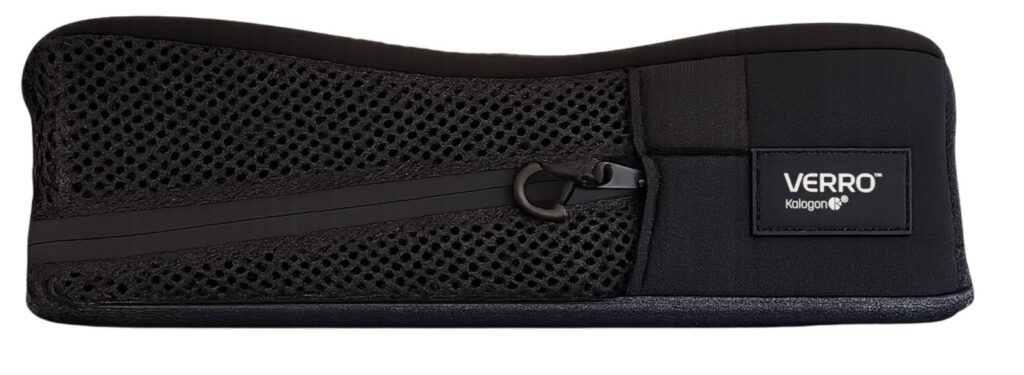
When LCS unveiled its 3D printed wheelchair cushion in early 2025, the open question was whether a lattice seat with an integrated ventilation system could become a product rather than a prototype.
Short answer: It has. The WheelAir Custom Cushion is now sold through LCS’s dealer network across Ireland, the UK and Europe, printed at the company’s local hub.
In the US today, Kalogon, a provider of inventive seating solutions that eliminate the stresses of sitting, has brought Verro, a wheelchair cushion to the market.
The Medicare-coded custom wheelchair cushion line for people with significant postural support needs is available in two constructions: Verro Lattice, a 3D printed variable-density lattice, and Verro Foam, a dual-density foam alternative.
“We kept hearing from clinicians that their most complex patients were falling through the cracks, so we developed a technology that lets us 3D print the cushion with precise, localized control over where the body gets support and where it gets relief,” said Tim Balz, CEO and founder of Kalogon.
How it differs from LCS’s wheelchair cushion
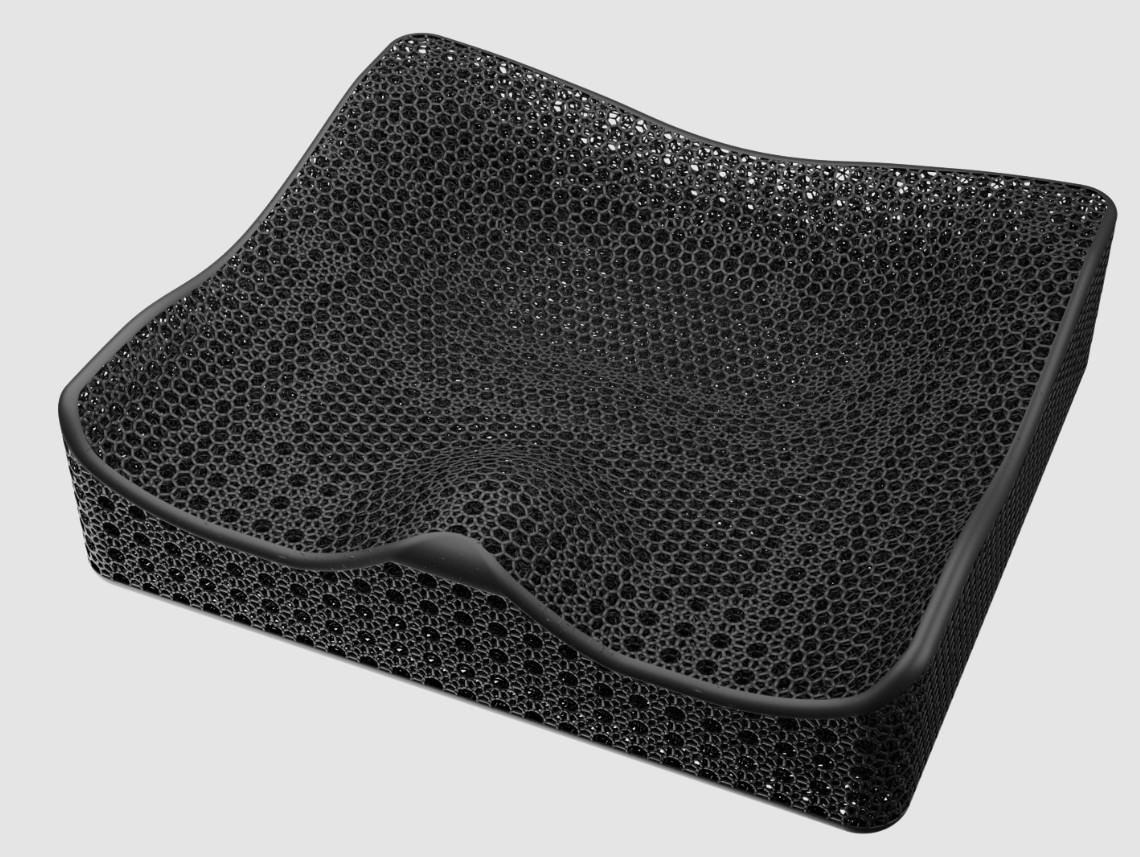
With a lattice whose patent is pending, Verro Lattice is printed from a lightweight elastomer and relies on passive ventilation — the open lattice lets air move through the cushion, the material is hydrophobic, so liquids pass rather than pool.
Kalogon claims the cushion is up to two pounds lighter than the market average. Firmness is not zoned in discrete steps but graded continuously, including along the sides.
LCS’s cushion, on the other hand, is a Programmable Foam structure paired with WheelAir. The latter is an active, fan-driven airflow system that pushes air through the lattice to manage temperature and moisture. Its customization logic is zonal: five selectable softness levels across multiple zones, printed as a single piece.
From a commercialization standpoint, Verro carries the E2609 Medicare code, is ordered by clinicians through Kalogon’s Launch Pad configurator, either from a 3D scan of a physical mould or from entered measurements.
It is thereafter shipped within 14 days, manufactured in-house in Melbourne, Florida.
Verro is already available. Clinicians and seating specialists can order it now by contacting Kalogon directly.
Images: Courtesy of Kalogon.
THE 3D ADEPT WEEKLY NEWSLETTER
The industry moves fast. Stay ahead.
Every week, the latest additive manufacturing news, in-depth features and real-world applications, straight to your inbox. Plus, be the first to know when a new issue of 3D ADEPT Mag is out.
Free · One email a week · Unsubscribe anytime
Clicking loads our email provider’s sign-up form, including its analytics and Google’s anti-bot protection. You’re only subscribed if you complete the sign-up. Read our privacy policy.