

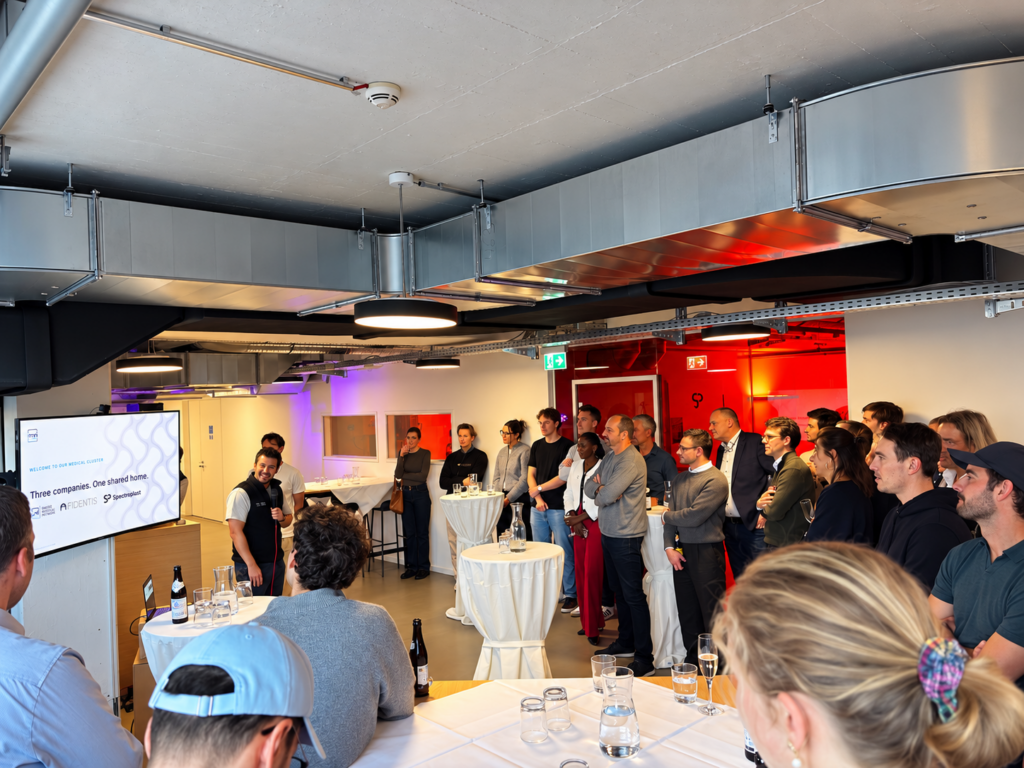
Following their launch in September, Munich Medical Devices joins forces with Spectroplast and FIDENTIS to open a shared Additive Manufacturing Hub at Flössergasse 2 in Munich.
By sharing production, lab and office space, the three companies aim to make Munich a leading location for additive manufacturing in medical technology. Around 80 guests among which researchers, physicians, investors and users of their technologies attended the opening on October 22.
How different expertises converge
Munich Medical Devices, Spectroplast and FIDENTIS, each covers a different material family and a different application:
- MMD prints porous, bioactive PEEK implants that are metal-free and radiolucent, so surgeons can follow bone healing on imaging. Patient-specific and series devices come from the same platform.
- Spectroplast prints medical-grade silicone with its own TrueSil materials, producing soft, skin-friendly parts that until now could only be molded.
- FIDENTIS, a spin-off of Fraunhofer IGCV, prints several metal alloys in a single part. It starts with dentistry, supplying dental labs with customized semi-finished components for removable prostheses.
Rigid polymer, soft elastomer, multi-material metal: together, they give clinicians and OEMs access to a broader range of materials and processes than any of them could offer alone.
“When we were looking for new premises, the question was: why do this alone? We work with different materials, but we face the same challenges, from quality systems and approvals to finding the right customers,” says Leonhardt, who brought the three companies together.
As observed over the years, what slows adoption in the medical and healthcare industries is often quality management systems, regulatory approvals, and documentation. Not to mention that from a technology provider standpoint, the search for the first customers willing to adopt a new device consumes time and money. For young companies, that overhead weighs disproportionately.
Pooling infrastructure and experience is a pragmatic answer. “In practice, that means we solve regulatory questions together, learn from each other’s go-to-market experience and share best practices, so good ideas reach patients faster,” explains Maximilian Eils, CEO of Spectroplast.
That said, each device will still follow its own regulatory pathway, and the announcement does not detail which resources are actually pooled. The hub’s value will be measured over time, in the joint projects it generates and in whether its members can indeed shorten the path from idea to approved product.
An open door
The founders seem aware that the opening is only a first step. “By regularly inviting customers, clinics and universities into the hub, we want to drive the innovation our industry needs,” says Dr.-Ing. Max Horn, co-founder and managing director of FIDENTIS.
The hub is open to further partners, research projects and customers who want to develop and manufacture 3D printed medical products in the region. With its universities, research institutes and med-tech industry, Munich offers fertile ground.
Elsewhere in Europe, medical additive manufacturing startups face the same hurdles, often in isolation. Hopefully, this model MMD is launching in Munich will pave the way for similar concepts in the next couple of years.
THE 3D ADEPT WEEKLY NEWSLETTER Every week, the latest additive manufacturing news, in-depth features and real-world applications, straight to your inbox. Plus, be the first to know when a new issue of 3D ADEPT Mag is out. Free · One email a week · Unsubscribe anytime Clicking loads our email provider’s sign-up form, including its analytics and Google’s anti-bot protection. You’re only subscribed if you complete the sign-up. Read our privacy policy.The industry moves fast. Stay ahead.