Compact SLS for teams that need color, aesthetics, or material diversity
SLS machine manufacturer Sinterit has announced BIANCO2, its latest compact SLS 3D printer and arguably its most strategically distinct one to date. Where previous generations of the Poland-based company’s machines were built around speed, accessibility, and PA12 optimization, BIANCO2 sets its sights on material limitation.
Powered by a CO₂ laser source, BIANCO2 is designed to process traditional technical powders and white, natural, and colorable materials. The machine targets a wide range of applications, from functional engineering parts and short-run production to aesthetic prototypes, medical components, and flexible applications, all within a single platform.
A clear move beyond the Lisa lineage
To understand what BIANCO2 represents, it helps to trace Sinterit’s hardware trajectory. The company officially launched the Lisa at the Euromold trade fair in 2015, making it one of the first affordable desktop SLS systems on the market. Sinterit followed the Lisa platform with the Lisa Pro in 2018, then the Lisa X three years later.
The timing reveals a consistent cadence of one major platform every three years, with lower costs and higher performance.
BIANCO2 comes just over a year after Suzy but it would be a mistake to read that as an acceleration. The two machines answer fundamentally different questions. Suzy was built to serve the roughly 80% of SLS users who rely on PA12 and need parts fast, offering a 35% increase in print speed and a 20% cost reduction over the Lisa X. BIANCO2, by contrast, is not trying to go faster or cheaper. It is trying to go broader.
What’s technically new
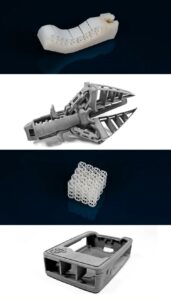
The key differentiator is the CO₂ laser architecture. Most compact SLS systems, including Sinterit’s own Lisa family, rely on diode lasers optimized for black and grey polyamide powders. White and natural powders absorb laser energy differently, which is why they have long been the domain of larger, more expensive SLS platforms. BIANCO2’s RF CO₂ laser source, rated at 30W and with a lifespan exceeding 20,000 hours, enables the system to handle this broader spectrum of materials within a compact footprint.
The build volume stands at 130 x 180 x 330 mm for PA-based materials, with a layer height range of 0.075 to 0.125 mm and build speeds of 15 to 30 mm/h. The machine’s overall dimensions (650 x 594 x 1330 mm at 150 kg) keep it firmly in the compact, office-adjacent category despite its expanded material ambitions.
For users who want deeper process control, BIANCO2 supports Full Open Parameters through Sinterit Studio Ultimate, giving access to 137 adjustable printing parameters. This positions it as a genuine R&D and material development platform, not just a production tool.
Commercial availability
The preorder price sits at EUR 39,950 (with a 15% preorder discount bringing it to approximately EUR 39,950 for the first 30 orders), with first deliveries expected from Q4 2026.
The BIANCO2 launch also reflects a broader maturation in how Sinterit is thinking about its portfolio. Rather than iterating a single platform, the company is now running parallel tracks: Suzy for speed and PA12 productivity, Lisa X for research and multi-material settings, and now BIANCO2 for aesthetic and material diversity. µ
Sinterit had previously explored the mid-tier market with the NILS 480 in 2021, but the company since pivoted away from that segment, with its sales director noting that the mid- and large-size SLS market is overcrowded with slim margins. BIANCO2 stays true to that focus on compact systems.
Whether the market is ready to pay a premium for that expansion is something first deliveries will tell.
*We curate insights that matter to help you grow in your AM journey. Receive them once a week, straight to your inbox. Subscribe to our weekly newsletter.