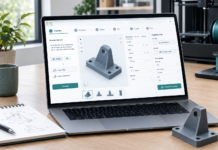
Xometry has upgraded its AI model architecture with a new generation of high-capacity, interconnected models that span the entire manufacturing journey.
This upgrade follows the recent integration of the company’s manufacturing intelligence, directly into Siemens Xcelerator.
The new AI models leverage Xometry’s proprietary data insights across five critical dimensions: geometry, manufacturability, pricing, supplier capability, and production outcomes. The smarter the platform gets, the faster Xometry can turn complex engineering inputs into manufacturing decisions.
What happens when a user uploads their model?
The company explains that the new version of the context-aware AI process recommender understands a part’s industry application – recognizing, for example, that an aerospace component likely calls for tighter tolerances and flight-grade alloys – along with its probable material and geometry, closing the gap for first-time customers who have no order history for the model to draw on.
Buyers get a manufacturing recommendation when they upload a part, providing them with the optimal process from among 20 supported manufacturing techniques.
Read more: Growth with MaaS: Xometry champions the best of both AM and conventional manufacturing processes
Early feedback reveals that the AI recommendation is accepted by buyers more than 85% of the time – a marked improvement over the prior model, with the biggest gains among first-time customers.
Pricing based on the specific parameters required to manufacture it
Pricing custom jobs using Xometry’s platform now depends on the specific parameters required to manufacture each part.
According to Xometry, the models consider a greater breadth and depth of inputs, including geometry, material, finish, and whether the part is a standalone part or one of several in a job. This granular input leads to more accurate pricing.
This improvement comes along with a new adaptive sourcing approach. The new adaptive sourcing models leverage Xometry’s proprietary supplier data layer to price each job dynamically, moving quickly on well-understood jobs, the company says.
The new models also incorporate an upgraded job-partner suitability that scores every job against a supplier partner’s machine characteristics – including dimensions of the machine and sub-process capabilities – in addition to quality history and on-time shipping record.
This has significantly improved partner-matching. Rather than navigating a noisy board of broad job notifications, partners are presented with a curated flow of better-fitting opportunities. This combination of deep capability matching and responsive pricing leads to a stronger network overall.
“Across the millions of parts quoted through Xometry, our AI is constantly learning. Our new models move beyond treating that knowledge as separate skills, where one model recommends how to build something, another prices it, another finds who should build it. Now, they are an intelligence layer that gets sharper every time a part moves through it. That’s what makes Xometry the digital infrastructure for custom manufacturing,” said Vaidy Raghavan, Chief Technology Officer at Xometry. “The data layers are what’s actually deciding how a part gets made, what it costs, and who builds it. And the smarter that data gets, the more directly our customers feel it – more optimal recommendations, accurate pricing, better-fit suppliers – every time they upload a part.”
*We curate insights that matter to help you grow in your AM journey. Receive them once a week, straight to your inbox. Subscribe to our weekly newsletter