

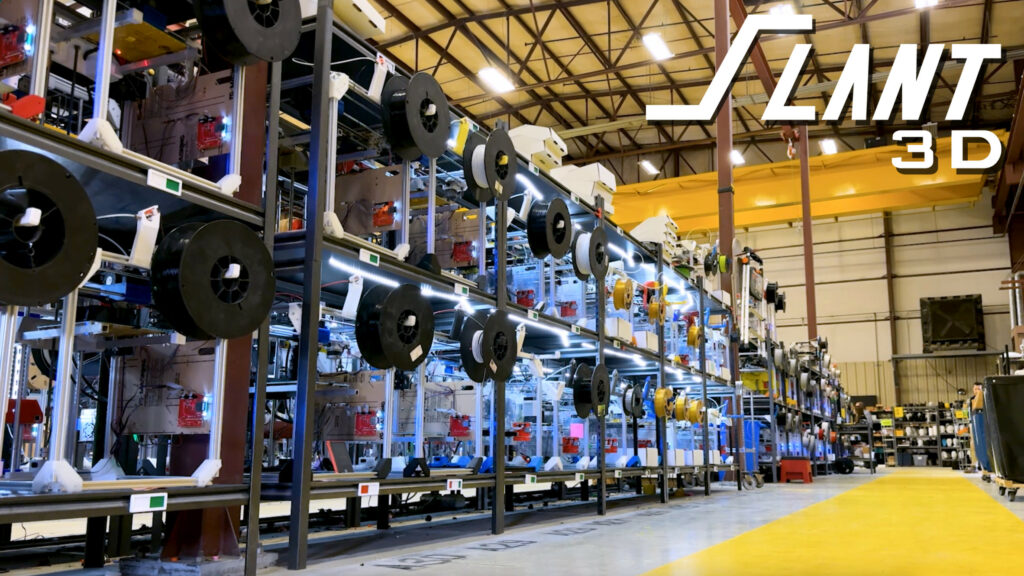
Last week, Slant 3D published a blog on how it built what it describes as the largest commercial print farm in the United States: a multi-thousand machine factory in Boise, Idaho, housed in a building that once turned out locomotives.
The company reports around 80% of parts shipping in under two business days during normal season. In 2026, Slant 3D says efficiency gains allowed it to cut print-on-demand prices by nearly 40% in some cases.
The company started in 2019 with machines bought on Amazon, then designed its own. Production is now powered by a control system called Kraken, which analyzes an incoming file, selects the print settings, slices it and chooses which machine should run it. Optimized for shipping speed, the company explains that a first-time order is routed to a printer physically closer to post-processing.
A print farm, the company says, is “a warehouse where the shelves make the product.”
That said, despite their differences, one common thread we can already see with OECHSLER’s fleet strategy is that both have concluded that at volume, what happens after the printing matters most. In Slant 3D’s factory, parts are scanned into tracked boxes, inspected by both humans and AI, and even a 200 mm component can be rejected for a blemish as small as 1 mm.
Slant 3D is stripping away every barrier to entry using an API, then ready-made storefronts, then AI design tools so that, in the company’s words, your grandmother could order a replacement dishwasher part.
However, they disagree entirely on what to do about it: one narrowing and qualifying, the other opening access to everyone.
So which strategy actually holds up? Does openness at that scale eventually meet a wall that qualification was built to handle? And at what volume, or what requirement, does a part have to leave one model for the other?
We will challenge both Andreas Knoechel, Head of Program Management at OECHSLER, and Gabe Bentz, CEO of Slant 3D, on these questions tomorrow, Wednesday, October 28th.
THE 3D ADEPT WEEKLY NEWSLETTER
The industry moves fast. Stay ahead.
Every week, the latest additive manufacturing news, in-depth features and real-world applications, straight to your inbox. Plus, be the first to know when a new issue of 3D ADEPT Mag is out.
Free · One email a week · Unsubscribe anytime
Clicking loads our email provider’s sign-up form, including its analytics and Google’s anti-bot protection. You’re only subscribed if you complete the sign-up. Read our privacy policy.