

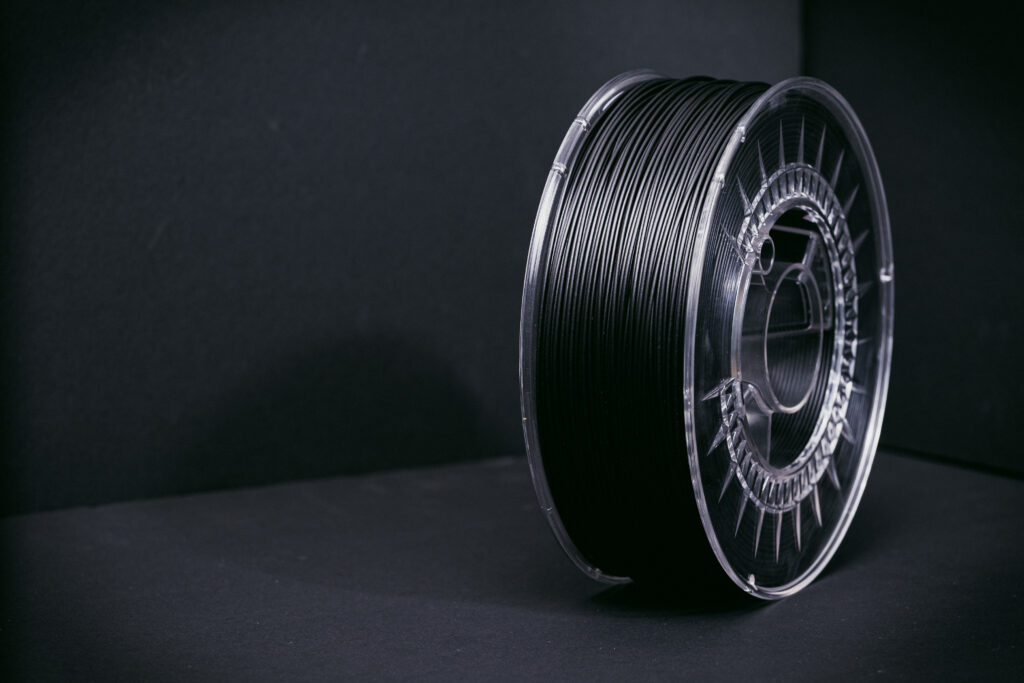
German material producer GRAFE introduces three standard black variants for two of the most used 3D printing materials: PLA & PETG. These customer-specific colourings are part of the Schwarz portfolio.
In addition to the classic PLA variant, an additional option is offered that meets the strict requirements with FDA approval for food contact. Established processes and a universal formulation, which does not require any customisation, enable cost-efficient production and rapid provision of standard batches. This gives GRAFE a particularly competitive and attractive offer.

“Our aim is to meet customer requirements even faster and to cover a wide range of customer requirements with the predefined range,” says Lars Schulze, Head of Colour Development and Material Sciences. “Our years of project work have shown that we not only need high-performance materials and excellent colour settings, but also fast and cost-efficient solutions,” the specialist continues.
PETG properties and applications
Polyethylene terephthalate glycol (PETG) combines stability with flexibility and is extremely resistant to mechanical stress and moisture. The material also offers high impact strength, temperature and weather resistance and low shrinkage. These properties make PETG ideal for the production of robust components, prototypes and end products. It is also ideal for technical applications, housings and functional components that require high durability. Engineers, designers and private users favour PETG for its excellent printability and strong layer adhesion. It also suits a wide range of industrial applications.
PLA properties and applications
Polylactide (PLA) is a bio-based plastic material made from renewable raw materials such as corn starch or sugar cane. It offers low moisture absorption and simplified storage. PLA also has good mechanical properties, such as high surface hardness, rigidity and high tensile strength. Due to its environmental friendliness and ease of processing for industrial and private applications, PLA is a versatile material that is ideal for modelling, product design and decorative items.
“In contrast to classic UN substrates, we also want to give our customers who demand the highest quality the option of selecting a substrate that matches the print material. This eliminates compromises in terms of layer adhesion, warping, or flow properties. We also offer our customers this service for our standard colour range,” says Schulze.
Stay connected by following us on Facebook, Twitter, LinkedIn & Instagram, and subscribe to our weekly newsletter for the latest updates. Have a story to share or want to be featured in our next digital magazine issue? Send it to editor@3dadept.com !
THE 3D ADEPT WEEKLY NEWSLETTER
The industry moves fast. Stay ahead.
Every week, the latest additive manufacturing news, in-depth features and real-world applications, straight to your inbox. Plus, be the first to know when a new issue of 3D ADEPT Mag is out.
Free · One email a week · Unsubscribe anytime
Clicking loads our email provider’s sign-up form, including its analytics and Google’s anti-bot protection. You’re only subscribed if you complete the sign-up. Read our privacy policy.