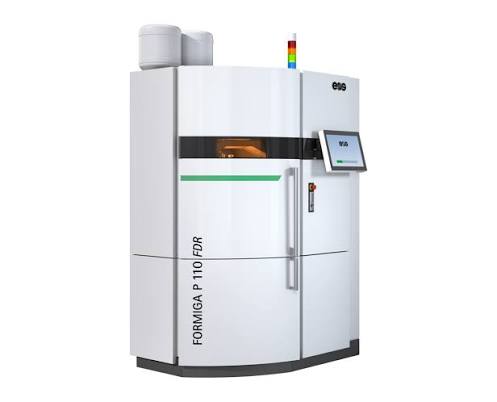
EOS’s decision to phase out FORMIGA marks a significant inflection point for selective laser sintering, but it’s not necessarily the death knell for the technology.
Industrial 3D printing leader EOS will retire its FORMIGA portfolio. The announcement was shared exclusively with users of this SLS 3D printer, which was thereafter relayed on LinkedIn by Lucas van Beers, an SLS expert at Inframotion.
“We recognize the reliability of the FORMIGA platform and the important role it continues to play in your production environment. While EOS will no longer offer FORMIGA systems for new sales, we remain committed to supporting your installed base, protecting your investment, and helping you continue your additive manufacturing journey with confidence for years to come,” EOS’s note reads.
Over the years, the FORMIGA platform has become an iconic selective laser sintering (SLS) system with higher integrated automation and data-driven process support. For many in the additive manufacturing community, the discontinuation of this platform that has shaped the learning curve of SLS enthusiasts for two decades triggered a question: Is this the end of an era for SLS?
The truth is, the current market might tempt us to confirm it’s a decline…As the SLS ecosystem has thinned over the past decade. Sintratec, the Swiss pioneer of desktop SLS, ceased operations in May 2024 due to bankruptcy, other players remain active with a smaller footprint. I am thinking here of Sharebot in Italy with reduced visibility in the market, Sinterit in Poland, Prodways (France) and 3D Systems which have maintained an SLS portfolio over the years.
On LinkedIn this week, the debate crystallized around two dominant narratives: Some argue that Formlabs’ Fuse series will inherit FORMIGA’s customer base and momentum, while others counter that HP’s 12Fast system is simply too fast, too efficient, and too entrenched in high-volume production to face serious competition.
Our take? Yes, Formlabs and HP dominate headlines and market share calculations. But other players remain in the space, and several are positioned to maintain relevance through differentiation, niche market focus, or integration strategies rather than pure speed or scale. Sinterit is a good example to mention here with its latest 3D printer that is built around material freedom.
From what I see, sustainability-focused manufacturers, mid-market producers, and specialized application developers are still actively choosing and championing alternatives. Some are leveraging older FORMIGA platforms (which continue to perform reliably) while others are exploring emerging technologies that sit between SLS and resin-based systems, or integrating SLS into hybrid production workflows.
As I often say, what would give credibility to these alternatives is the applications that will result/ At least, that’s the only think I am eager to monitor.
As for EOS, it is clear that the company is now betting on larger, more integrated systems that can support data pipelines, process automation, and Industry 4.0 workflows.
This adaptation reflects the current need to meet the production requirements of many AM users across vertical industries.
*We curate insights that matter to help you grow in your AM journey. Receive them once a week, straight to your inbox. Subscribe to our weekly newsletter.