

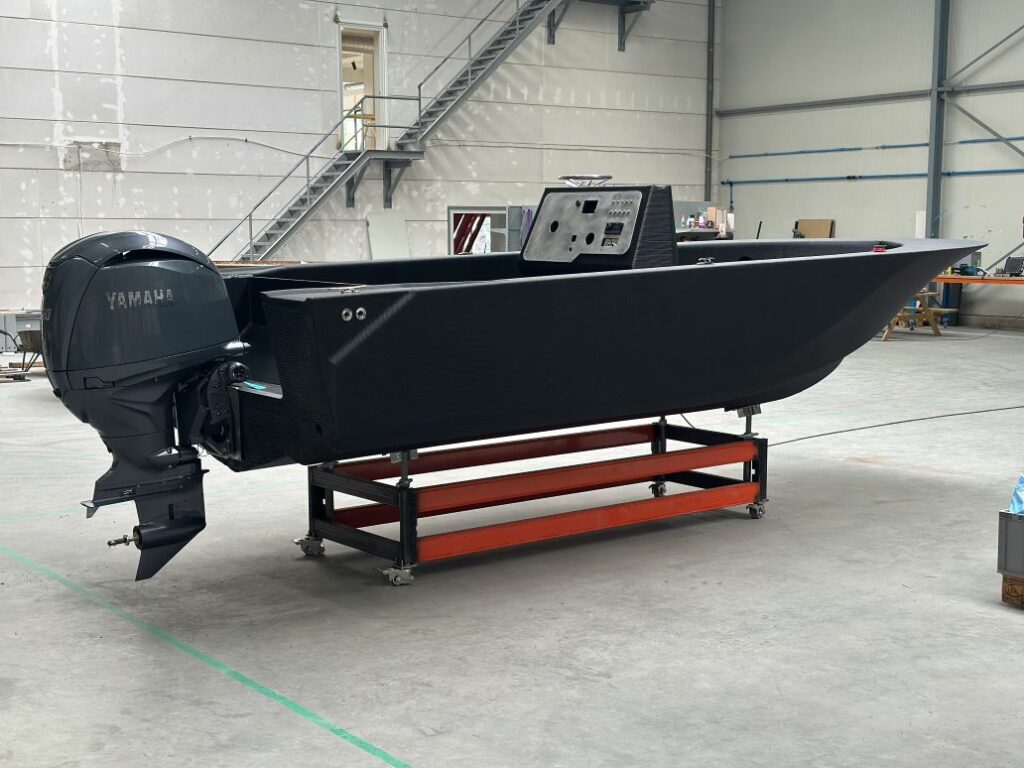
CEAD, an expert in large-scale AM, is transforming a 2300 m2 space into the boat factory of the future. This is happening in Delft, the Netherlands, next to its HQ.

Named Maritime Application Center (MAC), this boat factory of the future will focus on accelerating the adoption of automated, large-scale AM in the field. For the manufacturer, this means:
- Provide production capacity supporting shipbuilders and maritime manufacturers who are not yet ready to adopt large-scale 3D printing in-house
- Accelerate application development through close collaboration with industry partners and existing CEAD customers. The team currently targets boats up to 12 meters in length, intended for industrial or defense applications, such as workboats, for example: patrol boats, fishing boats, supply boats, etc., and unmanned surface vessels (USVs). They are engaged in hands-on experimentation, exploring every aspect of the application. One example worth mentioning here is the full-scale fishing boat 3D printed using the material CEAD®HDPro, completed in just 88 hours of printing time.
The MAC will showcase how two to three operators could produce over a hundred boats per year, depending on the specific factory configuration.
The company is currently scaling production capacity to manufacture at least 100 boats per year, to supply the market and to actively demonstrate technical feasibility, efficiency, and profitability of this factory model.

How does shipbuilding look today?
Shipbuilding today requires the combined efforts of an entire shipyard ecosystem, relying heavily on skilled labor, large-scale infrastructure, and complicated, interconnected value streams.
Recent growth in demand is straining shipyards already facing a surge in employee retirements, aging infrastructure, and day-to-day operational inefficiencies, making it difficult to scale or adapt quickly to market demands. There is also an increasing demand to lower the maritime industry’s impact on greenhouse gas emissions, as targets set by the International Maritime Organization (IMO) require organizations to transition towards more sustainable manufacturing approaches.
These conditions provide an opportunity for large-scale AM to demonstrate its potential.
While the MAC is specifically designed for the maritime industry, other microfactories have already been realized, such as the recently launched Haddy facility in Florida, focused on localized, sustainable furniture production.
Looking for a job in the AM industry or hiring new talent? You can post job opportunities on 3D ADEPT Media for free or explore openings via our job board. Stay connected by following us on Facebook, Twitter, LinkedIn & Instagram, and subscribe to our weekly newsletter for the latest updates. Have a story to share or want to be featured in our next digital magazine issue? Send it to editor@3dadept.com !
THE 3D ADEPT WEEKLY NEWSLETTER
The industry moves fast. Stay ahead.
Every week, the latest additive manufacturing news, in-depth features and real-world applications, straight to your inbox. Plus, be the first to know when a new issue of 3D ADEPT Mag is out.
Free · One email a week · Unsubscribe anytime
Clicking loads our email provider’s sign-up form, including its analytics and Google’s anti-bot protection. You’re only subscribed if you complete the sign-up. Read our privacy policy.