It takes a single trip to Dubai to understand why the city holds a “UNESCO Creative City of Design” recognition. With its creative industries now reported as an economic sector, it’s obvious to us to pay a closer look at this region in this special edition of 3D ADEPT Mag.
So far, our coverage reveals a stream of applications coming out of the region: Façades, sculptures, pavilions, or even record-breaking interiors all made possible thanks to additive manufacturing (AM). What we have covered far less is the companies behind them.
Proto21 is one of those companies. If we have learned with Lin Kayser that building in the UAE is a strategic advantage, the 3D printing service bureau headquartered in Dubai exports its services to more than 30 countries. It has been operational in Germany for a year now through its partnership with Joseph Westiform GmbH.
We sat down with founder and CEO Pir Arkam to learn more about the company’s unique approach to AM in the creative industries.
“Dubai-it”
Holder of a master’s degree in Mechatronics, Arkam started Proto21 with a single 3D printer and a hundred thousand dollars.
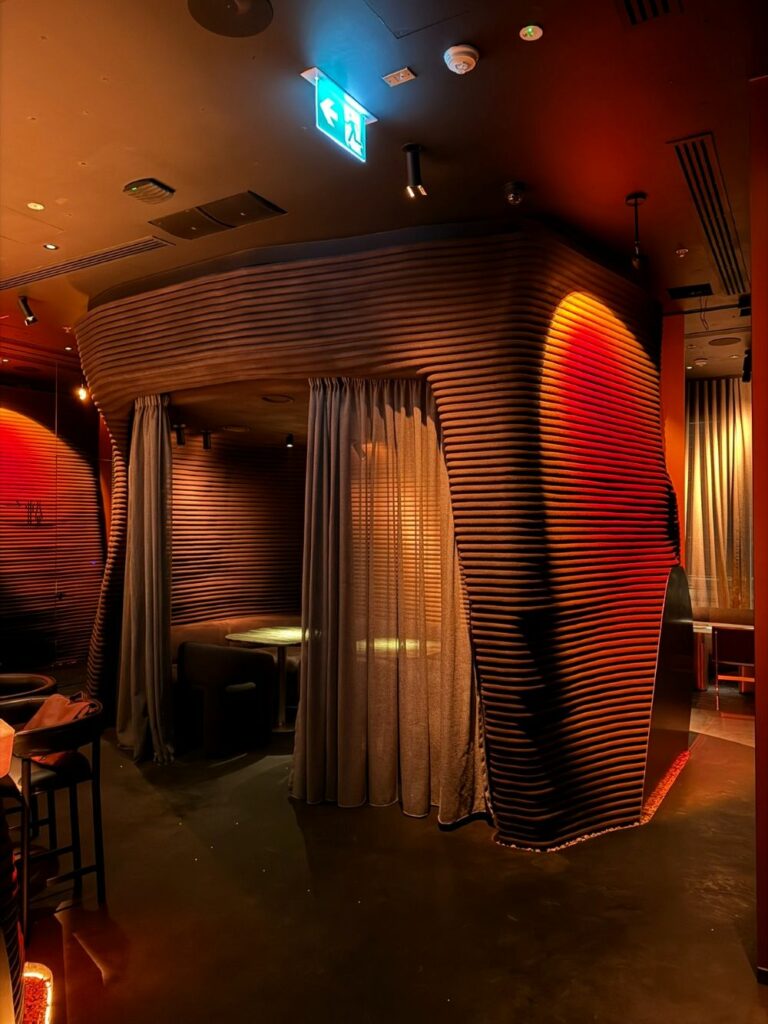
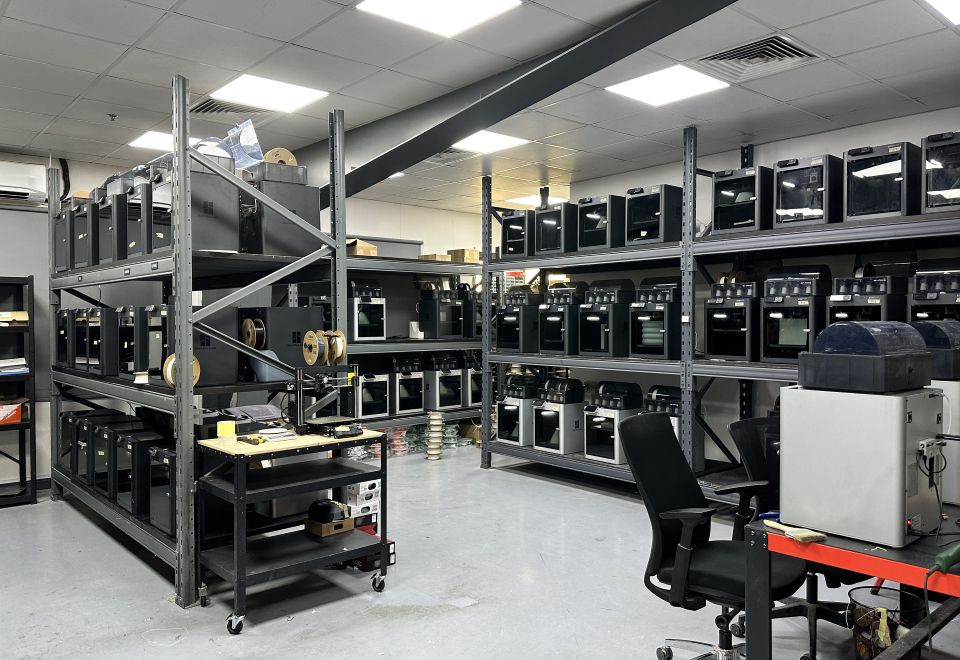
Today the company runs more than 250 printers with a team of over 50 and counts among its achievements a Guinness World Record for the largest 3D printed structure by volume, installed at the MYATA Platinum restaurant in City Walk.
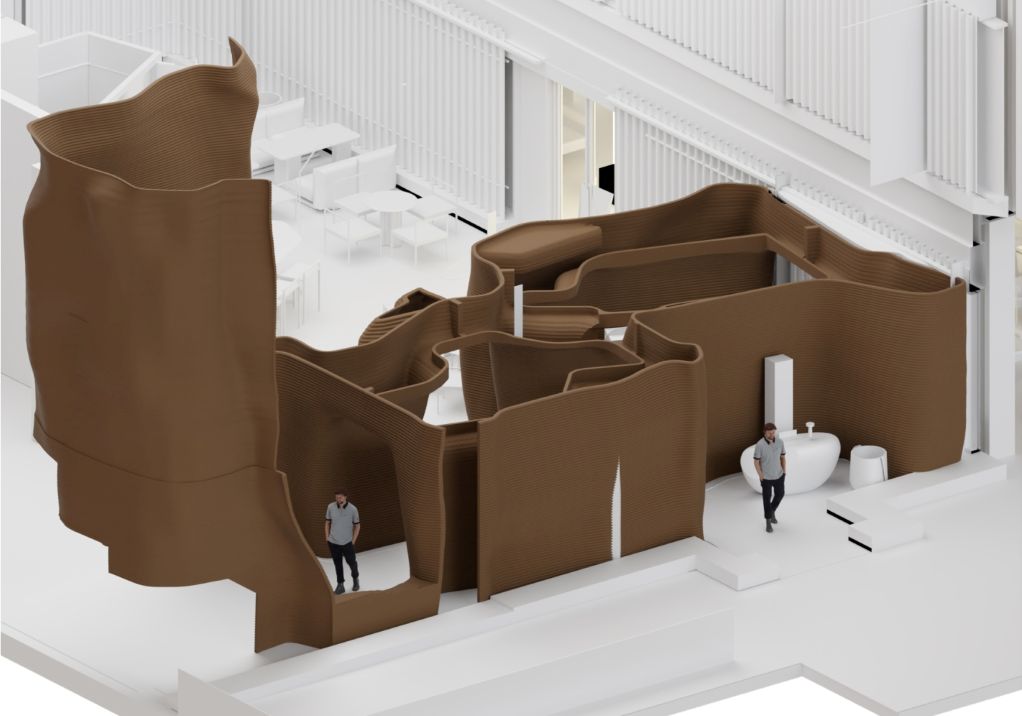
| The project spans 1,190 m² of printed area, with 38 m³ of material shaped into more than 10,500 parts using 158 printers running continuously for over 160,000 hours. In total, it consumed 10.2 tons of 3D printing material, making it the largest 3D printed figure ever produced. To address the project’s requirement, Proto21 relied on a combination of FDM, SLA, and LfAM technologies, as well as a 3D printing farm equipped with Prusas, Bambu Labs, KINGs SLA machines, and CARACOL Heron LfAM robotic arms. |
He credits the city with the pace at which the company works: “Dubai-it”, a leadership philosophy coined by His Highness Sheikh Mohammed bin Rashid Al Maktoum, to express the ability to achieve the extraordinary with excellence and precision in record time.
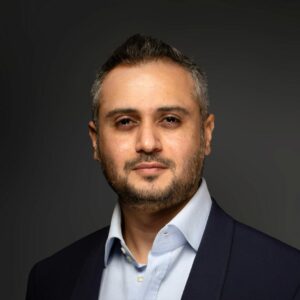
In Proto21’s terms, this means delivering premium results within deadlines that look impossible. While each project delivered contributes to reinforcing the team’s confidence, it explains why Arkam is a CEO and founder who does not believe in “failure”.
When asked to describe a project that did not go as planned and what he learned from it, he says:
“Never has come across as something doesn’t work. We are 9-1-1 for the market. We make things happen and have zero failures. The popular thing in the market is that failure is a prerequisite of success. I don’t agree with that. If you already have a plan B, plan A will never work. You shouldn’t have a plan B.”
Hearing this bold affirmation from Arkam challenged my own thinking. Over the years, we have seen companies thrive with this mindset. Remember our conversation with Oerlikon CEO Markus Tacke for example, when he described a “try everything, fail fast” ethos as the strategy behind the group’s entire path into additive manufacturing? This philosophy has led the company to restructure and relocate its AM business a year after this conversation happened.
 Proto21’s philosophy is anchored in an assessment strategy that enables the team to know what deserves to be printed, what doesn’t, and why certain jobs are rejected.
“Sometimes clients come to us with a project and I turn it down because it simply isn’t right for 3D printing. I tell them honestly: you shouldn’t print this. What already exists on the market does the job better”, Arkam explains.
Is it faster, cheaper, or better?
Proto21’s production environment includes a farm of roughly 250 FDM machines, six industrial SLA systems, HP Multi Jet Fusion 4200 series, Formlabs 3L, a WASP platform, and a Caracol large-format robotic arm. The point of holding that many processes, Arkam argues, is that it changes the nature of the decision.
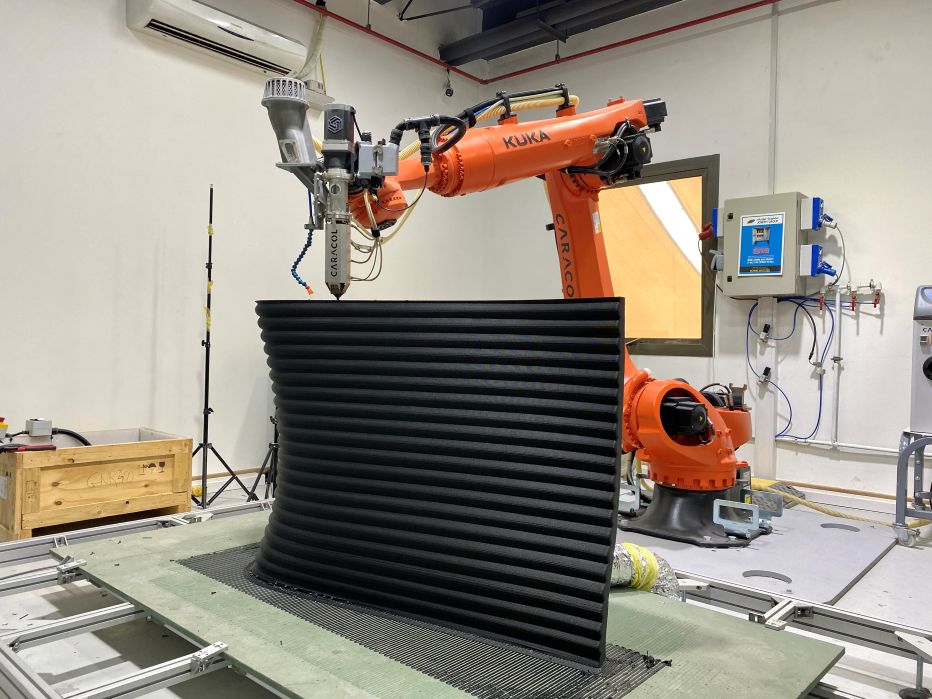
Interestingly, many applications covered in creative industries highlight large-scale 3D printing as a natural technology in these sectors. Remember this 3D printed MEANDER, or even the tallest 3D printed human sculpture?
For Arkam, the choice for one AM technology obviously varies from one project to another.
“The world’s largest 3D printing structure is not done with the robotic arm. You’ll be surprised. The complexity in that project can’t be achieved with the accuracy of one machine. You have to build it in small pieces, assemble, and go to the site.”
The CEO explains that large-format systems are often slow, are limited by nozzle diameter and cannot resolve complex geometry. A two-by-two-meter model, for example, takes five or six days, whereas ten smaller machines will finish in one.
Where large format earns its place, he notes, is industrial material requirements (polycarbonate with glass fiber, ABS with carbon fiber) rather than scale for its own sake.
He’s just as direct when talking about other well known large format projects, which he sees as marketing stunts chosen because the company owned that specific technology, not because the application truly needed it.
Beyond extravagant 3D printed structures, Proto21 has seen SLA work well with jewelry applications, because the surface finish removes a post-processing step that FDM would have added.
That said, clients in the region frequently want 3D printing for reasons that have nothing to do with manufacturing.
“People sometimes ask, ‘Can you 3D print a table?’ But why 3D print a table when carpentry already does it perfectly? They insist, ‘No. We just want to tell people that it’s 3D printed.’”
In my view, and from the little I have seen of the MENA region, Dubai is probably the region where it makes sense to see the technology being used as a driver for visibility, aesthetics, or commercial purpose.
For Arkam on the other hand, this is one among many reasons to be more selective. Proto21 also runs sheet and metal fabrication, and he says he rejects jobs he does not believe belong in AM. His test is a thumb rule: is it faster, cheaper, or better?
The limitations of metal 3D printing
 Set aside the metal 3D printed bridge in Amsterdam that made a real splash, we count on our fingertips, the number of applications enabled by metal 3D printing in the creative industries, let alone those using desktop metal 3D printing.
One explanation is metallurgical, and it is the one Arkam offers. Porosity remains in the part because of the layer-by-layer process, he argues, and the part then has to be sintered in a furnace, which costs it its integrity. A poor trade-off, he says, compared with machining a block that is already fully dense.
This limitation would be linked to a specific family of processes: Sinter-based routes (metal binder jetting and bound metal deposition, which most desktop systems use) do produce green parts that must be debound and sintered, shrinking roughly 20% and finishing below wrought density.
Laser powder bed fusion works differently: the powder is fully melted, parts routinely exceed 99.5% density, and hot isostatic pressing closes what remains.
Next: drones
While the focus here has been on creative applications, Proto21 also serves medical, and automotive customers. Drones are the stated next focus, which makes sense for anyone watching the current market opportunities. In Europe and the US, drones are already among the top defense applications for AM, and with the UAE building its own unmanned systems capability, the pull is domestic as much as it is imported.
UAV production is the clearest current case for polymer AM at volume: compressed design cycles, mission-specific configurations, unforgiving weight budgets, and volumes too low to justify tooling. HP Multi Jet Fusion, which Proto21 already operates, has become a production route for airframes and housings, and defense budgets across the US and Europe are now funding distributed drone manufacturing directly. For a bureau built on speed and process breadth, this seems like a natural step.
When asked for a final thought, Arkam returned to terminology. His objection is with how technology is marketed: printed pizza, printed chocolate, printed organs, in a nutshell, an industry that keeps announcing what it “can do” rather than what it should do.
“3D printing is not there to replace anything. It is there to make existing processes faster, to bring the product to market faster,” he affirms.
While these thoughts may raise the debate around the purpose behind every single business model, I agree with the idea that when 3D printing is sold as a replacement technology, every project becomes a demonstration.
However, when it is treated as one process among several, the goal becomes to understand: what does this application need? And from this conversation with Arkam, we can clearly picture him saying: sometimes additive manufacturing, sometimes sheet fabrication, or sometimes something else, as long as it helps produce faster, better (or cheaper.)
*All images: courtesy of Proto21. This article has first been shared in the 2026 July/August edition of 3D ADEPT Mag.