Remember when we examined in in-house versus outsourced 3D printing in healthcare, where the debate is almost often the compliance infrastructure? Well, with the support of the right partner, Walter Reed has shown that a clinical site can carry the quality system and the submission for FDA clearance.
The 3D Medical Applications Center (3D MAC) at Walter Reed National Military Medical Center has received FDA premarket clearance for its Titanium Cranial Plate (TCP) System, listed under submission number K253116. It is understood to be the first implant ever cleared for a point-of-care institution, and it is the 3D MAC’s first FDA-cleared medical device.
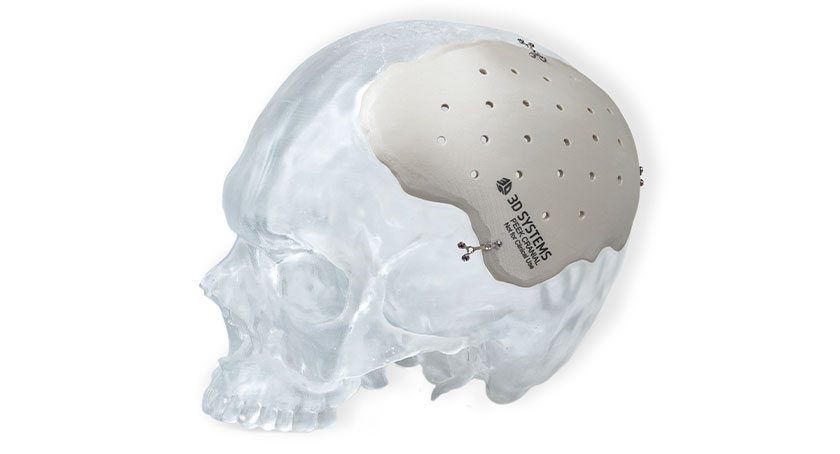
The patient-specific plate reconstructs complex cranial and facial defects caused by trauma, disease or cancer, and will treat active duty personnel and war fighters with traumatic head injuries. It was designed by Dr Peter Liacouras, director of services at the 3D MAC, a unit within Walter Reed’s Department of Radiology producing anatomical models, surgical guides, implants and custom devices.
The center has been leveraging medical 3D printing since the late 1990s, and the 3D MAC was created at the former Walter Reed Army Medical Center in the early 2000s.
The 3D‑printed titanium cranial implants
Titanium replaced polymethyl methacrylate (PMMA) in cranial reconstruction because PMMA, while it restores structural integrity, does not integrate with surrounding tissue. Titanium is biocompatible and can promote tissue integration.
The TCP System’s distinguishing feature is built-in fixation. “One feature of the TCP is that the fixation bars are already incorporated into the design, so you can simply place it and screw it down,” Liacouras said. “You can also plan the fixation locations using the CT scans and the 3D reconstructions. We can get these out quite quickly because we receive the CT scans and do all the design and manufacturing in-house.”
What the regulatory route looked like
The clearance follows work that started in 2020, when Liacouras began coordinating with Dr Beth Ripley of the VA Puget Sound Health Care System. Anticipating tighter FDA oversight of point-of-care printing, the two secured a joint incentive fund to implement quality management systems at both sites.
The 510(k) was later sponsored by the Defense Health Agency’s Office of Regulated Activities and cleared on the first attempt, which biomedical engineer Nikki McMinn noted is unusual for a first-time submitter.
3D Systems supported the multi-year effort, contributing process controls, device design optimization, additive manufacturing workflows and regulatory strategy. Natalie Byrnes, Manager of Product Development, Patient Specific Medical Technology at 3D Systems, said: “This clearance underscores the power of combining clinical innovation with deep expertise in additive manufacturing and regulatory compliance. We are honored to help enable expanded access to personalized care delivered at the point of treatment.”
The 3D MAC is now pursuing a PEEK implant, a non-metallic alternative with stress distribution closer to bone, and a custom titanium ridge augmentation matrix that regenerates bone ahead of dental implant placement.
Liacouras also intends to enrol other military facilities as contract designers working under the 3D MAC’s quality management system, sending design files to Walter Reed for manufacture.
Deep dives in our dossier on reimbursement pathways for 3D printing in Europe.
*We curate insights that matter to help you grow in your AM journey. Receive them once a week, straight to your inbox. Subscribe to our weekly newsletter.