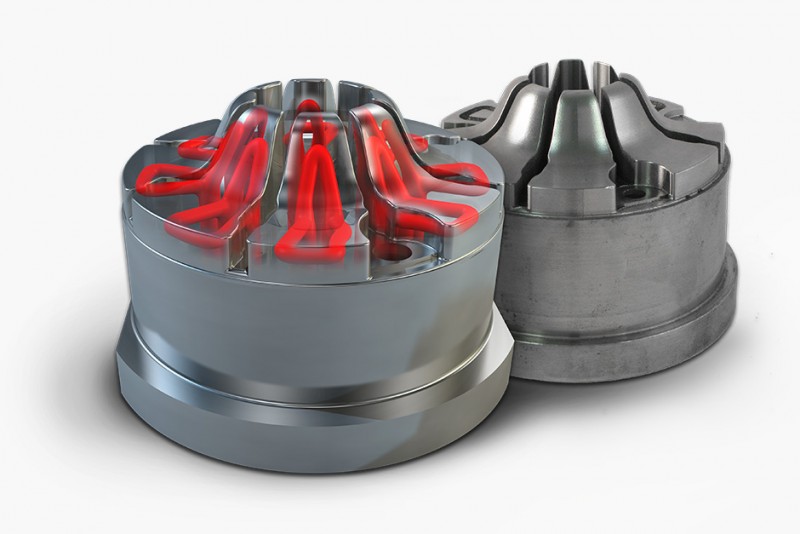
Designing conformal cooling channels for additive manufacturing (AM) has become a recurring focus in current research and development. Enabled by advances in AM processes and simulation-driven computational design, conformal cooling can significantly improve productivity, part quality, and manufacturability in applications such as injection molding and high-performance tooling. Yet, despite its potential, the topic still feels largely confined to R&D. One contributing factor is the set of common mistakes or misconceptions companies face when attempting to design conformal cooling channels for AM.
While a future dossier will dive deeper into production-level projects and the broader practical barriers to widespread adoption, this piece aims to highlight some of these design-level challenges.
In this “experts’ advice” segment, Mark Hartnett, Senior Technologist – AM at Irish Manufacturing Research, Corrado Muner, Product Manager at Texer Design S.r.l., and Domen Tršar, Head of Additive Technologies at HTS, answer a single question:
“What is the most common mistake or misconception companies have when designing conformal cooling channels for additive manufacturing, and how would you advise they avoid it?”
Their responses make it clear that misconceptions in this area are far more diverse and more persistent than many would expect.
Mark Hartnett, Senior Technologist – Additive Manufacturing, IMR
 “The most common misconception people have around conformal cooling for injection moulding is that it is only useful when cycle time reduction is vital, and cost and throughput are the only reasons you should ever care about conformal cooling. In reality, in all of the conformally cooled injection mould tools we have worked with companies on over the years, only one has focused on reducing cycle time.
The greatest gains we realise by using conformal cooling are achieved in eliminating issues like part warpage, poor material flow, and removing cold spots. Assessing the performance of your mould as early as possible using validated simulation tools to look at your part deformation and mould temperature is crucial.
Once you know the thermal performance of your mould tool, you can apply conformal cooling using simulation as a design tool to optimize your part quality and minimize your issues after you cut (or build) steel.”
Corrado Muner, Product Manager, Texer Design S.r.l.
 “That is an interesting question! I often notice that a common mistake in conformal cooling design is ineffective channels distribution in critical areas of the mould inserts. Precise control of steel temperature is a key feature that drastically limits thermal fatigue, extending tool life and ensuring process stability; this directly reflects on the quality of the casted or injected parts.
To achieve this, an optimized design is essential; mould designers should be focused on target areas without wasting thermal capacity where it is not necessary. Designing conformal cooling channels for Additive Manufacturing requires skilled designers capable of balancing AM technology features with thermal design principles.”
Domen Tršar, Head of Additive Technologies, HTS
 “The most common mistake companies make when designing conformal cooling channels for additive manufacturing is overcomplicating the geometry without properly accounting for fluid dynamics and thermal behavior. The design freedom of AM is often misunderstood as a license to create excessively convoluted flow paths, which leads to sharp curvature transitions, inconsistent cross-sections, and regions of stagnant flow. These features increase pressure drop, reduce coolant velocity, and create uneven heat extraction. As a result, tools frequently exhibit local hotspots, delayed cooling, and thermal gradients that drive distortion or early cracking, negating the advantage of conformal cooling altogether.
To mitigate these issues, it is important to anchor the design process in predictive analysis rather than geometric intuition alone. Beyond flow-field evaluation, designers should incorporate thermal and solidification simulations that capture heat flux, cooling uniformity, and stress development throughout the cycle. These tools reveal where channel topology is genuinely beneficial and where it introduces risk, allowing the final geometry to be shaped by measurable thermal performance instead of aesthetic complexity. This combined, simulation-driven approach ensures the cooling network supports reliable, repeatable tool behavior under real processing conditions.”
The editor’s notes
This article has first been published in this edition of 3D ADEPT Mag.
So, why did we invite these experts?
Mark Hartnett, Senior Technologist – Additive Manufacturing at Irish Manufacturing Research (IMR), brings hands-on expertise in helping industry adopt metal additive manufacturing for tooling, high-value components, and process optimisation.
Irish Manufacturing Research is a leading industrial research and technology organization focused on accelerating advanced manufacturing adoption. IMR supports companies through applied R&D, testbeds, training, and collaborative projects in areas such as additive manufacturing, robotics, digitization, and sustainable production. Their AM team works closely with industry on tooling innovations, thermal management solutions, and end-to-end workflow integration, including projects where conformal cooling channels play a key role.
Corrado Muner recently supported a research paper on “the causes of failure of an LPBF-conformal cooling insert for HPDC” conducted by Metal L@bs – Laboratorio di Metallurgia UniBs.
He is Product Manager at Texer Design, where his work is at the intersection of tooling engineering, DfAM, and simulation-driven design. This gives him direct experience with the challenges companies face when implementing conformal cooling solutions.
With a strong experience in complex tool geometries and simulation-led design, Texer Design S.r.l. supports industrial partners in adopting AM for functional tooling components, particularly where thermal management, precision, and cycle-time reduction are critical.
Domen Tršar, Head of Additive Technologies at HTS, brings extensive experience in applying additive manufacturing to industrial production and tooling.
HTS is a vertically integrated manufacturer specializing in high-performance strategic components. With proprietary additive manufacturing, premium tool steel distribution, high-precision machining, and advanced heat treatment – all under one roof – they deliver fully optimized solutions from concept to completion.