

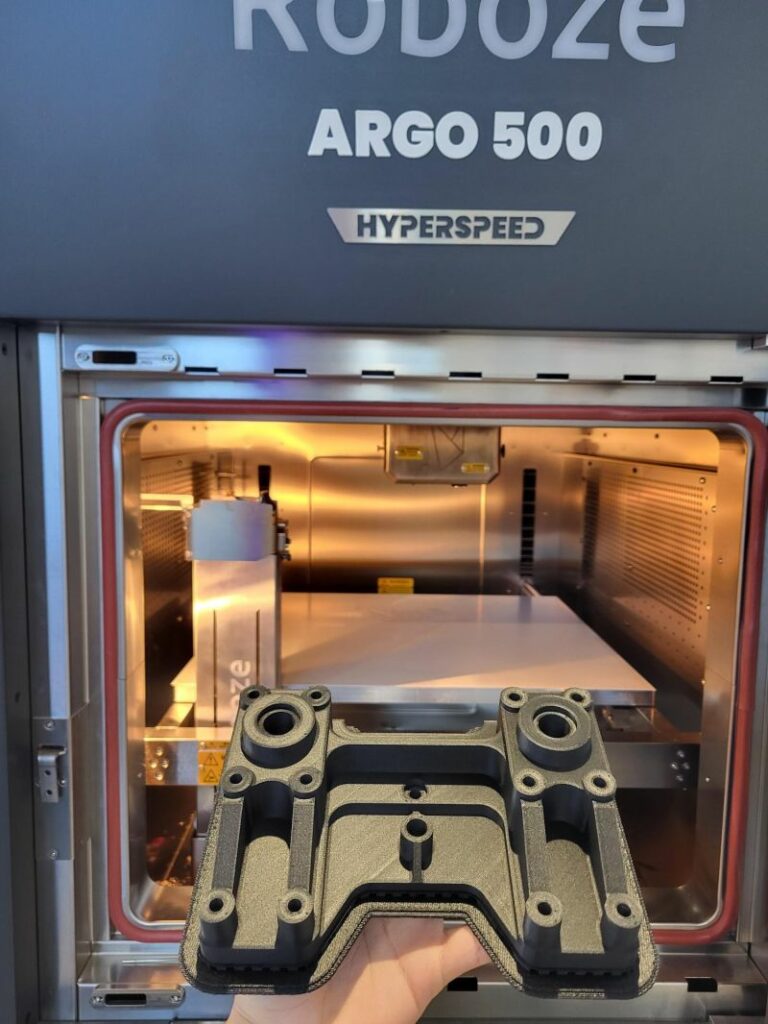
The qualification of Roboze’s ARGO 500 Hyperspeed system for Airbus flight-ready component production might sound like another tick on a certification checklist but in reality, it’s not.
With Airbus approving high-performance polymer parts in telecom and Earth observation satellite applications, this could simplify procurement chains, shrink inventory management requirements, and remove a critical barrier that keeps alternative suppliers out of the qualification game.
As CEO Alessio Lorusso notes, “Qualification by Airbus is far more than a technology milestone. It is validation that autonomous manufacturing can meet the most demanding requirements of one of the world’s leading aerospace companies.”
ULTEM 9085, the material at the heart of this qualification, offers mechanical strength, flame retardancy, and thermal stability. The qualification validates that Roboze’s process control, thermal management, and production architecture can deliver this consistency at scale, across distributed facilities worldwide.
As Stratasys reported, Airbus produced more than 25,000 flight-ready 3D-printed parts in 2025 alone. That volume, combined with over 200,000 3D-printed parts already in active flight across their fleet, represents both an achievement and a vulnerability. Massive scale creates dependency while a single qualified vendor can easily become a bottleneck.
Roboze’s qualification introduces an alternative hardware and material ecosystem with proven performance.
On another note, while aerospace headlines often focus on metal additive manufacturing, this qualification reminds us that polymers occupy an equally critical space. Secondary structural components, thermal protection, lightweight enclosures are all examples of parts whose performance determines mission success.
This opens a door for aerospace manufacturers to hedge their procurement bets. It also reduces the cost and complexity of dual-sourcing, a strategic necessity in defense and commercial aerospace, where supply chain interruptions ripple across entire programs.
What comes next
Additional high-performance materials from Roboze’s portfolio are progressing through qualification. If those succeed, Airbus will gain a platform for material innovation that doesn’t depend on a single OEM’s product roadmap.
Source: Roboze — Airbus qualification announcement.
Source: Stratasys — Airbus polymer parts, December 2025.
THE 3D ADEPT WEEKLY NEWSLETTER
The industry moves fast. Stay ahead.
Every week, the latest additive manufacturing news, in-depth features and real-world applications, straight to your inbox. Plus, be the first to know when a new issue of 3D ADEPT Mag is out.
Free · One email a week · Unsubscribe anytime
Clicking loads our email provider’s sign-up form, including its analytics and Google’s anti-bot protection. You’re only subscribed if you complete the sign-up. Read our privacy policy.