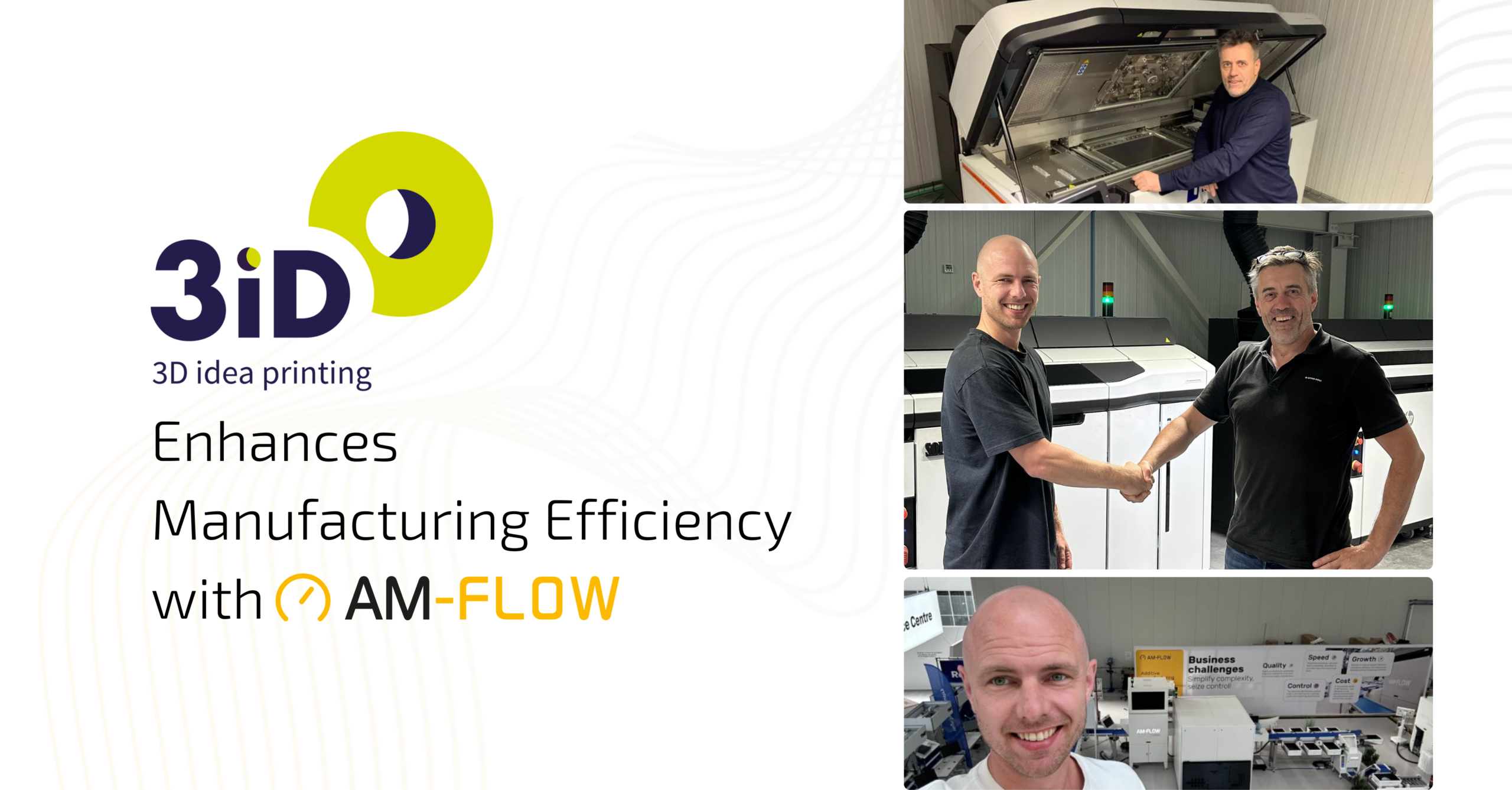
Belgian 3D printing service provider 3iD just added intelligent workflow automation to its production lines through the integration of AM-Flow’s automated post-processing solution.
Since its debut in the market, post-processing expert AM-Flow has been championing the idea that scaling AM production demands more than better printers. It demands smarter systems for everything that comes after.
As Stefan Rink, the company’s CEO, told 3D ADEPT in an interview: “What we are seeing right now in the industry is there is a lot of focus on 3D printing itself and not really on the overall manufacturing process. Additive Manufacturing is a great technology but it is not limited to the printing itself, especially if you want to achieve a full production cycle.”
For 3iD’s Dave Vanhove, founder, the challenge is familiar: as production volumes grow, so does the complexity of tracking, identifying, and sorting parts. Manufacturing at scale in AM means handling hundreds (or thousands) of parts with infinite variations in geometry, each destined for different customers or post-processing stages.
The AM-Flow solution deployed at 3iD’s facility addresses this head-on. AM-Feed simulates printed parts automatically. AM-Vision’s AI-powered machine vision identifies each part without labels or markings, processing parts in milliseconds. AM-Sort then routes components to the correct destination. Together, these integrated systems create what AM-Flow and 3iD describe as a “seamless and traceable workflow.”
The result? Manual labor shifts from repetitive sorting and identification to higher-value activities. Production capacity increases. Human error diminishes.
Beyond the shop floor
Three years ago, when AM-Flow secured $4M in Series A funding, the company emphasized the same insight: less than 10% of parts manufactured globally use additive processes, despite the technology’s obvious advantages. Part of the gap was cost. But another critical part was scalability, the inability to automate the workflows that surround 3D printing.
Since then, we have seen Belgian service provider ZiggZagg integrated AM-Flow’s automation into its HP Multijet Fusion production lines, targeting the tracking and traceability challenges that emerge at high volumes.
For 3iD serving customers across aerospace, automotive, medical, and beyond, that shift from printing-centric thinking to manufacturing-centric systems is critical as customers increasingly expect both high-quality parts, and reliable, data-backed workflows.
Dave Vanhove positioned the move as a natural evolution: “As production volumes continue to grow, we are continuously looking for technologies that help us improve efficiency while maintaining the quality and flexibility our customers expect.”
*We curate insights that matter to help you grow in your AM journey. Receive them once a week, straight to your inbox. Subscribe to our weekly newsletter