…And why that changes the equation for hydrogen propulsion
Additive manufacturing is so known for what I often describe as the “sexy applications” it enables that when you discover something very unusual, you’re like: What? Why? How? Was it even a possibility? You’re literally speechless.
Well, that was exactly my feeling when I discovered that the team led by Prof. Vincenzo Esposito at the Technical University of Denmark (DTU Energy) demonstrated monolithic solid oxide fuel cells (SOFCs) built around nature-inspired gyroid geometries using a Lithoz CeraFab system. The result: a fivefold increase in power-to-weight ratio compared to conventional planar SOFCs, reaching approximately 1 W g⁻¹ against the typical 0.2 W g⁻¹ of current architectures.
This is not the type of application you will discover every day. And when you dig deeper, you realize that ceramic manufacturing processes are almost always the most ideal route for this, which makes me think that ceramics, and in this specific case, ceramic AM and LCM in particular, have once again achieved another level of maturity.
But before reaching that conclusion, I had to sit with Johannes Homa, CEO and founder of Lithoz.
Homa is one of the rare accessible CEOs I know and one of the most technically sharp. You may remember how he recently walked me through how a 0.01% design improvement in 3D-printed parts can save up to $240K/day in the semiconductor field. So, when I asked him what makes these SOFCs so compelling, I expected a multi-part answer.
He gave me one concept: “Power-to-weight ratio.”
The flatland problem
To understand why that answer matters, it’s important to look at what solid oxide fuel cells (SOFCs) have always been and what they have always been constrained by.
In their conventional form, SOFCs are flat. Oxygen flows on one side of a ceramic tile, fuel on the other, and electricity comes out. Stack enough tiles, compress them with interconnects and sealants, and a power system emerges. Engineers have known it works for decades. And that, in a way, is precisely the problem.

“It was a solution that worked, but it’s difficult to scale when you want to get more efficiency,” Homa told me. The stacking introduces sealing problems, contact resistance between components, and thermal mismatch that accumulates over time. Researchers have spent years refining those contact points (tighter seals, better interconnect materials, thinner layers). Marginal gains, every one of them. The architecture itself has remained untouched.”
A planar SOFC is fundamentally two-dimensional: every gram of added ceramic contributes to the surface area in only two directions. The volume in between is largely wasted on structure, seals, and thermal management between independently operating components.
The power density limit this imposes is around 0.2 W per gram, a figure that has proved resistant to meaningful improvement. For stationary applications (data centers, commercial buildings, industrial sites), this could be sufficient. But the moment mobility enters the equation, the weight of that architecture becomes the limiting constraint.
For example, an aircraft running on hydrogen cannot afford a power system five times heavier than it needs to be. Neither can a drone, nor a maritime vessel optimizing for range and payload. It may seem trivial to state it that way but it’s not because up until this work, the field had accepted that constraint as fixed.
Rethinking the entire planar stack
What Esposito’s team proposed was an architectural replacement. To understand how, I asked Homa how they managed to maximize the electrochemical surface area within a given volume, without any of the assembly constraints that stacking imposes.
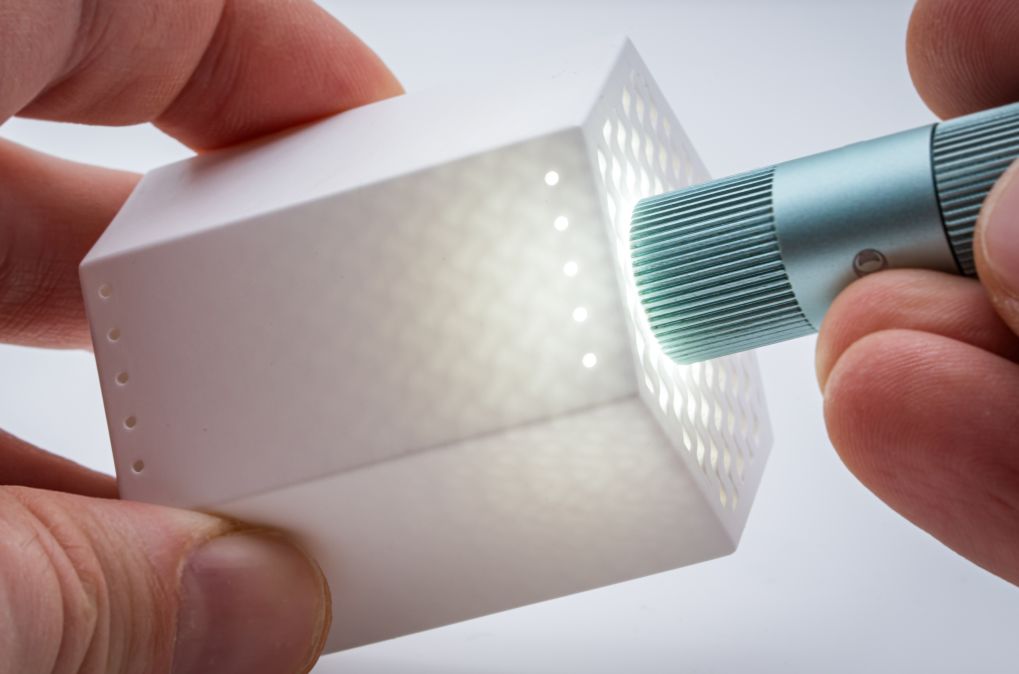
His answer was the gyroid, a triply periodic minimal surface (TPMS), a mathematically defined structure that divides space into two continuous, interpenetrating channels that never touch.
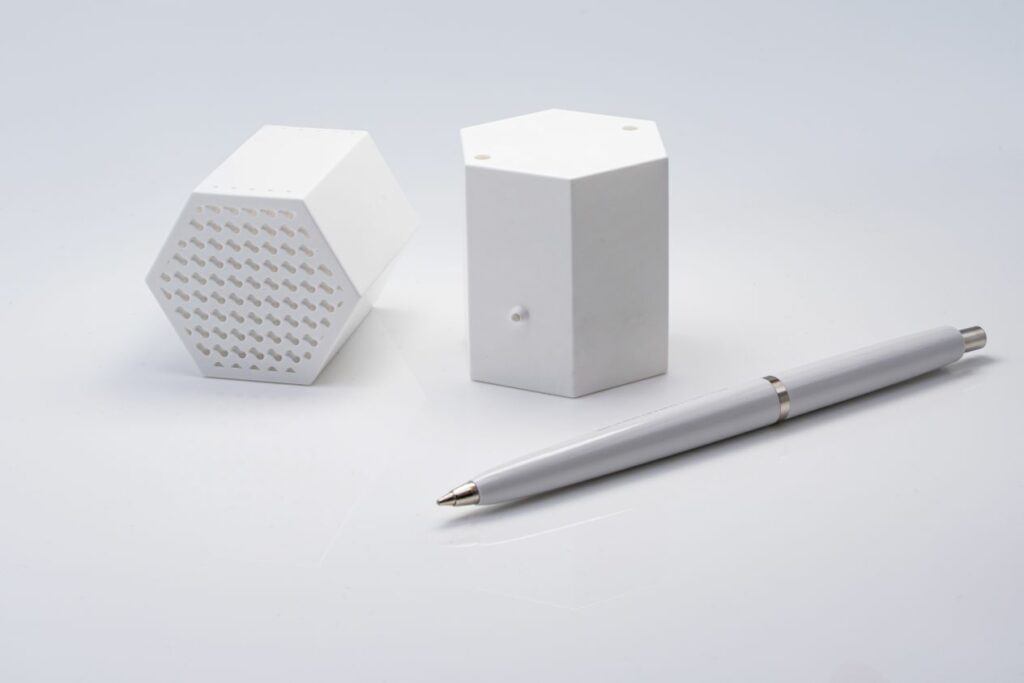
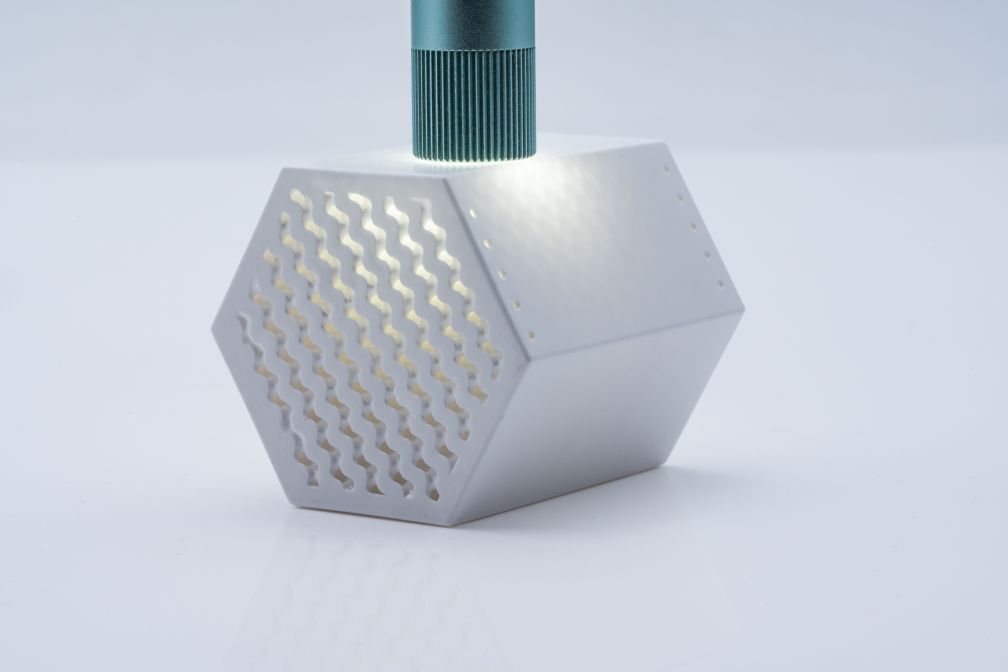
The monolithic SOFCs were built around nature-inspired gyroid geometries, three-dimensional, thin-walled structures printed as a single unit from 8 mol% yttria-stabilized zirconia (8YSZ).
The TPMS channels inherently satisfy gas supply requirements. The monolithic concept is completed by replicating the gyroid units and enclosing them in a sealed outer shell, the only boundary the design requires.
No interconnects. No sealants. No thermal mismatch between separately manufactured components. And a different way of designing stacking. A single, continuous ceramic structure in which gas and air flow in proximity but never mix, separated only by the precision of the walls between them.
If the concept seems obvious, the manufacturing process needed to implement it was the missing and crucial element of that strategy.
The 3D printed ceramic gyroid and why LCM specifically
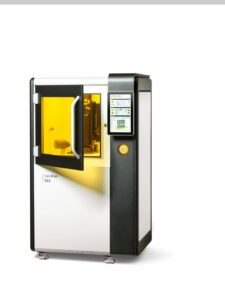
Lithoz’s Lithography-based Ceramic Manufacturing (LCM) process works by dispersing ceramic particles in a photosensitive resin, solidifying that dispersion layer by layer with precision light exposure, then sintering the part to develop its final ceramic properties. We have covered LCM extensively across applications ranging from semiconductors to medical devices and aerospace. But this application tests the technology in a specific way that others do not.
“Design freedom is not design ignorance,” Homa told me. “Every manufacturing process has geometries it handles well and constraints it imposes. The question for the DTU team was not simply whether a ceramic AM process could produce a gyroid. It was whether one could produce it at the wall thickness and dimensional consistency that a monolithic SOFC actually requires.”
Tape casting and screen printing (the established routes for conventional SOFC manufacturing) produce flat layers. They cannot produce a continuous three-dimensional surface. Extrusion-based ceramic AM can approach complex geometries, but the linear development of the materials introduces high losses, reproducibility, and tolerance issues, making it an unreliable route for a structure where a single defect means fuel and oxidant mix, and the cell fails.
To ensure the required thickness and dimensional consistency, it was crucial to push the gyroid wall geometry toward what was geometrically and thermally achievable. At each iteration, LCM continued to deliver usable, gastight parts. “The narrower you can get the walls to each other, the better you have to make sure they are not touching, and the printing system must build these intricate geometries 100%, without any error.“
Other processes, he noted, simply fell out of the race as the design pushed further.
The thickness of the inner parts plays a decisive role. Thinner walls allow more channels to fit within the same volume; more channels increase the electrochemical surface area; and greater surface area drives higher power density. LCM’s process also minimizes material waste and keeps internal channels accessible for post‑processing.
The measurable outcomes
 At first glance, the outcomes here can be hard to frame because one may easily fall into the production mindset, expecting the usual metrics on lead times and saved costs. But scaling is not the primary goal of this work, and the numbers that matter are different ones.
The monolithic gyroid SOFC reaches approximately 1 W g⁻¹ against the 0.2 W g⁻¹ of conventional planar architectures. A factor of five. And as Esposito notes, experiments have shown the specific power per kilogram can be doubled even from there.
According to Esposito’s experiment, one can incorporate all components into a single unit, thanks to the achievable level of complexity. This creates a whole range of options, because multifunctionality can be built directly into the design. The fuel cell is also much more compact, delivering the same output, simply because space is used far more efficiently.
What will this change in practice?
More efficiency for the same weight. The ability to carry more payload. Less thermal loss between components. A clear pathway for hydrogen to power aircraft.
“It’s not the cost savings per part that matters, it’s the cost saving in the application,” Homa told me. “In cars, a kilogram saved might be worth €10. In aviation, €1,000. On a rocket, €10,000. The question is whether the power-to-weight ratio it enables makes applications that were simply out of reach before.”
On durability: eliminating interconnects and sealants removes the primary failure mechanisms in conventional stacked designs. Esposito’s team expects the absence of steel interconnects to significantly extend lifespan by reducing thermal and mechanical stress at joints, which cause conventional stacks to degrade. Early results on dynamic operation are described as “very interesting”.
What’s next?
It can be difficult to realize, but research shows that SOFCs are already shifting from specialized projects toward mainstream commercial deployment, powering data centers, commercial buildings, and maritime vessels. Analysts forecast the market to grow from $2.04 billion in 2024 to $12.55 billion by 2032. Knowing that, I can’t help but think that this work will widen the reach of LCM technology.
With the design and test phase complete, Esposito’s team is planning to scale to an industrial level. The cell design, set to be marketed under the name GYROX, is moving toward production. Homa is direct about what that transition requires: more printers, increased furnace capacity, quality control systems, and supply chain infrastructure that enable reproducibility at scale.
“We have already done it,” he says, not for SOFCs, but for other applications at comparable complexity. In 2024, Lithoz’s largest customer produced four million parts in a single year, on twenty machines, running nearly continuously. The point is not to conflate industries. The point is that the infrastructure for high-volume LCM production exists and has been stress-tested. “Scaling with trust” is how Homa frames what Lithoz can offer.
While Lithoz is tapping into a market not yet crowded by other AM processes and this, incidentally, may be one of the luxuries of ceramic 3D printing specifically, what I see is a company that, once more, went the extra mile to demonstrate how LCM continues to mature into credible industrial technology.
*Homa’s answers have been edited for brevity and clarity.
This content has been produced in collaboration with Lithoz. All images: Courtesy of Lithoz.