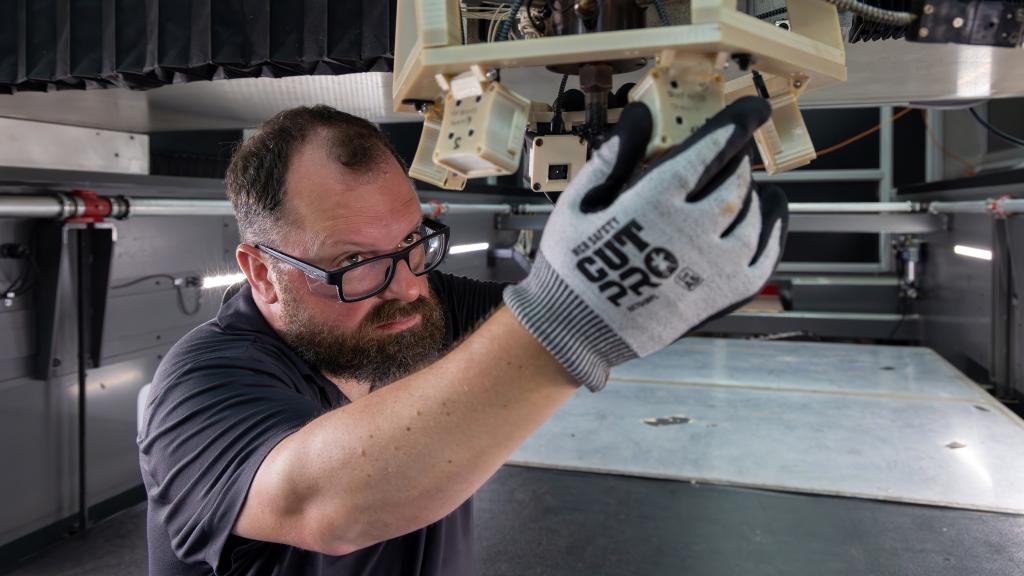
Researchers at Oak Ridge National Laboratory (ORNL) have developed a controller that enables to detect errors during large-format composite 3D printing, and correct them automatically, in real time.
The system combines a suite of sensors (tracking nozzle position, print speed, and material temperature) with a ring of low-cost thermal cameras mounted around the print head. A computer vision algorithm interprets the live thermal feed and adjusts print speed on the fly whenever layer temperature deviates from target values, ensuring proper adhesion between layers before the next one is deposited.
In-process monitoring has become one of the most active development areas in additive manufacturing. AI-driven platforms interpreting thermal, optical, and other sensor data layer by layer to identify anomalies in real time are increasingly common, but almost exclusively in metal powder bed fusion processes. Solutions from players like Sigma Additive Solutions, Additive Assurance, and Fraunhofer IAPT have focused on L-PBF and SLM, where the economics of scrapped metal parts justify significant monitoring infrastructure.
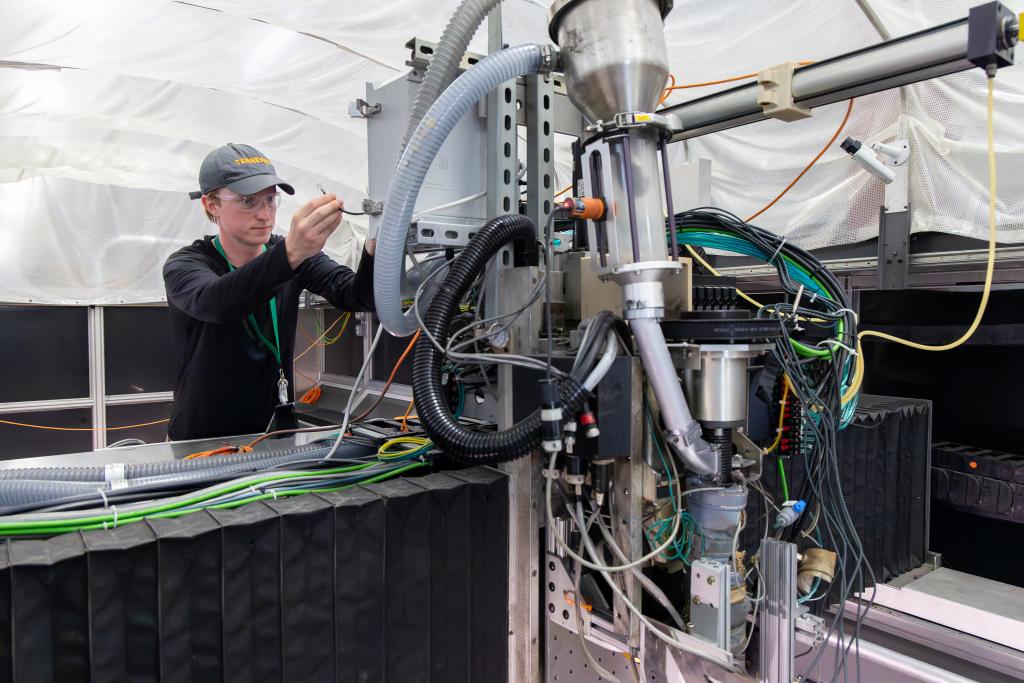
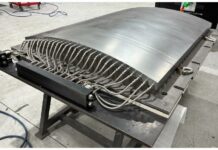
ORNL’s work addresses a different and underserved challenge: large-format polymer composite extrusion, where parts can be the size of aircraft components, boat molds, or building panels. At that scale, a failed print is a significant material and energy loss.
And crucially, unlike some monitoring systems, ORNL’s controller does not need retraining for every new design, saving time and computing power while increasing flexibility, designed to work with any large-area composite printer, any plastic type, and any geometry.
ORNL’s approach uses a digital twin built through machine learning to run risk-free experiments with new shapes and materials, without the retraining overhead.
In validation testing, the system printed a hexagon larger than a truck tire, detected a 30% temperature shortfall in the first layers, and autonomously corrected print speed to bring temperatures back within spec.
Automating supervision could free skilled operators from constant monitoring, opening the door to broader adoption of large-scale AM for refrigerated shipping containers, boat hull molds, and architectural components.
*We curate insights that matter to help you grow in your AM journey. Receive them once a week, straight to your inbox. Subscribe to our weekly newsletter.