

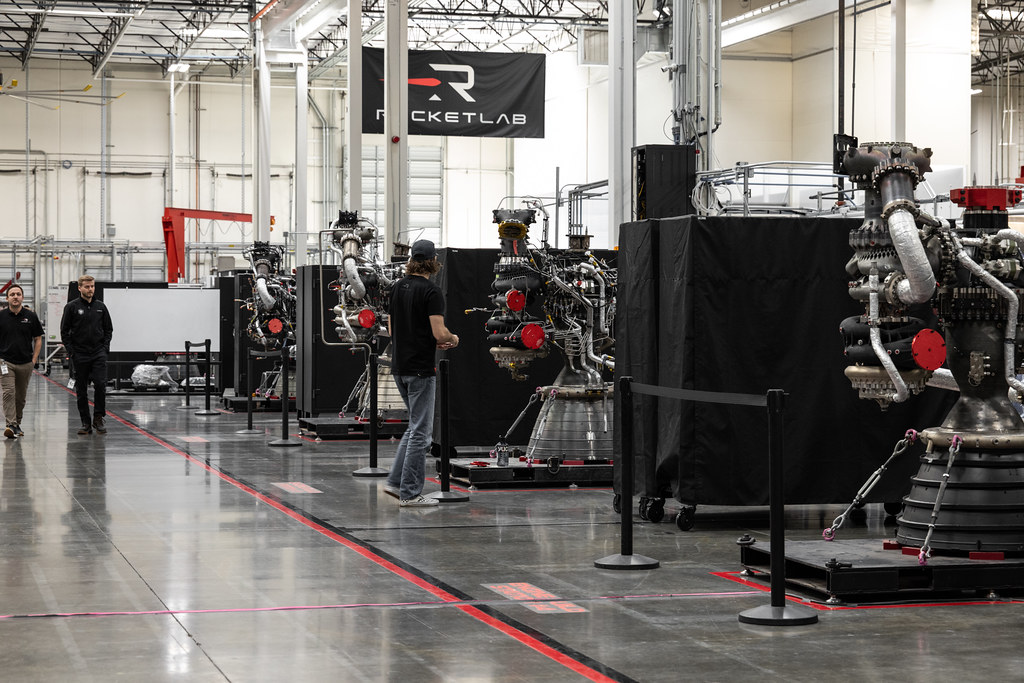
Space company Rocket Lab has just announced a milestone: the 1,000th Rutherford engine has rolled off its production line. In the world of space propulsion, this number is a statement about what industrialized additive manufacturing actually looks like when it works.
We have been following Rocket Lab’s use of 3D printing since 2017, when the company prepared to launch its very first Electron rocket from New Zealand’s Mahia Peninsula. Back then, we noted that the Rutherford was the first engine of its kind to use additive manufacturing for all primary components — injectors, pumps, propellant valves, and the combustion chamber itself, produced via electron beam melting, with the entire engine manufacturable in roughly 24 hours. That was a remarkable claim. Nearly a decade later, 1,000 units later, it holds up.
What makes the Rutherford different
Beyond the manufacturing process, the Rutherford’s architecture is unconventional: it uses an electric pump-fed cycle powered by lithium-polymer batteries rather than the gas-generator or staged combustion cycles typical of conventional engines.
This eliminates the complex turbopump systems that drive up cost and manufacturing complexity in traditional designs. The result is a lighter, simpler engine with fewer failure points and critically, one whose geometry and performance can be tightly controlled through the repeatability that additive manufacturing enables.
Producing one 3D printed rocket engine is an engineering achievement. Producing a thousand of them, consistently, reliably, at pace, is a manufacturing achievement of an entirely different order.
As Alexander Pluta noted on Rocket Lab’s LinkedIn announcement: “Everyone focuses on who’s launching the most rockets, but the real competitive advantage is in production. 1,000 engines means repeatable, reliable, scalable. That’s what separates a rocket company from a rocket program.“
He’s right. The space industry’s new entrants compete on technology and cadence. Rocket Lab’s ability to manufacture Rutherford engines at volume, with additive manufacturing as the backbone of that production system, is precisely the kind of structural advantage that is hard to replicate quickly.
For the additive manufacturing industry, this milestone is a useful proof point: AM is the true production line.
THE 3D ADEPT WEEKLY NEWSLETTER
The industry moves fast. Stay ahead.
Every week, the latest additive manufacturing news, in-depth features and real-world applications, straight to your inbox. Plus, be the first to know when a new issue of 3D ADEPT Mag is out.
Free · One email a week · Unsubscribe anytime
Clicking loads our email provider’s sign-up form, including its analytics and Google’s anti-bot protection. You’re only subscribed if you complete the sign-up. Read our privacy policy.