

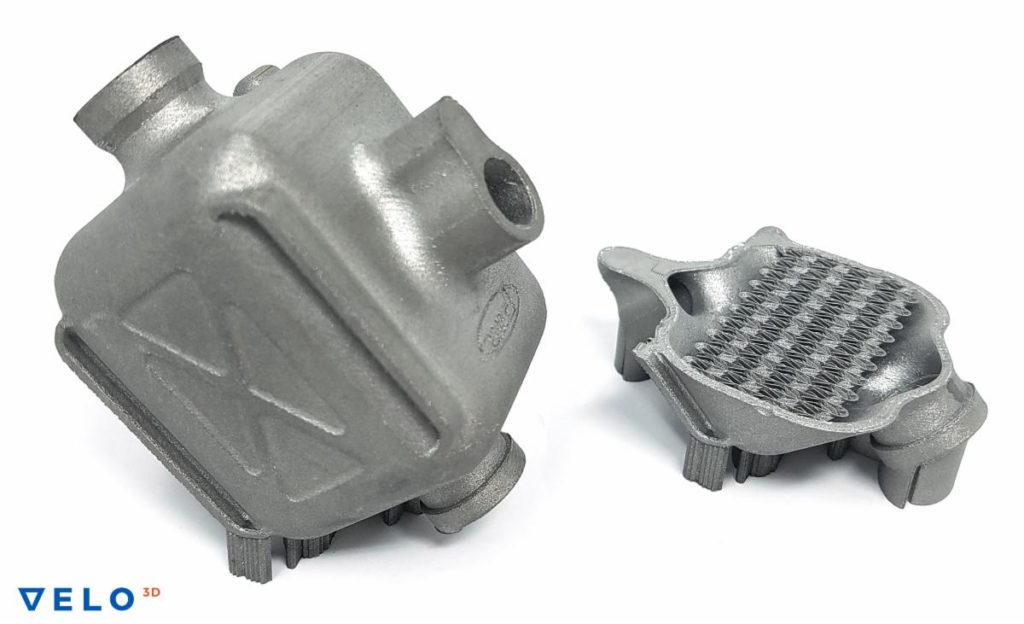
Heat exchanger applications are used across a range of fields including motorsport, battery cell, electronics, aerospace and automotive cooling. PWR and Velo3D partner to explore these applications with metal 3D printing technology.
With offices in Australia, the USA and the UK, PWR supplies cooling solutions to F1, NASCAR and other racing series—as well as the custom-automotive OEM, military and aerospace industries.
Using the Sapphire system, both companies will develop aluminum alloy designs with thinner and more-complex heat exchange features. Since the launch of the metal 3D Printer last year, we haven’t yet seen possible applications of the system. We know the system is capable of high-volume manufacturing, especially in demanding industries. Benny Buller in an Opinion of the Week, laid emphasis on the system’s ability to manufacture parts with redesign. We also know the company partners with high profile material producers to develop AM powders, and that they are in the midst of an exciting growth.
As far as this collaboration is concerned, Matthew Bryson, General Manager, Engineering, for PWR said they “chose Velo3D after extensive testing. The Velo3D Sapphire printer demonstrated the ability to produce class-leading thin-wall capabilities and high-quality surfaces with zero porosity.”
“Heat exchanger weight and pressure-drop characteristics have a huge impact on performance and are significant factors in all motorsport categories,” he says. “Using additive manufacturing to print lightweight structures, enhancing performance with freedom-of-design, we have the ability to further optimize these characteristics to the customer’s requirements whilst providing the necessary cooling. The broad design capabilities and extremely high print accuracy of the Velo3DSapphire 3D metal printer will help us optimize these various performance attributes.”
So, these heat exchanger applications, if successful, would be a tangible application of the economic & technological benefits that the Sapphire system unlocks.
For further information about 3D Printing, follow us on our social networks and subscribe to our newsletter : Facebook, Twitter, LinkedIn & Instagram !Would you like to be featured in the next issue of our digital magazine? Send us an email at contact@3dadept.com
THE 3D ADEPT WEEKLY NEWSLETTER
The industry moves fast. Stay ahead.
Every week, the latest additive manufacturing news, in-depth features and real-world applications, straight to your inbox. Plus, be the first to know when a new issue of 3D ADEPT Mag is out.
Free · One email a week · Unsubscribe anytime
Clicking loads our email provider’s sign-up form, including its analytics and Google’s anti-bot protection. You’re only subscribed if you complete the sign-up. Read our privacy policy.