The development of food-contact materials and substances is subject to very strict regulations as they are in contact with food or potable beverages during processing, packaging or storage. Molecules can migrate from materials into food or beverages. Assessing this migration and the resulting exposure helps determine whether the intended use is safe.
The development of 3D printing materials for such applications will require further monitoring as 3D printing is still considered as a “novel technology” for these industries. Two companies that have recently decided to join forces to develop new materials for food and drinking water applications are machine manufacturer Farsoon and Fabulous, a French company that develops powder materials for powder bed systems.
Both companies have previously worked together in the past as we learned that all FABULOUS’ materials have been successfully tested on FARSOON systems, with early adopters service bureaux continuously using them.
Through this new collaboration, both parties will focus on helping end-users with new materials specific to industrial applications, such as BLUECARE material specific for the Food industry, or ACTIVE material dedicated mainly to the Water industry.
Materials for food and water applications
Two materials are already commercially available: BLUECARE and ACTIVE.
Based on bio-sourced PA11, BLUECARE material is mass blue and has been certified for Food Contact Application following the “Commission Regulation (EU) No 10/2011 of 14 January 2011 on plastic materials and articles intended to come into contact with food and alcohol. The material can be used for the manufacture of modular food conveyor belts, removing this way, the need for producing a mold that is too expensive for the number of parts to be made.
Drinking-water applications and certification
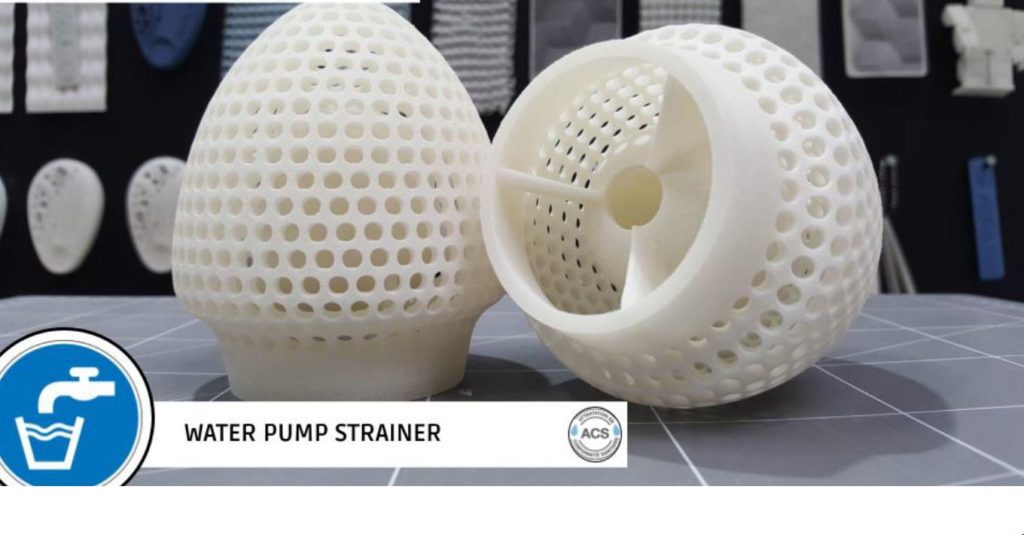
ACTIVE on the other hand, is designed for the Water industry. It has been certified (ACS certification) for potable water applications and plastic parts in contact with drinkable water, such as water pumps, hydraulic systems, data sensors, and all permanent water-immersed parts.
Thanks to its composite formulation, the material has very high-standards properties (especially High-T° and low-T° resistances). The Attestation de conformité sanitaire (ACS) is a French assessment of materials and products in contact with drinking water. NSF-ANSI 61 addresses the health effects of drinking-water system components in North America; it is a separate standard.
Make sure to follow us on our social networks and subscribe to our weekly newsletter : Facebook, Twitter, LinkedIn & Instagram ! If you want to be featured in the next issue of our digital magazine or if you hear a story that needs to be heard, make sure to send it to contact@3dadept.com
THE 3D ADEPT WEEKLY NEWSLETTER
The industry moves fast. Stay ahead.
Every week, the latest additive manufacturing news, in-depth features and real-world applications, straight to your inbox. Plus, be the first to know when a new issue of 3D ADEPT Mag is out.
Free · One email a week · Unsubscribe anytime