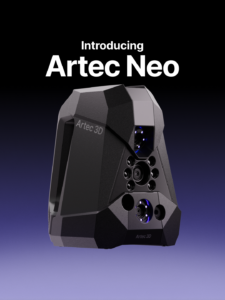
 Artec 3D has launched Artec Neo at IMTS 2026, a tolerance-driven wireless 3D scanner that opens a new approach to inspection and reverse engineering. The expert in 3D scanning solutions claims it is the first of its kind that enables to apply metrology where the design requires it while capturing the complete part.
The new 3D scanner would deliver metrology-grade accuracy of 0.025 mm and volumetric accuracy of 0.025 mm + 0.035 mm/m where the design demands it, while capturing full-color 3D data of the entire part at up to 0.05 mm resolution.
It is ideal for demand industries with fine tolerances: automotive, aerospace maintenance, repair, and overhaul (MRO), defense and industrial maintenance or retrofit and installation.
The new 3D scanning approach
The new 3D scanning approach consists in reserving metrological accuracy for functional features. The manufacturer calls this approach “tolerance-driven 3D scanning” as it gives users full flexibility in how they apply targets, and delivers metrology-grade results with far greater efficiency.
Modern engineering is built around a simple principle: measure the surfaces that determine whether a part will function as designed. This idea lies at the heart of GD&T. Engineers use dimensions and tolerances to communicate design intent, which features are critical to fit, alignment, sealing, and function, and how tightly each must be controlled.
Until now, metrology-grade 3D scanning has treated all surfaces alike: conventional laser workflows rely on targets across the whole part to maintain guaranteed accuracy, including areas with no critical requirements. According to the manufacturer, that makes inspection and reverse engineering unnecessarily slow and expensive.
“The idea behind GD&T is simple. Ultimate precision is not required everywhere — control what determines whether the part works,” said Art Yukhin, President & CEO of Artec 3D. “Artec Neo applies the same principle to 3D scanning. If you have a drawing, it tells you where metrology belongs. If you’re reverse engineering, you make that decision as you reconstruct the design. Put metrology where function demands it, while capturing the entire part. That’s tolerance-driven scanning.”
Ideal for quality inspection and reverse engineering
Users of Artec Neo could benefit from multiple workflows. For example, in dimensional control, targets could be placed around the key features with critical tolerances; with delicate or worn surfaces, attached them to surrounding fixtures instead, preserving the condition of the part while anchoring dimensional accuracy around it.
According to the company, they could also scan entirely without targets at up to 0.05 mm resolution, capturing fine detail in true-to-life color.
The new device is built on the company’s flagship software for 3D data capture and processing, Artec Studio.
Artec 3D’s flagship software for 3D data capture and processing, Artec Neo delivers data ready for reverse engineering and inspection. The platform includes all the essential editing tools, alongside integration with SOLIDWORKS, Geomagic, and PolyWorks for more advanced tasks.
Accuracy verified on every Artec Neo
Artec Neo’s metrology performance is verified in Artec 3D’s independent metrology and calibration laboratory, operating according to ISO/IEC 17025 principles and using test methods per VDI/VDE 2634 Part 3 standards. Automated robotic testing eliminates operator influence and ensures repeatability across the whole measurement volume, the company explains.
Artec Neo works tethered or fully wirelessly, with up to 50 minutes of continuous battery-powered scanning and Wi-Fi connectivity. Soon, a companion app for iOS and Android will also turn any smartphone into Artec Neo’s display.
In the meantime, every Artec Neo is individually tested and shipped with its own verification certificate.
*We curate insights that matter to help you grow in your AM journey. Receive them once a week, straight to your inbox. Subscribe to our weekly newsletter.