

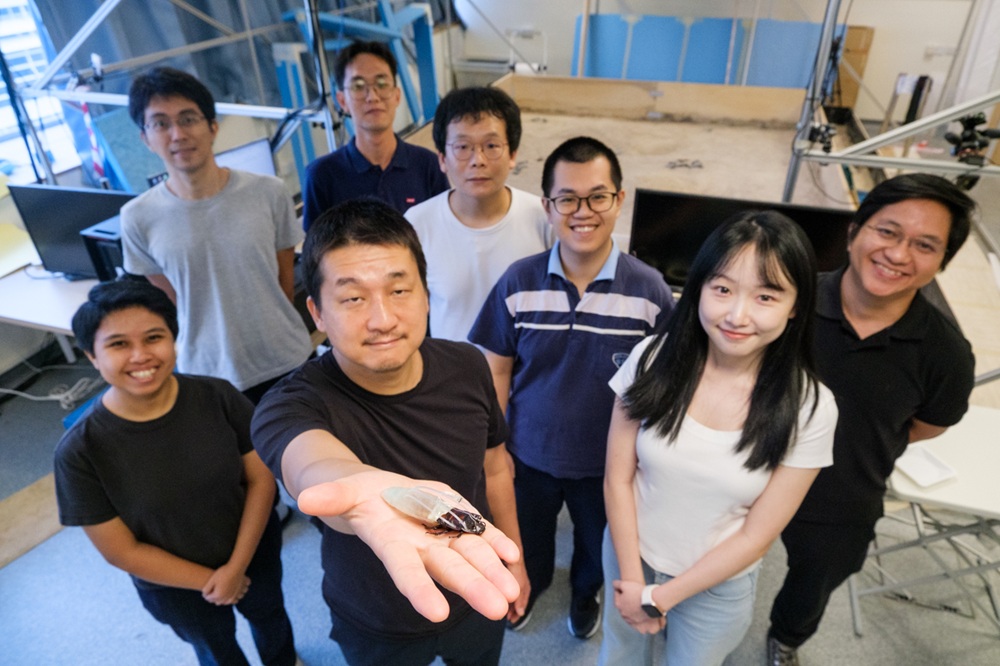
Researchers from NTU Singapore and Waseda University have found a new use case for 3D printing: keeping a cyborg cockroach alive underwater. Published in Nature Communications, their study introduces a flexible “diving suit” that lets electronically guided Madagascar hissing cockroaches operate submerged or in low-oxygen environments for up to three hours, extending cyborg-insect search-and-rescue missions into flooded disaster zones.
Cyborg insects steer their host’s own muscles rather than powering motors, making them far more energy-efficient than small robots. Their limitation has always been biological: cockroaches breathe through spiracles connected to a tracheal system, and submersion cuts off that oxygen supply.
NTU and Waseda’s solution is a three-part system built around a 3D-printed oxygen-generation tank in PMMA-type resin. Inside, a manganese-dioxide-coated sponge reacts with injected hydrogen peroxide to release oxygen, which travels through a flexible shell and four silicone tubes directly to the insect’s thoracic spiracles. The suit is removable and, according to the researchers, doesn’t harm the animal.
Back in 2018, we covered Amphibio, a 3D-printed wearable gill developed by biomimicry designer Jun Kamei with the RCA-IIS Tokyo Design Lab, built from a porous hydrophobic material designed to let a person extract oxygen from surrounding water.
Kamei’s design brief drew on the exact same biological approach. He was explicitly inspired by water-diving insects, which trap a thin air layer on their superhydrophobic skin to breathe underwater. Amphibio never made it past the concept stage; producing enough oxygen for a full-size human required a gill of roughly 32 square meters.
NTU and Waseda have essentially solved the same physiological constraint by working with an insect’s own tiny oxygen demand and outsourcing the “gill” function to a chemical reaction.
What comes next?
The team is already testing the suit in simulated disaster environments and plans to add sensors and navigation, building on Prof. Hirotaka Sato’s cyborg insects already used in real search-and-rescue work, including after Myanmar’s March 2025 earthquake.
They also need to consider adaptability to other spiracle-breathing insects, such as locusts and beetles, and applications beyond disaster response, including inspection of flooded pipes, drains, and tunnels.
If that trajectory holds, 3D-printed micro life-support systems could become a recurring, if niche, thread in underwater AM.
Source: NTU — deployment in Myanmar, March 2025.
THE 3D ADEPT WEEKLY NEWSLETTER
The industry moves fast. Stay ahead.
Every week, the latest additive manufacturing news, in-depth features and real-world applications, straight to your inbox. Plus, be the first to know when a new issue of 3D ADEPT Mag is out.
Free · One email a week · Unsubscribe anytime
Clicking loads our email provider’s sign-up form, including its analytics and Google’s anti-bot protection. You’re only subscribed if you complete the sign-up. Read our privacy policy.