Imagine the following scenario:
A child arrives in the operating theatre. The surgical team has prepared for weeks. They have the imaging, the plan, the expertise. Sitting on a sterile tray, and made specifically for this patient is a 3D-printed anatomical model, a custom surgical guide, or a device that did not exist in any catalogue. Someone built it. Someone validated it. Someone made it safe enough to put in the hands of a surgeon operating on a child.
That “someone” is a biomedical engineer, a radiologist, a clinical team working inside a hospital with limited budgets, complex regulatory obligations, and no margin for error.
Additive manufacturing has been described as a revolution in healthcare for over a decade. The implants, the surgical models, the patient-specific devices are the proof of concept that made us believe the technology capabilities. What is in question is something harder and more important: can it scale? Not in a research lab. Not in a pilot program. In real hospitals, across specialties, within regulatory frameworks, with the infrastructure and the workflows to make it repeatable, safe, and sustainable.
The answer, depending on who you ask and where you look, is: “not yet”. Or “not everywhere”. Or “yes, but only if…”
The next Additive Talks – Healthcare edition aims to get clarity on this topic.
A wide range of questions matter for this conversation. They include, for instance, “How do you build a quality management system inside a hospital that satisfies MDR or FDA requirements? How do you validate a patient-specific device that, by definition, will never be made twice? How do you justify the cost of an in-house 3D lab to a hospital administration ? How do you go from one surgical team that is passionate about 3D printing to an institution-wide program that can serve ten specialties reliably?”
And on the commercial side: how does a company build an FDA-cleared, patient-specific device, get it into clinical practice, and scale distribution without losing the precision that makes it valuable in the first place?
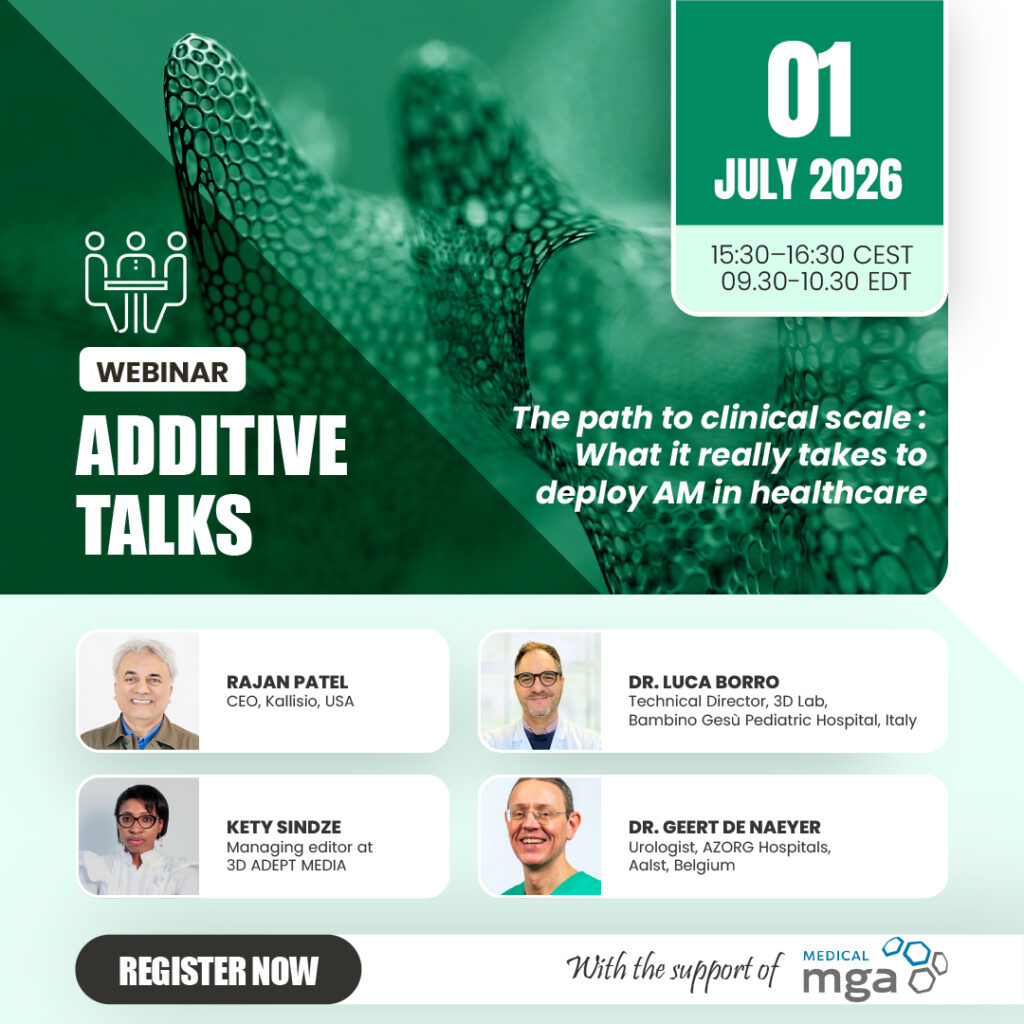
Season 6 of Additive Talks will tackle these questions directly on:
Date: Wednesday, July 1st, 2026
Time: 15:30–16:30 CEST | 09.30-10.30 EDT
Format: Virtual panel | Free to attend
Meet the panelists

Dr. Luca Borro, Technical Director, 3D Lab, Bambino Gesù Pediatric Hospital, Rome
At Bambino Gesù, one of Europe’s leading pediatric hospitals, the 3D Lab supports surgical teams across cardiovascular, neurosurgical, maxillofacial, and oncological specialties. Its scope ranges from anatomical model production and pre-operative simulation to the design of custom medical devices and bioprinting research. As Technical Director and biomedical engineer, Dr. Luca Borro brings a decade of expertise in medical image processing, patient-specific anatomical modelling, and the translation of clinical needs into physical, manufacturable solutions in one of the world’s most demanding surgical environments.
Dr. Geert De Naeyer, Urologist, AZORG Hospitals, Aalst, Belgium

A globally renowned urologist and pioneer of the HOLEP technique in the Benelux since 2010, Dr. Geert De Naeyer brings an h-index of 34, multiple textbook chapters, and an extensive record of live surgeries at international congresses.
He is a trainer at the ORSI Academy, a faculty member of the European School of Urology, and since April 2026, President of the Belgian Laparoscopic and Robotic Urology Group.
In May 2025, he performed the first tele-surgery on a European patient. His commitment to technological innovation now extends to additive manufacturing: in collaboration with PrintPlace, embedded on the AZORG Moorselbaan campus with 30+ 3D printers and advanced visualization tools, he co-developed a patient-specific guidance tool for prostate punctures. Currently in patient testing with promising early results, the project reflects AZORG’s deliberate strategy to position itself as a pioneer in point-of-care medical 3D printing in Belgium.
Rajan Patel, CEO, Kallisio, USA

Kallisio advances precision cancer care through patient-specific platforms that combine design automation, rapid 3D manufacturing, and seamless clinical workflows. Its flagship Stentra™ solution, FDA-cleared and CE-marked, improves radiotherapy accuracy for head and neck cancer patients and has been recognized as Best New Radiology Technology Solution at the 2026 MedTech Breakthrough Awards.
With over 30 years in medical device innovation across diagnostics, critical care, and drug delivery, Rajan Patel brings the perspective of a company that has navigated the full journey from concept to cleared device to clinical-scale deployment.
Why this conversation matters now
The gap between AM’s clinical potential and its clinical reality is real.
Closing it requires honest dialogue between those building the technology and those deploying it in practice. It requires understanding what hospital-based programs actually need from the industry and what the industry has yet to provide. It requires naming the obstacles, not just celebrating the successes.
Join us on July 1st.
This session is supported by Medical Goes Additive, the leading European network for additive manufacturing in healthcare.