


Imagine the following scenario:
A child arrives in the operating theatre. The surgical team has prepared for weeks. They already have the imaging, the plan, and the expertise. On a sterile tray sits something made specifically for this patient. It could be a 3D-printed anatomical model, a custom surgical guide, or a device absent from any catalogue. Someone built and validated it. That person made it safe enough for a surgeon to use while operating on a child.
In practice, behind that work stands a biomedical engineer, a radiologist, or a clinical team. They work inside a hospital with limited budgets, complex regulatory obligations, and no margin for error.
From clinical promise to everyday practice
For over a decade, additive manufacturing has carried the promise of a healthcare revolution. Implants, surgical models, and patient-specific devices have demonstrated the technology’s capabilities. Yet a harder question remains: can it scale?
In other words, the challenge goes beyond research labs and pilot programs. It concerns real hospitals, multiple specialties, and regulatory frameworks. Consequently, these settings need infrastructure and workflows that make AM repeatable, safe, and sustainable.
Depending on who you ask and where you look, the answer is “not yet”, “not everywhere”, or “yes, but only if…”
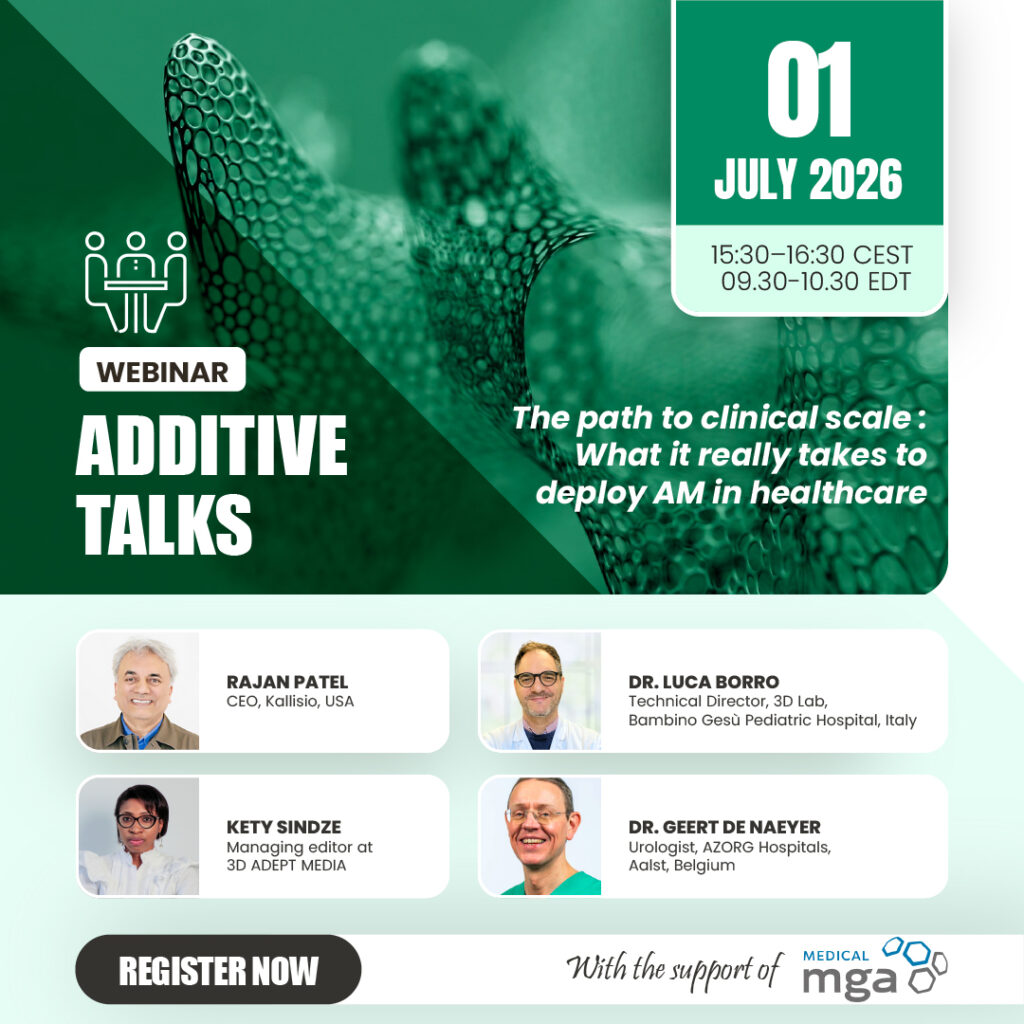
The next Additive Talks – Healthcare edition aims to get clarity on this topic.
The questions behind clinical scale
For hospital teams, the discussion raises several practical questions:
- How do you build a hospital quality management system that satisfies MDR or FDA requirements?
- What validation does a patient-specific device need when, by definition, you will never make it twice?
- How can hospital teams justify the cost of an in-house 3D lab to administrators?
- Finally, what would turn one surgical team’s enthusiasm for 3D printing into an institution-wide program? Such a program may need to serve ten specialties reliably.
Meanwhile, companies face a related challenge. How do they develop an FDA-cleared, patient-specific device and bring it into clinical practice? Then, how do they scale distribution while retaining the precision that makes it valuable?
Season 6 of Additive Talks will tackle these questions directly:
Date: Wednesday, July 1st, 2026
Time: 15:30–16:30 CEST | 09.30-10.30 EDT
Format: Virtual panel | Free to attend
Meet the panelists

Dr. Luca Borro, Technical Director, 3D Lab, Bambino Gesù Pediatric Hospital, Rome
Bambino Gesù is one of Europe’s leading pediatric hospitals. For example, its 3D Lab supports cardiovascular, neurosurgical, maxillofacial, and oncological teams. The lab produces anatomical models and supports pre-operative simulation. Its work also covers custom medical devices and bioprinting research.
As Technical Director and biomedical engineer, Dr. Luca Borro brings a decade of expertise in medical image processing and patient-specific anatomical modelling. He helps translate clinical needs into physical, manufacturable solutions within one of the world’s most demanding surgical environments.
Dr. Geert De Naeyer, Urologist, AZORG Hospitals, Aalst, Belgium

A globally renowned urologist, Geert De Naeyer has pioneered the HOLEP technique in the Benelux since 2010. In addition, his record includes an h-index of 34, multiple textbook chapters, and extensive live surgery experience at international congresses.
He also trains surgeons at the ORSI Academy and serves on the European School of Urology faculty. Since April 2026, he has been President of the Belgian Laparoscopic and Robotic Urology Group.
In May 2025, he performed the first tele-surgery on a European patient. Today, his commitment to technological innovation extends to additive manufacturing.
For example, he co-developed a patient-specific guidance tool for prostate punctures with PrintPlace. This facility sits on the AZORG Moorselbaan campus and operates 30+ 3D printers and advanced visualization tools.
For now, the tool is in patient testing, with promising early results. In this way, the project reflects AZORG’s deliberate strategy to pioneer point-of-care medical 3D printing in Belgium.
Rajan Patel, CEO, Kallisio, USA

Kallisio advances precision cancer care through patient-specific platforms. In practice, these combine design automation, rapid 3D manufacturing, and seamless clinical workflows.
For example, its flagship Stentra™ solution is FDA-cleared and CE-marked. It improves radiotherapy accuracy for patients with head and neck cancer. In addition, the 2026 MedTech Breakthrough Awards named it Best New Radiology Technology Solution.
In turn, Rajan Patel brings over 30 years of medical device innovation across diagnostics, critical care, and drug delivery. His company has navigated the full journey from concept to cleared device and clinical-scale deployment.
Why this conversation matters now
Ultimately, a gap remains between AM’s clinical potential and its clinical reality. Closing it requires honest dialogue between those building the technology and those deploying it.
Hospital-based programs must explain what they actually need from the industry. In turn, the industry must identify what it has yet to provide. The conversation therefore needs to name the obstacles as well as celebrate the successes.
Join us on July 1st.
Medical Goes Additive, the leading European network for additive manufacturing in healthcare, supports this session.
THE 3D ADEPT WEEKLY NEWSLETTER
The industry moves fast. Stay ahead.
Every week, the latest additive manufacturing news, in-depth features and real-world applications, straight to your inbox. Plus, be the first to know when a new issue of 3D ADEPT Mag is out.
Free · One email a week · Unsubscribe anytime
Clicking loads our email provider’s sign-up form, including its analytics and Google’s anti-bot protection. You’re only subscribed if you complete the sign-up. Read our privacy policy.