

Technical clarification — 25 September 2026. The July 2025 release reports “five million atmospheres”. The cited study compares the shock response of additively manufactured and wrought tantalum between 125 and 437 GPa, within experimental uncertainties. It does not demonstrate industrial-scale amplifier production or commercial fusion energy. The amplifier description has also been corrected to distinguish it from the projectile.
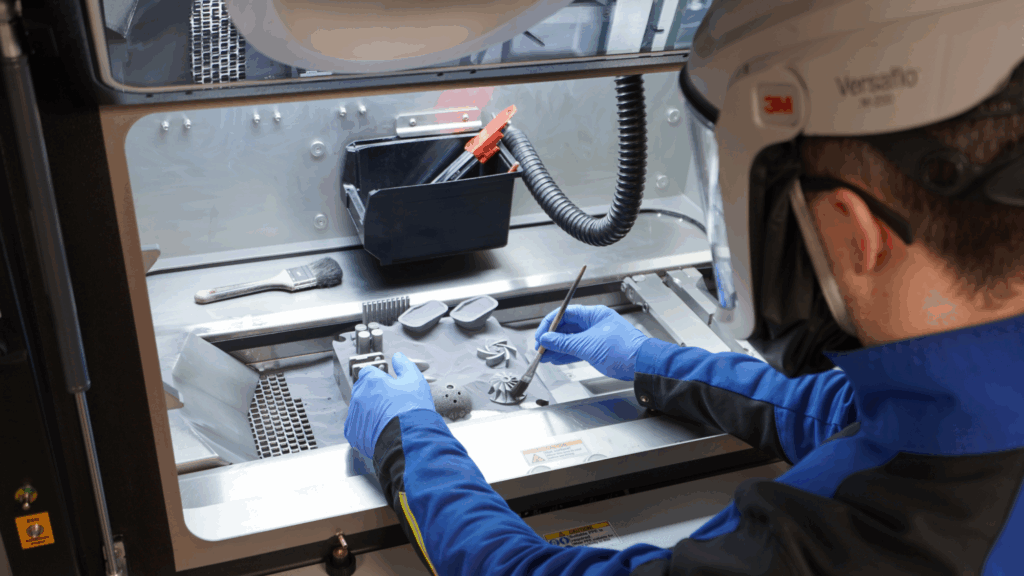
Croom Medical – a company specializing in 3D printing tantalum – recently improved the production of First Light Fusion’s flagship product – Pressure Amplifier.
The role of the Pressure Amplifier
First Light Fusion focuses on the commercialization of fusion energy, a clean energy source. The company’s Pressure Amplifier is a proprietary piece of inertial-fusion hardware. It forms part of its “target” design, combining both an amplifier and a fuel capsule. In projectile-driven experiments, a projectile impacts the amplifier; the company also envisages applications in space and defence. It is built with carefully shaped cavities that focus and multiply the pressure—converging shockwaves to intensify the force applied to the fuel capsule.
For the first time, tantalum components made via additive manufacturing have been shown to exhibit a response comparable to conventionally produced tantalum under shock compression up to pressures of five million atmospheres, enabling a faster, lower-cost production path, First Light explains in a press communication.
Tantalum beyond the medical sector
Through this application, Croom Medical goes beyond its scope of expertise and demonstrates the capabilities of 3D printed tantalum in sectors beyond the medical sector.
According to the companies, the team used Croom’s TALOS™ laser-powder-bed-fusion process to produce fully dense, ultra-pure, metallic components. These components, like First Light’s amplifier, are difficult and labor-intensive to manufacture by traditional methods.
Martin Gorman, Lead Shock Scientist at First Light Fusion, said: “3D printing tantalum gives us a reliable, cost-effective path to mass-produce our amplifiers – unlocking wide-ranging applications outside of inertial fusion, from materials research to defence.”
Sources: First Light Fusion, 14 July 2025; Journal of Applied Physics, 137, 215903 (3 June 2025).
THE 3D ADEPT WEEKLY NEWSLETTER
The industry moves fast. Stay ahead.
Every week, the latest additive manufacturing news, in-depth features and real-world applications, straight to your inbox. Plus, be the first to know when a new issue of 3D ADEPT Mag is out.
Free · One email a week · Unsubscribe anytime
Clicking loads our email provider’s sign-up form, including its analytics and Google’s anti-bot protection. You’re only subscribed if you complete the sign-up. Read our privacy policy.