

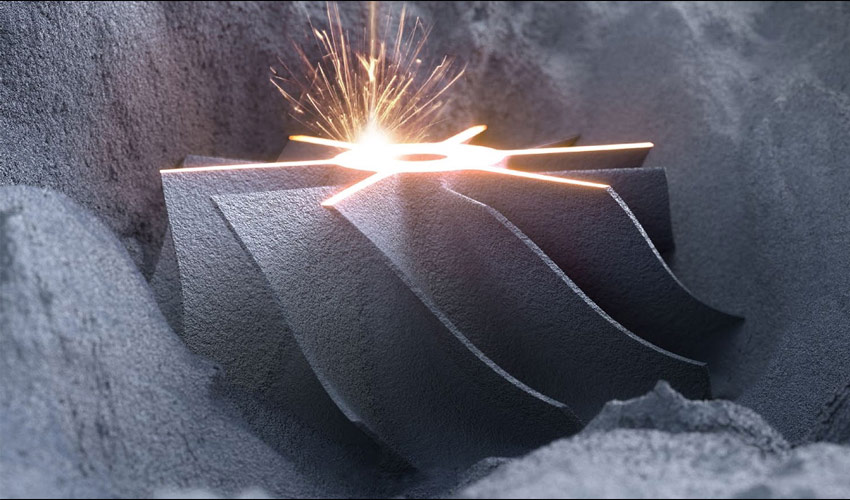
Producing high-quality feedstock, i.e., powder of a variety of alloys, to achieve high-quality metal AM products is one of the challenges that the AM industry constantly faces. As powder characteristics directly influence process stability, melt pool behavior, and the quality of the final component, it’s crucial to understand and optimize powder production, together with the subsequent additive manufacturing process.
This requires a comprehensive understanding of the underlying physics across multiple length and time scales.
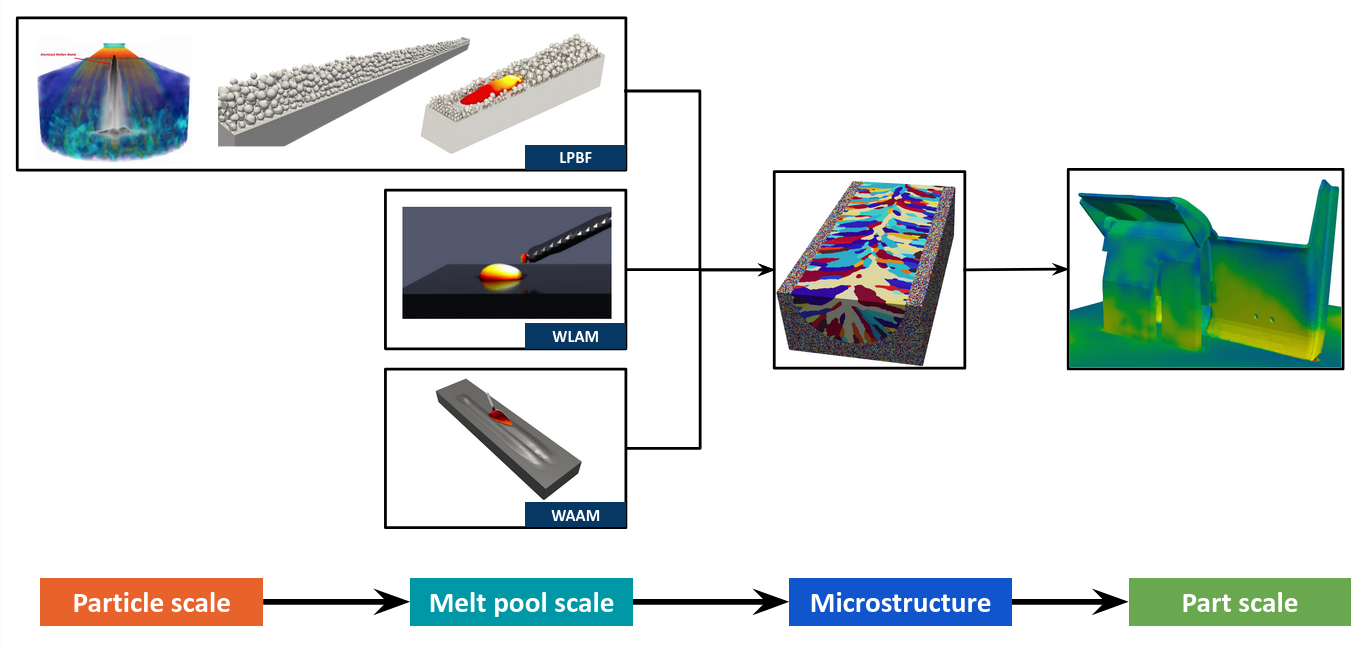
High-fidelity multiphysics simulation provides critical insights into the dynamic and transient phenomena occurring throughout the additive manufacturing process, but also enables accurate prediction of thermal history, melt pool evolution, residual stresses, distortion, and microstructural development.
By capturing the complex interactions of the laser with the material, between heat transfer, fluid flow, and mechanical behavior, it enables engineers to optimize process parameters, reduce costly trial-and-error experimentation, improve part quality, and accelerate the qualification of new materials and components.
According to Paanduv, the GUI-based simulation framework, AM PravaH®, enables researchers to implement novel concepts such as laser beam shaping, non-spherical particle usage for LPBF, and manufacturing for in-space applications that require extensive experimental resources.
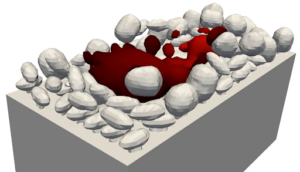
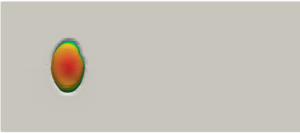
Developed by Paanduv, the software uses a 4-phase multiphysics model based on the Volume of Fluid approach to predict the thermal fluid behavior of the metal AM processes.
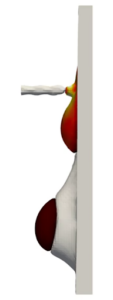
The model simulates laser–material interactions in great detail by explicitly resolving the vapor phase rather than treating it as an empirical approximation. This enables accurate prediction of vaporization-induced phenomena, including recoil pressure, vapor plume dynamics, and their coupling with melt pool fluid flow. As a result, the model can realistically capture keyhole formation and stability, melt pool evolution, and defect mechanisms such as keyhole porosity and spatter, leading to more reliable predictions of process behavior and final part quality.
Due to advanced numerical schemes and a corrective approach, it is convenient to achieve scale using multiphysics simulations for multitrack and multilayer details such as interlayer defects, lack of fusion, hatch spacing and overlapping of the tracks, extent of remelting between the layers, and decrease in overall height of the build by layer addition.
The platform addresses industry challenges across every stage of the metal additive manufacturing workflow.
• During the R&D phase, it helps evaluate alloy printability, optimize process parameters through design of experiments, and provide insight into process dynamics that are otherwise investigated using advanced characterization techniques such as synchrotron X-ray imaging.
• At the material characterization stage, it enables the prediction and interpretation of microstructural evolution, complementing experimental analyses performed using optical microscopy and Electron Backscatter Diffraction (EBSD).
• As development progresses to component qualification, the platform accurately predicts residual stresses, distortion, and dimensional deviations, enabling engineers to identify potential issues before fabrication and significantly reducing the need for costly trial-and-error experimentation. Interestingly, it improves predictive accuracy by utilizing small-scale data and coupling it to the larger scale, e.g., by importing the melt pool thermal history for microstructure grain evolution prediction.
New addition to AM PravaH® – part-scale thermo-mechanical analysis
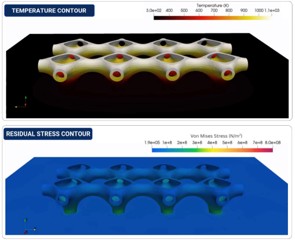
The recently added thermomechanical model completes the multiscale thread, extending predictive capabilities from the melt pool and microstructure to the mechanical integrity of the final part.
Beyond melt-pool-scale modelling, thermo-mechanical analysis enables the prediction of the behaviour of entire components during additive manufacturing. Applicable to LPBF, WAAM, and WLAM processes, it provides early insight into residual stresses, distortion, thermal gradients, and dimensional accuracy before physical production using two approaches: Flash Heating and Moving Heat Source.
This can be used for complex designs such as triply periodic minimal surfaces (TPMS), i.e., lattice structures. While the structural performance of these structures can be good, they are still tricky to manufacture as their thin walls make them susceptible to warpage and delamination due to residual stress. AM PravaH offers a thermo-mechanical simulation module to predict deformations and verify the printability of parts.
Source: Paanduv — AM PravaH capabilities.
THE 3D ADEPT WEEKLY NEWSLETTER
The industry moves fast. Stay ahead.
Every week, the latest additive manufacturing news, in-depth features and real-world applications, straight to your inbox. Plus, be the first to know when a new issue of 3D ADEPT Mag is out.
Free · One email a week · Unsubscribe anytime
Clicking loads our email provider’s sign-up form, including its analytics and Google’s anti-bot protection. You’re only subscribed if you complete the sign-up. Read our privacy policy.