

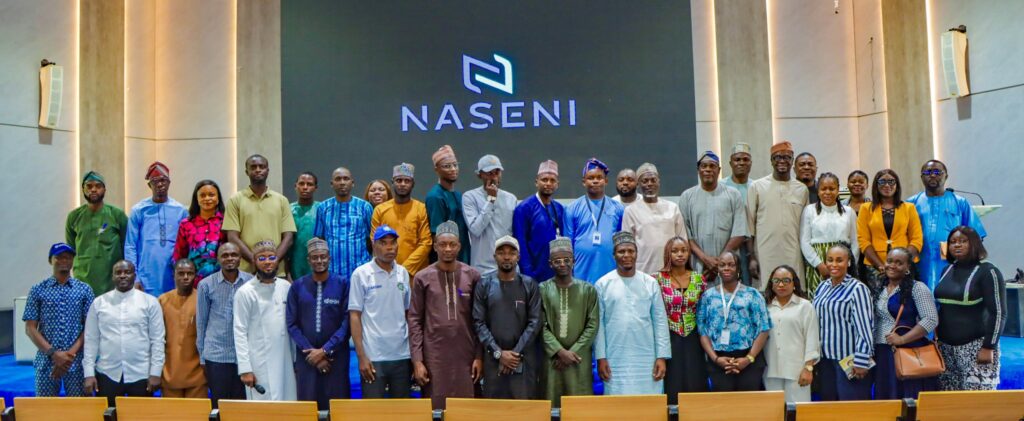
The National Agency for Science and Engineering Infrastructure (NASENI) plans to establish a Metal Additive Manufacturing Hub that would strengthen local production, reduce dependence on imported industrial components and unlock greater value from the nation’s vast mineral resources.
The vision was presented at the second edition of NASENI’s Science Perspective Engagement Series in Abuja, where experts highlighted the transformative potential of metal additive manufacturing.
Presenting a paper titled “The Science of Layer-by-Layer Fabrication of High-Value Metallic Components: Towards Establishing Nigeria’s Metal Additive Manufacturing Hub,” Overseeing Officer of Advanced Manufacturing Technology Development Institute (AMTDI), a division of NASENI at Jalingo, Taraba State, Mr. Abdulrahman Barkindo Bawuro, represented by Chief Engineer Dr. Okechukwu Chijioke, described the technology as a game changer for industrial development.
In a good position to propel metal AM in Africa
AM is already operating in Nigerian industry. RusselSmith and Shell are a few examples of companies that are fostering the adoption of the technology on the continent. As a reminder, RusselSmith obtained approval from the Nigerian Upstream Petroleum Regulatory Commission to use industrial 3D printing in the sector, and is now positioned as West Africa’s first supplier of industrial AM equipment.
Nigeria is in a good position to open its metal additive manufacturing hub. It is one of the African countries that strongly relies on its internal resources: the country prioritizes the production of its own cars, with Innoson claiming at least 65% local content on vehicles built in Nnewi, though engines and gearboxes are still imported.
Since 2024, in the heavy industry, new mining permits are only granted to companies that present a plan for local ore processing, in a country with documented tantalite deposits. In oil and gas, the NOGICD Act gives the NCDMB a legal lever to ring-fence certain equipment tenders for companies manufacturing in Nigeria, with a 70% local content target set for 2027.
In the defense sector, which is another one that is heavily investing in AM, Defence Industries Corporation of Nigeria (DICON) and Ajaokuta Steel Company Ltd. signed an agreement to produce military hardware at Ajaokuta.
These examples are all potential opportunities for using metal AM across sectors.
First benefits of the metal AM hub
The ultimate goal of NASENI is to further retain capital currently spent on imported components while expanding indigenous manufacturing capabilities.
The country could, for instance, locally process minerals which can serve as feedstock for producing metal powders used in advanced manufacturing.
Needless to say, beyond industrial growth, the proposed hub could stimulate new businesses, create skilled jobs, generate revenue and strengthen national competitiveness in emerging technologies.
The envisioned hub would integrate the entire manufacturing ecosystem, including digital product design, process simulation, laser powder-fusion systems, powder recovery and recycling, surface finishing and quality assurance facilities.
To ensure sustainability, Mr. Bawuro advocated a public-private partnership model in which government provides enabling infrastructure while private sector players contribute specialized equipment, technical expertise and investment capital.
Source: Nigerian Geological Survey Agency — National Integrated Mineral Exploration Project.
THE 3D ADEPT WEEKLY NEWSLETTER
The industry moves fast. Stay ahead.
Every week, the latest additive manufacturing news, in-depth features and real-world applications, straight to your inbox. Plus, be the first to know when a new issue of 3D ADEPT Mag is out.
Free · One email a week · Unsubscribe anytime
Clicking loads our email provider’s sign-up form, including its analytics and Google’s anti-bot protection. You’re only subscribed if you complete the sign-up. Read our privacy policy.