Kallisio, an expert in technology-enabled solutions, engineered, manufactured, and delivered within 72 hours a patient-specific device matched precisely to Gia’s anatomy, a head and neck cancer patient.
She reached out to Kallisio after discovering the company’s Stentra™ device through her own research and reached out directly, hoping it could protect her oral health during radiation therapy. By the end of treatment, her care team was surprised by how few oral complications she had developed.
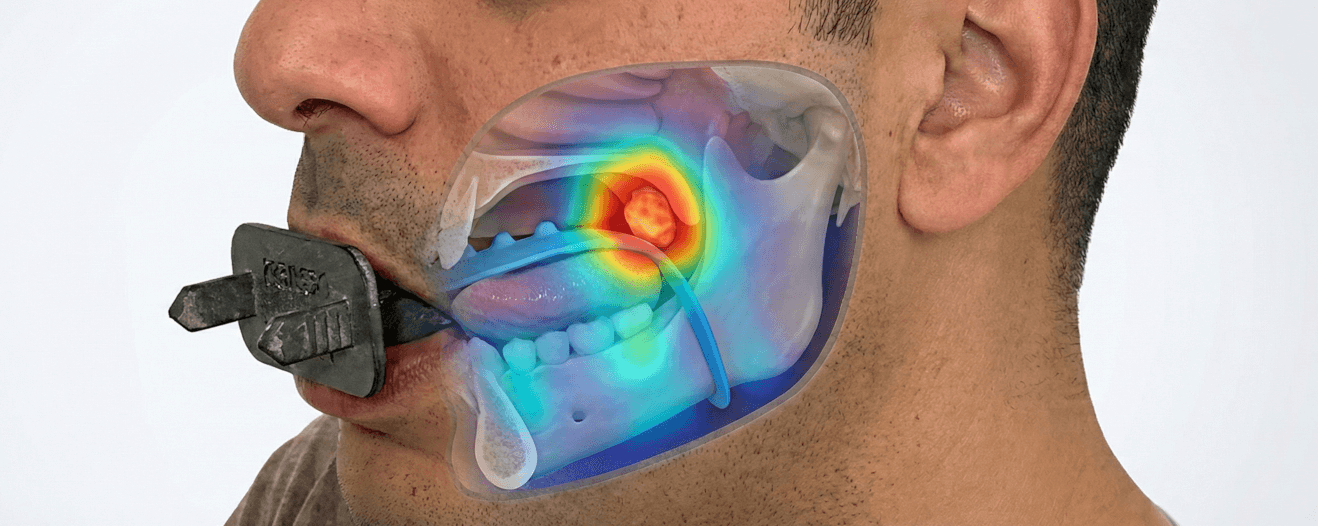
Stentra™, the device built by Kallisio, is a patient-specific intraoral positioning solution designed to support consistent immobilization during external beam radiation therapy for head and neck cancer patients.
Kallisio’s core expertise is in advancing precision oncology. Gia’s story illustrates how it is possible to build a clinical-scale workflow around a patient-specific AM device, at the speed that oncology requires.
How exactly does Stentra™ work?
From our understanding, by precisely positioning the tongue and soft tissues based on each patient’s unique anatomy, the device enables millimeter-accurate immobilization throughout every session of a treatment course that can last several weeks. This way, it helps reduce radiation-induced toxicity and improve therapeutic accuracy.
It integrates into existing clinical workflows without requiring changes to treatment planning systems or IT infrastructure.
Stentra™ received FDA clearance and has since been implemented at Stanford Health Care, among other leading oncology centers.
The move to Europe
In March 2026, Kallisio received CE certification under EU MDR 2017/745 for its intraoral device, with initial deployment planned in Germany through selected clinical pilot sites.
The certification marks a significant step in the company’s international expansion and brings Stentra™ into one of the most demanding regulatory environments. The EU MDR requires documented clinical evidence, rigorous post-market surveillance, and a quality management system that can sustain compliance across every device produced.
Needless to say, that any company that manufactures patient-specific devices deals with these systemic challenges.
To ease its path, Kallisio partners with Ricoh 3D for Healthcare, a dedicated business established by Ricoh to deliver FDA-cleared, patient-specific medical devices through a network of certified manufacturing facilities.
The question is whether the geographical challenge was the main limitation slowing down scalability in Europe. What does scaling mean for the company? Plus, how do you demonstrate ROI on a device that can never be compared to a standardized alternative?
These are the types of questions we are eager to hear Kallisio CEO Rajan Patel address on July 1st during “The Path to Clinical Scale: What It Really Takes to Deploy AM in Healthcare.”
*We curate insights that matter to help you grow in your AM journey. Receive them once a week, straight to your inbox. Subscribe to our weekly newsletter