Founded in Rome in 1869 and now operating as an IRCCS, a Scientific Institute for Research, Hospitalization and Health Care, Bambino Gesù is the largest paediatric hospital in Europe, treating children from across Italy and beyond across more than 20 specialties.
The hospital’s 3D Laboratory supports hospital clinicians in improving the effectiveness and appropriateness of care. Specifically, the team working in the Laboratory, composed of doctors, engineers, and biotechnologists, aims to reduce intra- and post-operative risks, saving approximately 40% of operating time for complex procedures, enabling access to a variety of therapeutic options.
According to Dr. Aurelio Secinaro, the hospital’s senior imaging expert, the three domains where 3D technology delivers the greatest clinical advantages are maxillofacial surgery, cardiac surgery, and neurosurgery.
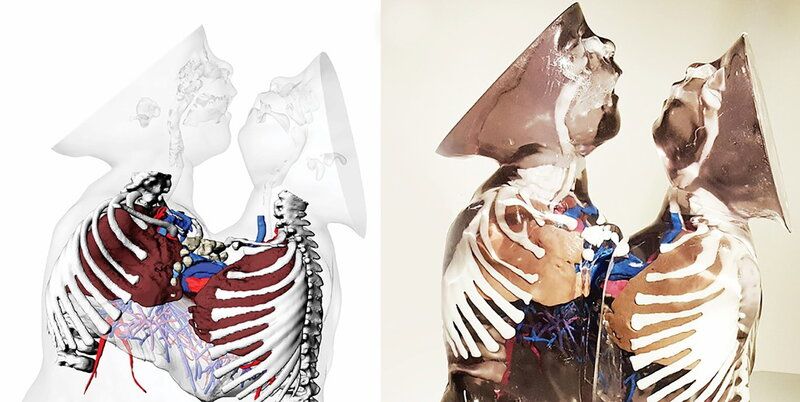
In 2020, Luca Borro and Aurelio Secinaro co-authored a peer-reviewed paper documenting the use of 3D modeling and printing in the successful surgical separation of thoraco-omphalopagus conjoined twins. The twins (six months old) presented a shared pericardial sac, fused sternums, and largely fused livers.
Using CT imaging, the team produced both virtual 3D models and physical prints that the multidisciplinary surgical team could study, manipulate, and rehearse before the operation. This preparation would have helped the team reduce operative times and improve clinical outcomes.
The lab has since contributed to the published literature on craniopagus twin separation. This case illustrates how the cases that most need patient-specific solutions are also the ones that most exceed the limits of standard tools.
The case of these twins is exceptional but is it scalable? Could the model of these twins be replicated in hospitals that do not have those resources?
And beyond replication: even within a program as mature as Bambino Gesù’s, how do you validate a device that could never be made twice? How do you manage quality across eleven surgical specialties with different clinical needs and different risk profiles? How do you build workflows that are rigorous enough for regulatory compliance but agile enough to respond to a surgical team’s needs in real time?
These are some of the questions we will discuss with Luca Borro on July 1st during the next Additive Talks session: “The Path to Clinical Scale: What It Really Takes to Deploy AM in Healthcare.”
*We curate insights that matter to help you grow in your AM journey. Receive them once a week, straight to your inbox. Subscribe to our weekly newsletter