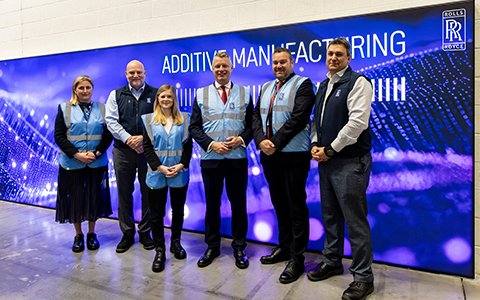
Rolls-Royce has officially inaugurated a new Additive Manufacturing (AM) Development Cell at its Defence Assembly and Operations facility in Bristol, UK. The opening, which took place on 24 April 2026, was attended by Luke Pollard MP, Minister for Defence Readiness and Industry, and Claire Hazelgrove, MP for Filton and Bradley Stoke.
Funded by the UK Ministry of Defence, the cell uses advanced AM technology to manufacture critical components for next-generation aircraft engines, integrating German-engineered machinery to produce complex parts with reduced lead time, lower cost, and greater efficiency compared to traditional methods.
Housed in a custom-built, carefully controlled 350 m² environment — where humidity, temperature and air pressure are precisely optimised — the facility manufactures aerospace components layer by layer using metal super-alloy powders, melted with laser beams into intricate geometries. The result: lighter, stronger parts that would be difficult or impossible to produce through conventional manufacturing.
The cell is designed to play a central role in accelerating development for the Global Combat Air Programme (GCAP) and future combat power and propulsion systems. As Andy Higginson, Senior Vice President of Manufacturing, Assembly and Test at Rolls-Royce, put it: “Programmes like FCAS and GCAP will be fundamental to the UK’s future aerospace sector and capabilities like additive manufacturing will be crucial to enabling innovation at pace, driving cost savings and enhancing the skills and capabilities of our people.”
Beyond performance gains, the facility carries a clear sustainability dimension. The precision of AM technology drives energy efficiencies by allowing the right quantity of raw materials to be used, resulting in less waste and lower power consumption during component development.
This announcement is consistent with a trajectory we have followed closely at 3D ADEPT Media. Rolls-Royce has been one of the most methodical adopters of additive manufacturing in the aerospace and defence sector, progressively scaling from research and prototyping toward series production of flight-critical parts.
The Bristol cell reflects a deliberate infrastructure build, designed to sustain long-term industrial capability rather than simply demonstrate technical feasibility.
For the UK industrial base, the stakes extend beyond one facility. Engineers are being specially trained to operate the cell, with the ambition of sustaining and creating jobs at the Bristol hub, a site that remains the home of UK military combat and transport aerospace power and propulsion.
*We curate insights that matter to help you grow in your AM journey. Receive them once a week, straight to your inbox. Subscribe to our weekly newsletter