People say reading helps them escape, helps them dream. Of all the things I could have compared Additive Manufacturing to, I never imagined it would be reading until I met Maeve Gillies. Like a story that opens the door to new worlds, AM allows Gillies to dream, build, and decorate metal objects without borders.
Everything about Gillies carries the thrill of discovery: her Celtic heritage, her craft, her artistic influences, and how each thread of her journey leads, almost inevitably, to 3D printing.
Artist by training, by essence, and by heart
As with any good artist, her journey with AM all starts with curiosity.

“I follow material science, technology innovation, and additive manufacturing out of curiosity, to understand what will become possible, imagine what could be made, and be inspired by the new creative potential across multiple disciplines. Direct printing in metal and other new materials is an exciting frontier to watch unfold in scientific and industrial applications, particularly as it begins to bring wider societal, sustainable, and environmental benefits. I am drawn to AM forms, finishes, and functions that would be difficult or impossible to make any other way! I have always leaned into technology to learn how to enhance design and manufacturing options, as a flexible shape-shifting tool in the toolbox. I hope to integrate processes that offer fresh design solutions and new ways of seeing. Yet it is always the heart and humanity of hand-crafted knowledge and skill that is needed to turn machined componentry into treasure – skill, tool, touch, and time – bringing pieces to life,” she told 3D ADEPT Media.
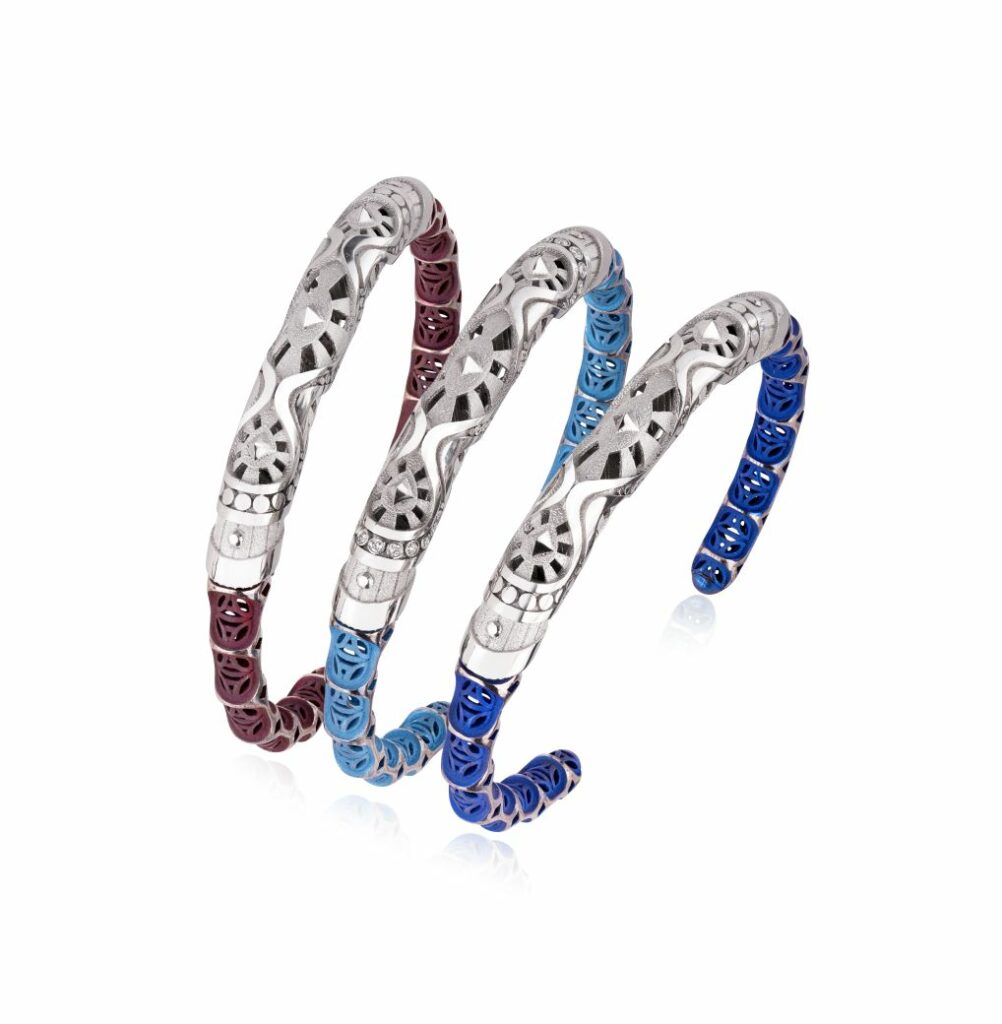
The focus on direct metal 3D printing led to the TÙSAIRE collection, a line of 3D printed platinum jewellery that demonstrates the use of platinum with direct metal 3D printing.
If you’re a regular follower of Additive Manufacturing (AM) trends, you probably know that the use of platinum in this field is far from widespread. While its most prominent application is in the jewelry industry, platinum in AM primarily enables the creation of high-end, luxury products.
Platinum is about 30 times rarer than gold, which contributed to its high value and status. It’s extremely durable and resistant to tarnish, making it ideal for heirloom-quality pieces. Commonly used in high-end bridal jewellery, limited edition collections, and luxury watches, it’s often associated with exclusivity and sophistication – all of which indicate a strong positioning in the luxury market.
So, how does the AM process look?
Many jewellers focus on design and finishing, leaving technical manufacturing to expert partners. The reasons that can explain this are high equipment costs, specialized expertise required, and low volume production – not to mention that there is a growing ecosystem of AM service providers offering precious metal printing services.
Maeve Gillies was not an exception to that process. She explains:
“I start with freehand drawings, which I refine by hand into technical blueprints, then CAD and 3D-printed resins in-house for visualisation. My AM is outsourced: for the TÙSAIRE collection, I collaborated with printing experts Progold and Platinum Guild International to collectively push the boundaries of what is possible in printed platinum, using new platinum powder technology within the LPBF (laser powder bed fusion) process. Everything is first printed in titanium to ensure the lightweight hollow structures, cold join connections, pre-articulation, and transformable components work in metal before progressing to platinum, which then requires final adjustments to orientation and support design.”
A closer look at the manufacturing process reveals notable similarities with the 3D printing of some titanium medical parts — particularly in the way it enables the production of lightweight jewelry components that would be difficult to achieve with traditional methods. Starting with titanium prototypes to explore the behavior of supports, assemblies, articulated elements, and surface finishes, the team later on transitioned to platinum.
Interestingly, this emphasis on design and finishing makes the artist’s experience with working with precious metals different in terms of challenges and opportunities.
“Industry deployment of 3D printed precious metal is often for manufacturing efficiencies and cost reduction, so printed surfaces and supports are removed, and the technology is mostly invisible. I approached the challenge and opportunity differently – to imagine a new world for Platinum: bold and hollow, large scale, in a colourful partnership with anodised 3D printed hollow Titanium, with decorated multi-surface hollow and pre-articulated forms.
Each component features a combination of contrasting split-level, highly polished/raw printed surfaces. This allows the printing resolution, supports, and process to be preserved and highlighted, like a printed artefact of this moment in a fast-moving technological landscape,” Gillies points out.
Maintaining the sense of luxury and craftsmanship in jewel pieces that are digitally fabricated
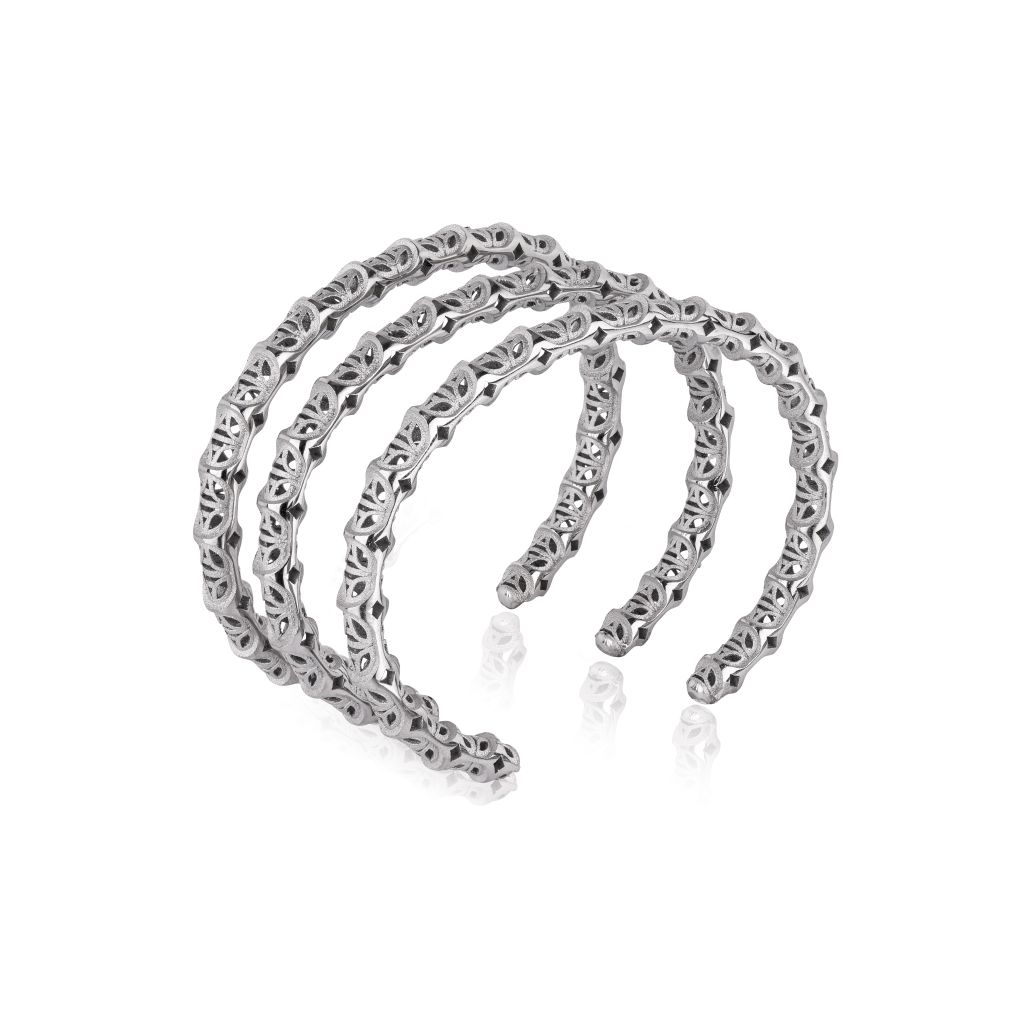
Luxury jewelry craftsmanship is a mix of art and skill. Each piece shares a story of creativity and beauty. Looking at the pieces of the TÙSAIRE collection, I can’t help but see the beauty of AM.
In a market where most luxurious brands have built their empire under an unsaid “don’t ask, don’t tell” policy that would retain the mystique of their amazing works, I am convinced that the TÙSAIRE collection will help increase the word about AM, as today’s consumers have high expectations for what they buy.
That’s probably the tiny impact of digital fabrication, Maeve Gillies tried to convey here:
“Digital fabrication is just one step in this creative journey. I think a sense of luxury comes from the customer/wearer, who decides the meaning, life and purpose of an object. I also think luxury is the essence of an object created with mindful material and skill. As a designer, part of my craftsmanship is in knowing what to hold back and what to set free, stemming from decades of observing, learning, and creating valued objects for others.”
The TÙSAIRE collection is now commercially available. For Gillies, this milestone serves as a reminder that “technological innovation in commercial product development is a long, slow, difficult, and often unpredictable journey.” It also stands as an encouragement for others, to stay curious and brave in their experimentation with technology, using it not as an end in itself, but as a tool to help humanity shape its own future with innovation. Ultimately, Gillies hopes that such bravery will one day culminate in the creation of a jewelry collection 3D printed entirely in diamond.
This content has been sponsored by Formnext.