

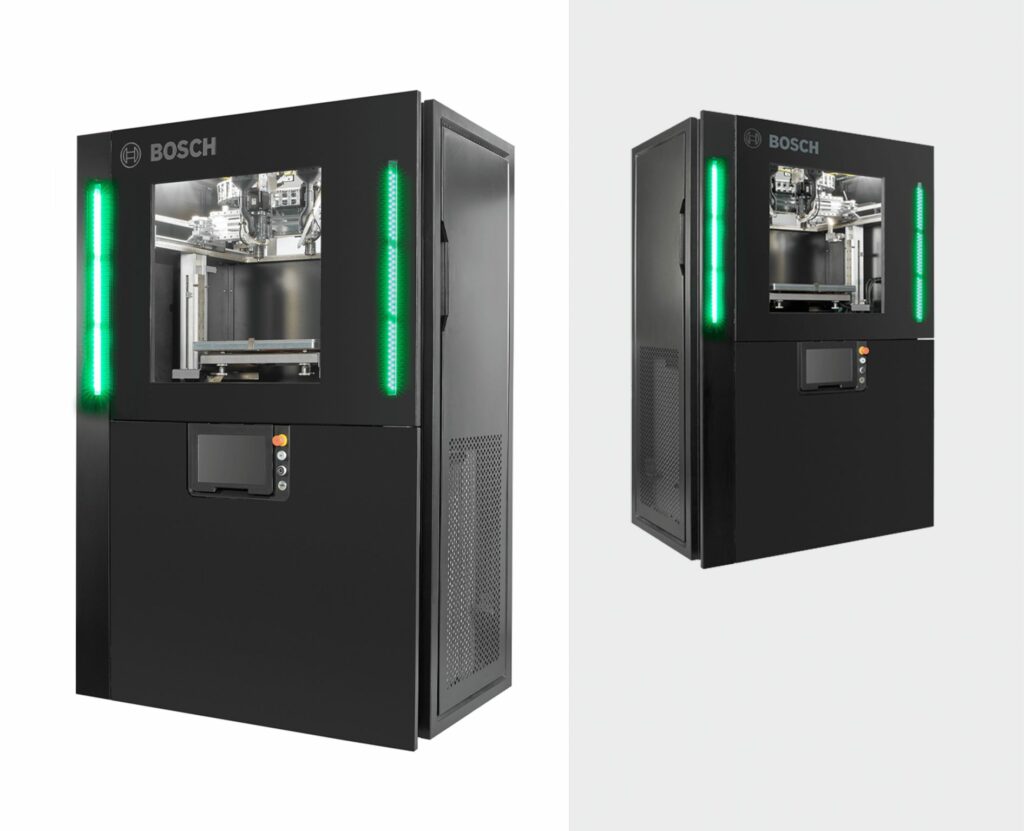
The next step for Bosch in industrial manufacturing would be to enable the production of industrial granulate directly as printing material
BOSCH is one of those multinational engineering and technology companies that has demonstrated a keen interest in Additive Manufacturing but whose real positioning in the industry is still hard to define. Whether it is through the utilization of 3D printers for the production of prototypes, tooling, jigs and fixtures, investment in AM companies, collaboration with others or 3D printing service bureaus, Bosch has demonstrated over the years that it understands the potential of AM technologies and it is ready to play its part in its evolution.
Interestingly, the past years have also been dedicated to the development of an industrial 3D printer by Bosch Industrial Additive Manufacturing (Bosch IAM). Based on pellet BIAM extrusion, the 3D printer would be capable to produce nearly every injection molding material (plastic pellets). No official announcement has yet been made by the company which is quite understandable as the Minimum Viable Product has just been completed and made available to a select group of customers that will provide feedback for future product development.
According to Alex Voigt from Bosch IAM, the promise the industrial 3D printer ambition to fulfil would be to produce prototypes with a real value using the same material as in production while saving costs or produce a small series in specific, heavily used materials such as PA66 or PA66 GF35.
“In my opinion the most valuable opportunity with this technology is the possibility to implement a more circular product life cycle with the option to shred your used product and use the shredded material to print a new one”, Voigt said on LinkedIn.

Features shared so far reveal that the 3D printer has two extruders that print one material at the time, and extrude it up to 350°C. With a build volume of 420 x 420 x 420 mm, the machine can achieve a build rate of 8 cm³/h and heats the build plate up to 120°C.
If all goes well, one may expect a formal introduction on the market next year at Formnext 2023.
Remember, you can post job opportunities in the AM Industry on 3D ADEPT Media free of charge or look for a job via our job board. Make sure to follow us on our social networks and subscribe to our weekly newsletter : Facebook, Twitter, LinkedIn & Instagram ! If you want to be featured in the next issue of our digital magazine or if you hear a story that needs to be heard, make sure you send it to contact@3dadept.com
THE 3D ADEPT WEEKLY NEWSLETTER
The industry moves fast. Stay ahead.
Every week, the latest additive manufacturing news, in-depth features and real-world applications, straight to your inbox. Plus, be the first to know when a new issue of 3D ADEPT Mag is out.
Free · One email a week · Unsubscribe anytime
Clicking loads our email provider’s sign-up form, including its analytics and Google’s anti-bot protection. You’re only subscribed if you complete the sign-up. Read our privacy policy.