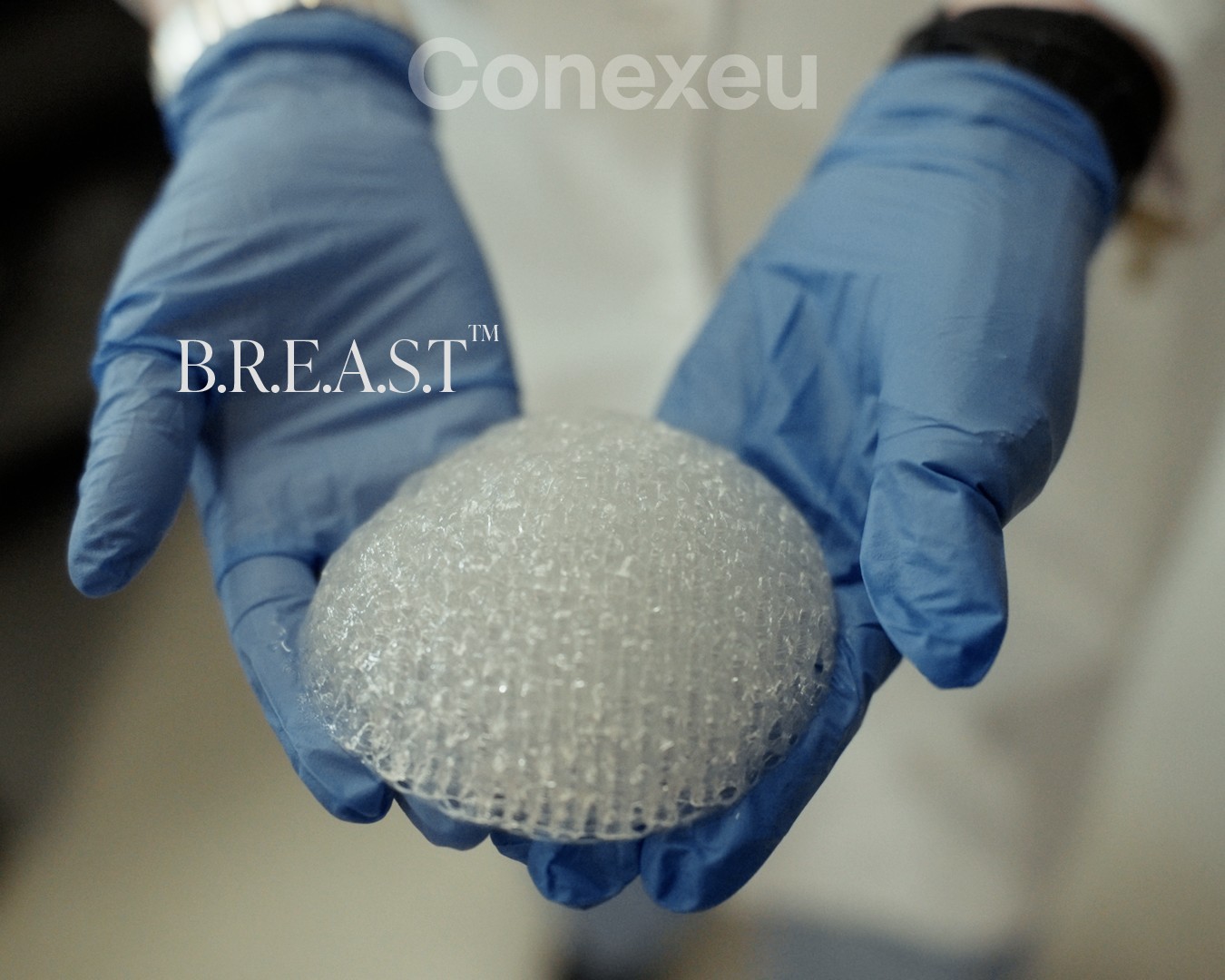
Biotechnology company Conexeu Sciences has announced the development of B.R.E.A.S.T.™ (BIO-REGENERATIVE ERGONOMICALLY ARCHITECTED SMART TISSUE), a 3D-bioprinted breast matrix designed to guide the patient’s own body into rebuilding tissue, rather than replacing it with a foreign device.
The system is built on Conexeu’s proprietary CXU™ platform, an extracellular matrix (ECM)-based biofabrication technology. Unlike conventional silicone implants or synthetic scaffolds, B.R.E.A.S.T.™ is designed to be resorbable: the scaffold degrades progressively as the patient’s own cells migrate, vascularize, and form new tissue around the structure. Patient-specific CT scans could be used to customize each matrix to individual anatomy.
The ambition is explicit. As Miles D. Harrison, President and CEO of Conexeu, puts it: “For more than 50 years, breast reconstruction has been defined by substitution, replacing what was lost with a foreign body. We are fundamentally shifting the paradigm from substitution to restoration.”
The intersection of additive manufacturing and breast reconstruction has drawn notable players: CollPlant Biotechnologies partnered with Stratasys to develop and test regenerative breast implants using the Origin® platform, while BellaSeno reported one-year clinical results for its own resorbable 3D-printed scaffolds. Evonik’s work on polymer materials for next-generation implants and a broader review of the 3D-printed scaffold approach have also featured in our coverage.
What distinguishes Conexeu’s announcement is its grounding in ECM and a regulatory path targeting a 510(k) submission for its initial indication in early 2027. The company is preclinical-stage, and its disclaimers are clear: no breast-specific preclinical data has been published yet, and safety and effectiveness remain to be established. The science still has a long road ahead.
That said, the direction of travel is consistent with where the most credible work in this space is heading, away from permanent substitution, toward structures the body can actually integrate and replace with living tissue.
*We curate insights that matter to help you grow in your AM journey. Receive them once a week, straight to your inbox. Subscribe to our weekly newsletter.